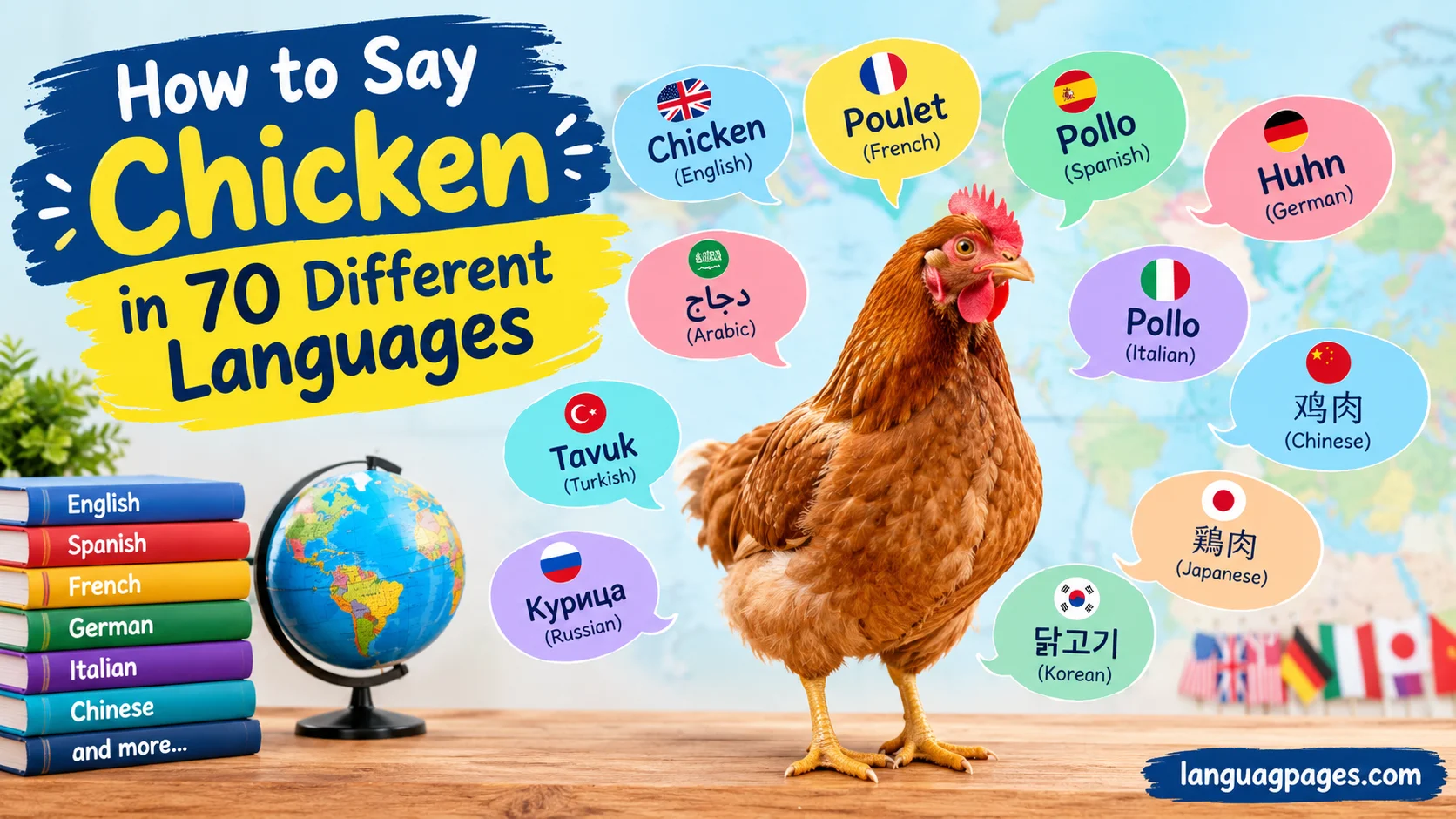
Chicken connects people through everyday meals, family recipes, and food traditions around the world. Learning how to say chicken in 70 different languages helps you explore international vocabulary and communicate more confidently when traveling, cooking, or meeting new people.
This topic is useful for language learners, travelers, and anyone curious about food vocabulary and cultural differences. Some languages use separate words for the living bird and its meat, while others rely on context. Understanding these translations, pronunciation patterns, and regional variations can help you recognize natural expressions and avoid common language mistakes in everyday conversations.
In this article, you’ll discover chicken translations in 70 languages, including European, Asian, African, and Middle Eastern languages. Each entry provides the native word, country or region, pronunciation guide, and a practical example sentence with its English meaning. You’ll also explore differences between animal names and food terms, learn about regional language variations, and find useful tips for choosing the right expression when ordering meals, reading menus, or building your multilingual vocabulary.
Interesting Facts About Chicken
- Chicken can mean a bird or its meat. English uses the same word for both, but some languages distinguish them.
- Food vocabulary reflects local traditions. Words for chicken may appear in names of soups, grilled dishes, stews, and festive meals.
- Writing systems differ widely. Chicken is written with Latin letters in Spanish, Cyrillic letters in Russian, and characters in Chinese.
- Pronunciation isn’t always obvious. A familiar-looking word can sound quite different across languages.
- Grammar affects word forms. Some languages change nouns according to gender, number, or grammatical case.
- Regional varieties matter. Speakers may use different everyday words for a chicken or chicken meat in different places.
- Translation depends on context. Ordering chicken at a restaurant may require a different expression from identifying a live bird on a farm.
What Does Chicken Mean?
Chicken generally refers to a domesticated bird raised for eggs or meat, or to its meat when used as food. For example, “The chicken is in the yard” describes a bird, while “We’re having chicken for dinner” refers to a meal.
The intended meaning matters when translating. Some languages have a common word for the animal and a separate word for its meat. Others use the same basic noun in both situations, relying on the rest of the sentence to clarify the meaning.
Why Can Chicken Have Different Translations?
Translations vary because languages organize vocabulary differently. A word used for the living animal may not be the most natural choice on a restaurant menu. Context is essential when deciding which term to use.
Other factors include regional dialects, pronunciation, grammatical gender, and formality. A standard written form may differ from a casual spoken expression. When traveling, it’s helpful to learn the basic noun first, then practice it in sentences about ordering food, cooking, or identifying animals.
European Languages
European languages include several distinct language families, and their words for chicken reflect different grammatical and culinary traditions. The table uses common forms for the bird or its meat, with examples that show how the word works in everyday conversation.
| 🌍 Language | Country/Region | Translation | Pronunciation | Example Sentence |
| English | International | Chicken | CHIK-in | We cooked chicken. |
| Spanish | Spain, Latin America | Pollo | POH-yoh | El pollo está listo. — The chicken is ready. |
| French | France, Belgium, Canada | Poulet | poo-LAY | Le poulet est prêt. — The chicken is ready. |
| German | Germany, Austria | Hähnchen | HEN-khen | Das Hähnchen ist fertig. — The chicken is ready. |
| Italian | Italy, Switzerland | Pollo | POL-loh | Il pollo è pronto. — The chicken is ready. |
| Portuguese | Portugal, Brazil | Frango | FRAHN-goo | O frango está pronto. — The chicken is ready. |
| Dutch | Netherlands, Belgium | Kip | kip | De kip is klaar. — The chicken is ready. |
| Swedish | Sweden, Finland | Kyckling | SHIK-ling | Kycklingen är klar. — The chicken is ready. |
| Norwegian | Norway | Kylling | CHUHL-ling | Kyllingen er ferdig. — The chicken is ready. |
| Danish | Denmark | Kylling | KÜL-ling | Kyllingen er klar. — The chicken is ready. |
| Finnish | Finland | Kana | KAH-nah | Kana on valmista. — The chicken is ready. |
| Icelandic | Iceland | Kjúklingur | KYOOK-ling-ur | Kjúklingurinn er tilbúinn. — The chicken is ready. |
| Irish | Ireland | Sicín | shi-KEEN | Tá an sicín réidh. — The chicken is ready. |
| Welsh | Wales | Cyw iâr | kuh-yoo YAHR | Mae’r cyw iâr yn barod. — The chicken is ready. |
| Polish | Poland | Kurczak | KOOR-chak | Kurczak jest gotowy. — The chicken is ready. |
| Czech | Czechia | Kuře | KOO-zheh | Kuře je hotové. — The chicken is ready. |
| Slovak | Slovakia | Kurča | KOOR-cha | Kurča je hotové. — The chicken is ready. |
| Ukrainian | Ukraine | Курка (kurka) | KOOR-kah | Курка готова. — The chicken is ready. |
| Russian | Russia, neighboring regions | Курица (kuritsa) | KOO-ree-tsah | Курица готова. — The chicken is ready. |
| Romanian | Romania, Moldova | Pui | poo-ee | Puiul este gata. — The chicken is ready. |
| Hungarian | Hungary | Csirke | CHEER-keh | A csirke elkészült. — The chicken is ready. |
| Greek | Greece, Cyprus | Κοτόπουλο (kotópoulo) | koh-TOH-poo-loh | Το κοτόπουλο είναι έτοιμο. — The chicken is ready. |
| Bulgarian | Bulgaria | Пиле (pile) | PEE-leh | Пилето е готово. — The chicken is ready. |
| Croatian | Croatia | Piletina | pee-leh-TEE-nah | Piletina je gotova. — The chicken is ready. |
| Serbian | Serbia, Balkans | Пилетина (piletina) | pee-leh-TEE-nah | Пилетина је готова. — The chicken is ready. |
| Slovenian | Slovenia | Piščanec | pee-SHAH-nets | Piščanec je pripravljen. — The chicken is ready. |
| Lithuanian | Lithuania | Vištiena | vish-tee-EH-nah | Vištiena paruošta. — The chicken is ready. |
| Latvian | Latvia | Vistas gaļa | VIS-tahs GAH-lya | Vistas gaļa ir gatava. — The chicken meat is ready. |
| Estonian | Estonia | Kana | KAH-nah | Kana on valmis. — The chicken is ready. |
| Albanian | Albania, Kosovo | Pulë | POO-luh | Pula është gati. — The chicken is ready. |
English Varieties
American English 🇺🇸, British English 🇬🇧, and Australian English 🇦🇺 all use chicken. The spelling is the same, although accents and some food-related expressions differ. In all three varieties, context tells you whether the speaker means the bird or its meat.
Cultural Note
In several European languages, the word for cooked chicken differs from the usual word for the living bird. For example, French commonly uses poulet for chicken meat, while poule refers to a hen. In Spanish, pollo commonly refers to both the young bird and chicken as food.
Asian Languages
Asia contains a wide range of language families, scripts, and pronunciation systems. Some languages use familiar alphabetic writing, while others use characters or syllabic scripts. These examples focus on common words and practical sentences.
| 🌍 Language | Country/Region | Translation | Pronunciation | Example Sentence |
| Mandarin Chinese | China, Taiwan, Singapore | 鸡肉 (jīròu) | jee-roh, high tone on jī | 我喜欢鸡肉。— I like chicken. |
| Cantonese | Hong Kong, Guangdong | 雞肉 (gai1 juk6) | gai-yook | 我鍾意食雞肉。— I like eating chicken. |
| Japanese | Japan | 鶏肉 (toriniku) | toh-ree-nee-koo | 鶏肉が好きです。— I like chicken. |
| Korean | Korea | 닭고기 (dalgogi) | dal-go-gee | 닭고기를 좋아해요. — I like chicken. |
| Hindi | India | चिकन (chikan) | CHIK-un | मुझे चिकन पसंद है। — I like chicken. |
| Urdu | Pakistan, India | مرغی کا گوشت (murghi ka gosht) | MOOR-ghee kaa gosht | مجھے مرغی کا گوشت پسند ہے۔ — I like chicken meat. |
| Bengali | Bangladesh, India | মুরগির মাংস (murgir mangsho) | MOOR-gir MANG-sho | আমি মুরগির মাংস পছন্দ করি। — I like chicken. |
| Punjabi | Pakistan, India | ਮੁਰਗੇ ਦਾ ਮਾਸ / مرغی دا گوشت | MUR-gay daa maas | ਮੈਨੂੰ ਮੁਰਗੇ ਦਾ ਮਾਸ ਪਸੰਦ ਹੈ। — I like chicken. |
| Gujarati | India | ચિકન (chikan) | CHIK-un | મને ચિકન ગમે છે. — I like chicken. |
| Marathi | India | चिकन (chikan) | CHIK-un | मला चिकन आवडते. — I like chicken. |
| Tamil | India, Sri Lanka | கோழி இறைச்சி (kōḻi iṟaicci) | koh-zhee ee-rye-chee | எனக்கு கோழி இறைச்சி பிடிக்கும். — I like chicken meat. |
| Telugu | India | చికెన్ (chiken) | CHIK-en | నాకు చికెన్ ఇష్టం. — I like chicken. |
| Kannada | India | ಕೋಳಿ ಮಾಂಸ (kōḷi māṃsa) | koh-lee MAAN-sah | ನನಗೆ ಕೋಳಿ ಮಾಂಸ ಇಷ್ಟ. — I like chicken meat. |
| Malayalam | India | കോഴിയിറച്ചി (kōḻiyiracci) | koh-zhee-yee-RACH-chee | എനിക്ക് കോഴിയിറച്ചി ഇഷ്ടമാണ്. — I like chicken. |
| Nepali | Nepal | कुखुराको मासु (kukhurāko māsu) | koo-khoo-RAH-koh MAH-soo | मलाई कुखुराको मासु मन पर्छ। — I like chicken meat. |
| Sinhala | Sri Lanka | කුකුල් මස් (kukul mas) | KOO-kul mahs | මම කුකුල් මස් කන්න කැමතියි. — I like eating chicken. |
| Thai | Thailand | เนื้อไก่ (nuea kai) | nʉ́a-gài | ฉันชอบเนื้อไก่ — I like chicken. |
| Vietnamese | Vietnam | Thịt gà | tit gah | Tôi thích thịt gà. — I like chicken. |
| Indonesian | Indonesia | Daging ayam | DAH-ging AH-yam | Saya suka daging ayam. — I like chicken. |
| Malay | Malaysia, Brunei, Singapore | Ayam | AH-yam | Saya suka ayam. — I like chicken. |
| Filipino/Tagalog | Philippines | Manok | mah-NOK | Gusto ko ng manok. — I like chicken. |
| Burmese | Myanmar | ကြက်သား (kyet-tha) | chet-tha | ကြက်သားကို ကြိုက်တယ်။ — I like chicken. |
| Khmer | Cambodia | សាច់មាន់ (sach moan) | sach moan | ខ្ញុំចូលចិត្តសាច់មាន់។ — I like chicken. |
| Lao | Laos | ຊີ້ນໄກ່ (sin kai) | seen kai | ຂ້ອຍມັກຊີ້ນໄກ່. — I like chicken. |
| Mongolian | Mongolia | Тахианы мах (takhiany makh) | tah-khee-uh-nee mahkh | Би тахианы маханд дуртай. — I like chicken. |
| Kazakh | Kazakhstan | Тауық еті (tauyq eti) | tah-oo-ik eh-tee | Мен тауық етін жақсы көремін. — I like chicken. |
| Uzbek | Uzbekistan | Tovuq go‘shti | toh-vook gosh-tee | Men tovuq go‘shtini yaxshi ko‘raman. — I like chicken. |
| Turkish | Türkiye, Cyprus | Tavuk | tah-Vook | Tavuk seviyorum. — I like chicken. |
Cultural Note
For restaurant orders, it is often more useful to learn the word for chicken meat than the word for a live bird. Mandarin jīròu, Japanese toriniku, and Korean dalgogi clearly refer to chicken meat. In Indonesian, ayam can refer to the bird or the food, depending on context.
Mandarin uses tones, and Cantonese uses a different tonal system. The numbers in Cantonese romanization represent tones, so they should not be treated as optional decoration.
African Languages
Africa is home to hundreds of languages and many regional varieties. The following examples represent different parts of the continent, from East and West Africa to southern Africa. The translations distinguish chicken meat from the living bird where needed.
| 🌍 Language | Country/Region | Translation | Pronunciation | Example Sentence |
| Swahili | Tanzania, Kenya, East Africa | Kuku | KOO-koo | Ninapenda kuku. — I like chicken. |
| Afrikaans | South Africa, Namibia | Hoender | HOON-der | Ek hou van hoender. — I like chicken. |
| Zulu | South Africa | Inkukhu | een-KOO-koo | Ngithanda inkukhu. — I like chicken. |
| Xhosa | South Africa | Inkukhu | een-KOO-koo | Ndiyayithanda inkukhu. — I like chicken. |
| Amharic | Ethiopia | የዶሮ ሥጋ (ye-doro siga) | yeh-DOH-roh SEE-gah | የዶሮ ሥጋ እወዳለሁ። — I like chicken meat. |
| Yoruba | Nigeria, West Africa | Adìẹ | ah-dee-eh | Mo fẹ́ràn ẹran adìẹ. — I like chicken meat. |
| Hausa | Nigeria, Niger, West Africa | Naman kaza | NAH-man KAH-zah | Ina son naman kaza. — I like chicken meat. |
| Somali | Somalia, Horn of Africa | Hilib digaag | HEE-lib dee-GAAG | Waxaan jeclahay hilib digaag. — I like chicken meat. |
Cultural Note
In Swahili, kuku can refer to a chicken as an animal or as food, depending on context. In Yoruba, adìẹ refers to the chicken, while ẹran adìẹ specifically describes its meat. These distinctions are useful when discussing cooking or ordering a meal.
Middle Eastern Languages
The Middle East includes several distinct language traditions. Arabic varies between Modern Standard Arabic and regional dialects, while Persian, Hebrew, Kurdish, and Armenian have their own vocabulary and grammatical patterns.
| 🌍 Language | Country/Region | Translation | Pronunciation | Example Sentence |
| Arabic (Modern Standard) | Middle East, North Africa | دجاج (dajāj) | da-JAAJ | أحب الدجاج. — I like chicken. |
| Persian | Iran, Persian-speaking communities | مرغ (morgh) | morgh | من مرغ دوست دارم. — I like chicken. |
| Hebrew | Israel | עוף (of) | ohf | אני אוהב עוף. — I like chicken. |
| Armenian | Armenia, Armenian communities | Հավի միս (havi mis) | hah-VEE mees | Ես հավի միս եմ սիրում։ — I like chicken meat. |
Important variation: In Arabic, dajāj is broadly understood in standard usage, while local dialects may use other everyday expressions. In Hebrew, of commonly refers to poultry or chicken as food; tarnegol refers to a chicken or rooster as an animal.
How to Choose the Right Translation
Choose a translation based on what you want to communicate. If you’re ordering food, use the word for chicken meat rather than the live animal when the language distinguishes them.
- Check the context: A farm conversation differs from a restaurant order.
- Consider the region: Local vocabulary can differ from standard written language.
- Listen to pronunciation: Tones and unfamiliar sounds can change meaning.
- Learn a complete sentence: This helps you use the word naturally.
- Ask politely: If you’re unsure, ask a speaker which expression sounds natural.
Common Mistakes When Translating Chicken
Some translation mistakes are easy to avoid:
- Translating literally: The word for a live bird may not be the usual term for its meat.
- Ignoring pronunciation: Similar spellings can represent different sounds.
- Mixing dialects: A regional expression may not be widely understood elsewhere.
- Overlooking grammar: Articles, word endings, and agreement may change within a sentence.
- Assuming every language works like English: Some languages use separate words for the bird and the food.
- Trusting informal spellings alone: Use the native script and a recognized romanization when available.
Why Learn Chicken in Different Languages?
Learning food vocabulary helps you communicate while traveling, reading menus, shopping at local markets, and preparing meals with people from other backgrounds. It also gives you a practical way to build foreign-language vocabulary and recognize differences between writing systems.
A simple word can open the door to a wider conversation about ingredients, recipes, and traditions. Practicing complete sentences helps you move beyond memorizing isolated translations and use new vocabulary more confidently.
FAQs:
How do you say chicken in different languages?
Examples include pollo in Spanish, poulet in French, frango in Portuguese, tavuk in Turkish, and daging ayam in Indonesian. The exact word depends on the language and context.
What is the most natural translation of chicken?
There isn’t one universal translation. Choose the word that fits the target language and whether you’re discussing the animal or its meat.
Can the translation change by country?
Yes. Regional dialects and local food vocabulary can influence everyday usage, even among speakers of the same language.
Why do some languages have separate words for chicken meat?
Languages organize animal and food vocabulary differently. Some distinguish the living animal from the meat served at a meal, while others rely on context.
Does pronunciation change between regions?
Yes. Accents, vowel sounds, consonants, and tones may vary. Some regional differences are subtle, while others can be significant.
How can I pronounce chicken correctly in another language?
Start with the pronunciation guide, listen to recordings from reliable language-learning resources, and practice the word in a complete sentence.
Is a literal translation always accurate?
No. A literal translation may refer to the wrong meaning or sound unnatural. Consider how the word is actually used in everyday conversation.
Which languages use different writing systems?
Examples include Mandarin Chinese, Japanese, Korean, Hindi, Urdu, Arabic, Hebrew, and Russian. Romanization can help beginners read these words, but it doesn’t replace learning the native script.
Can I use these translations when ordering food?
Yes, as a starting point. Learn a complete ordering phrase and check local pronunciation, especially when discussing a particular dish or preparation method.
Is chicken the same word as hen or rooster?
Not always. In English, hen means an adult female chicken, and rooster usually means an adult male chicken. Other languages may make similar distinctiWhy does Mandarin use 鸡肉 instead of just 鸡?
鸡 (jī) refers to chicken as a bird, while 鸡肉 (jīròu) specifically means chicken meat. The second form is clearer when talking about food.
How can learning food words improve language skills?
Food words provide practical vocabulary for travel, shopping, cooking, and conversation. Learning them in complete sentences also helps you understand grammar and pronunciation.
Conclusion:
Learning How to Say Chicken in 70 Different Languages helps you explore global food vocabulary, understand cultural differences, and communicate confidently when traveling, cooking, or connecting with people from different linguistic backgrounds around the world.
Exploring these chicken translations makes language learning more practical and enjoyable. By learning native words, pronunciation, and regional expressions, you can understand menus, discover food traditions, and improve everyday conversations. Keep practicing these multilingual vocabulary terms to build confidence and appreciate how different cultures describe familiar foods.