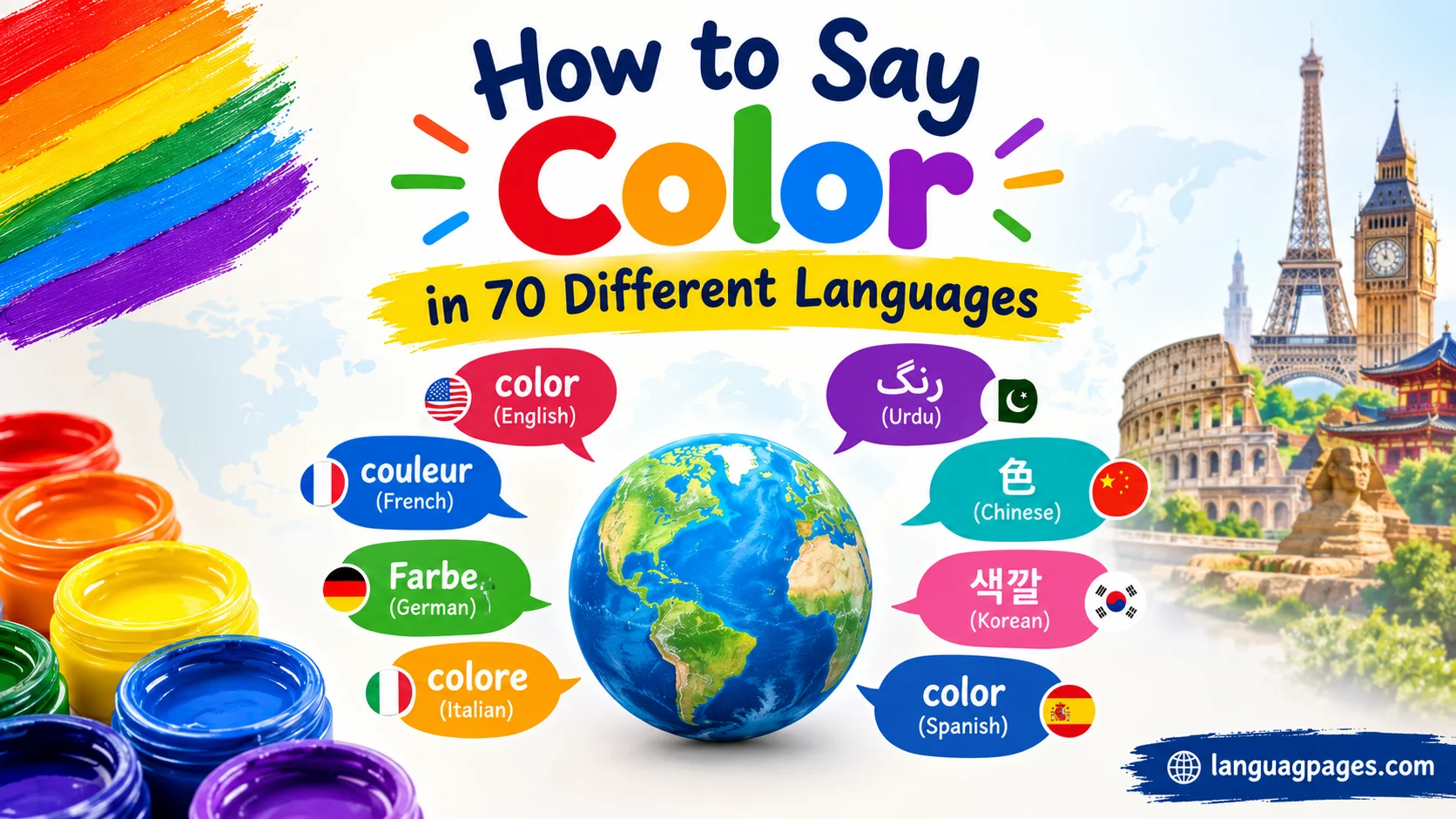
Color connects language with the world we see every day. Learning How to Say Color in 70 Different Languages helps you describe objects, explore vocabulary, and discover how people express familiar ideas across cultures. From everyday conversations to creative projects, these translations make language learning more engaging and practical.
Understanding color translations, pronunciation, and word meanings can help travelers, students, artists, and language learners communicate more clearly. Different languages use distinct vocabulary and writing systems, while regional variations and grammar rules can influence how words appear in sentences. Comparing these expressions also builds vocabulary and reveals interesting connections between languages, spelling, and everyday communication across cultures.
In this article, you’ll explore color in different languages, including European, Asian, African, and Middle Eastern expressions. Discover common translations, pronunciation guides, native scripts, and example sentences that demonstrate natural usage. You’ll also learn about language differences, regional forms, and practical translation tips to help you choose the right word for conversations
Interesting Facts About Color
- Color and colour have the same meaning. American English generally uses color, while British, Australian, and several other varieties of English use colour.
- Many European languages have related words for color. Spanish color, Italian colore, and Portuguese cor illustrate similarities alongside differences in spelling and pronunciation.
- Not every language uses the same grammatical structure when describing colors. A word may change its ending to agree with a noun or fit a sentence.
- Mandarin Chinese writes color as 颜色 (yánsè), combining two characters into one common expression.
- Japanese uses 色 (iro) for color, while longer expressions can specify a shade or describe something as colorful.
- In some languages, a word for color can also refer to a hue, complexion, or appearance, depending on context.
- Color words and color perception are not identical concepts. People can perceive similar visual experiences while categorizing or describing shades differently in their languages.
What Does Color Mean?
Color is the visual quality of an object or light that helps us distinguish red, blue, green, yellow, black, white, and other shades. In language, the word can refer to a specific hue, the general idea of color, or the appearance of something.
People use color vocabulary in everyday conversations, art, fashion, education, photography, design, and science. For example, someone might ask about the color of a shirt or describe the colors in a painting.
The word can also have figurative meanings. In English, adding color to a story can mean making it more vivid or interesting. These figurative uses may not translate directly into another language, so context matters.
Why Can Color Have Different Translations?
The word color does not have one universal translation. Languages use different vocabulary, grammatical patterns, and writing systems to express the concept.
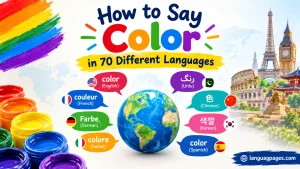
For example, French uses couleur, German uses Farbe, and Spanish uses color. In Mandarin, 颜色 (yánsè) is a common noun for color, while Japanese commonly uses 色 (iro).
The form may also change inside a sentence. Some languages use different endings for singular and plural nouns, while others require grammatical agreement. Regional dialects may offer additional everyday expressions.
A literal translation is not always the most natural choice. When learning a new word, consider whether you mean color in general, a particular shade, or the act of coloring something.
European Languages
Europe contains several language families, including Romance, Germanic, Slavic, and Uralic languages. Their words for color can look similar or completely different, and pronunciation varies across regions.
The translations below give the common noun for color, followed by an example sentence that demonstrates natural use.
American, British, and Australian English
| Language | Country/Region | Translation | Pronunciation | Example Sentence |
| American English 🇺🇸 | United States | Color | KUH-ler | I like this color. |
| British English 🇬🇧 | United Kingdom | Colour | KUH-ler | I like this colour. |
| Australian English 🇦🇺 | Australia | Colour | KUH-ler | This colour looks lovely. |
The main difference in these examples is spelling, not meaning. Pronunciation can vary by speaker and accent.
Other European Languages
| Language | Country/Region | Translation | Pronunciation | Example Sentence |
| Spanish 🇪🇸 | Spain, Latin America | color | koh-LOR | Me gusta este color. — I like this color. |
| French 🇫🇷 | France, other Francophone regions | couleur | koo-LUHR | Cette couleur est belle. — This color is beautiful. |
| German 🇩🇪 | Germany, Austria | Farbe | FAR-buh | Die Farbe ist schön. — The color is beautiful. |
| Italian 🇮🇹 | Italy | colore | koh-LOH-reh | Mi piace questo colore. — I like this color. |
| Portuguese 🇵🇹 | Portugal, Brazil | cor | kor | Esta cor é bonita. — This color is beautiful. |
| Dutch 🇳🇱 | Netherlands, Belgium | kleur | klur | Deze kleur is mooi. — This color is beautiful. |
| Swedish 🇸🇪 | Sweden | färg | fairg | Färgen är fin. — The color is lovely. |
| Norwegian 🇳🇴 | Norway | farge | FAR-geh | Denne fargen er fin. — This color is lovely. |
| Danish 🇩🇰 | Denmark | farve | FAR-vuh | Farven er flot. — The color looks great. |
| Finnish 🇫🇮 | Finland | väri | VEH-ree | Tämä väri on kaunis. — This color is beautiful. |
| Icelandic 🇮🇸 | Iceland | litur | LEE-tur | Þessi litur er fallegur. — This color is beautiful. |
| Polish 🇵🇱 | Poland | kolor | KOH-lor | Ten kolor jest ładny. — This color is nice. |
| Czech 🇨🇿 | Czechia | barva | BAR-vah | Tato barva je krásná. — This color is beautiful. |
| Slovak 🇸🇰 | Slovakia | farba | FAR-bah | Táto farba je pekná. — This color is pretty. |
| Ukrainian 🇺🇦 | Ukraine | колір | koh-LEER | Цей колір гарний. — This color is beautiful. |
| Russian 🇷🇺 | Russia, other Russian-speaking regions | цвет | tsvyet | Этот цвет красивый. — This color is beautiful. |
| Romanian 🇷🇴 | Romania, Moldova | culoare | koo-LOH-ah-reh | Culoarea este frumoasă. — The color is beautiful. |
| Hungarian 🇭🇺 | Hungary | szín | seen | Ez a szín szép. — This color is beautiful. |
| Greek 🇬🇷 | Greece, Cyprus | χρώμα | KHROH-ma | Αυτό το χρώμα είναι όμορφο. — This color is beautiful. |
| Irish 🇮🇪 | Ireland | dath | dah | Is dath álainn é. — It is a beautiful color. |
| Welsh 🏴 | Wales | lliw | roughly HLEE-oo | Mae’r lliw yn hardd. — The color is beautiful. |
| Croatian 🇭🇷 | Croatia | boja | BOH-yah | Ova boja je lijepa. — This color is beautiful. |
| Bulgarian 🇧🇬 | Bulgaria | цвят | TSVYAT | Този цвят е красив. — This color is beautiful. |
| Estonian 🇪🇪 | Estonia | värv | vairv | See värv on ilus. — This color is beautiful. |
| Lithuanian 🇱🇹 | Lithuania | spalva | SPAL-vah | Ši spalva graži. — This color is beautiful. |
| Latvian 🇱🇻 | Latvia | krāsa | KRAH-sah | Šī krāsa ir skaista. — This color is beautiful. |
Regional note: The same language may have different accents across countries. Spanish in Spain and Latin America, for example, shares the noun color, although pronunciation and some surrounding vocabulary vary.
Asian Languages
Asia includes languages with distinct grammatical systems and writing traditions. Some use alphabets, while others use characters or scripts that represent syllables or other linguistic units.
The following examples distinguish common everyday words from expressions that may have more specific uses.
| Language | Country/Region | Translation | Pronunciation | Example Sentence |
| Mandarin Chinese 🇨🇳 | China, Taiwan, Singapore | 颜色 | yán-sè | 我喜欢这个颜色。— I like this color. |
| Cantonese 🇭🇰 | Hong Kong, Guangdong | 顏色 | ngaan-sik | 我鍾意呢隻顏色。— I like this color. |
| Japanese 🇯🇵 | Japan | 色 | EE-roh | この色が好きです。— I like this color. |
| Korean 🇰🇷 | South Korea, North Korea | 색깔 | saek-kkal | 이 색깔이 좋아요. — I like this color. |
| Hindi 🇮🇳 | India | रंग | rung | मुझे यह रंग पसंद है।— I like this color. |
| Urdu 🇵🇰 | Pakistan, India | رنگ | rang | مجھے یہ رنگ پسند ہے۔— I like this color. |
| Bengali 🇧🇩 | Bangladesh, India | রং | rong | আমার এই রংটি পছন্দ।— I like this color. |
| Punjabi 🇵🇰🇮🇳 | Pakistan, India | ਰੰਗ / رنگ | rung | ਮੈਨੂੰ ਇਹ ਰੰਗ ਪਸੰਦ ਹੈ।— I like this color. |
| Gujarati 🇮🇳 | India | રંગ | rung | મને આ રંગ ગમે છે. — I like this color. |
| Marathi 🇮🇳 | India | रंग | rung | मला हा रंग आवडतो. — I like this color. |
| Tamil 🇮🇳 | India, Sri Lanka | நிறம் | ni-rum | எனக்கு இந்த நிறம் பிடிக்கும். — I like this color. |
| Telugu 🇮🇳 | India | రంగు | RUNG-goo | నాకు ఈ రంగు ఇష్టం. — I like this color. |
| Kannada 🇮🇳 | India | ಬಣ್ಣ | BUN-na | ನನಗೆ ಈ ಬಣ್ಣ ಇಷ್ಟ. — I like this color. |
| Malayalam 🇮🇳 | India | നിറം | ni-rum | എനിക്ക് ഈ നിറം ഇഷ്ടമാണ്. — I like this color. |
| Nepali 🇳🇵 | Nepal | रङ | rung | मलाई यो रङ मन पर्छ।— I like this color. |
| Sinhala 🇱🇰 | Sri Lanka | වර්ණය | var-na-ya | මම මේ වර්ණයට කැමතියි. — I like this color. |
| Thai 🇹🇭 | Thailand | สี | see, falling tone | ฉันชอบสีนี้ — I like this color. |
| Vietnamese 🇻🇳 | Vietnam | màu sắc | roughly mow suk | Tôi thích màu này. — I like this color. |
| Indonesian 🇮🇩 | Indonesia | warna | WAR-nah | Saya suka warna ini. — I like this color. |
| Malay 🇲🇾 | Malaysia, Brunei | warna | WAR-nah | Saya suka warna ini. — I like this color. |
| Filipino/Tagalog 🇵🇭 | Philippines | kulay | koo-LAI | Gusto ko ang kulay na ito. — I like this color. |
| Burmese 🇲🇲 | Myanmar | အရောင် | a-yaung | ဒီအရောင်ကို ကြိုက်တယ်။— I like this color. |
| Khmer 🇰🇭 | Cambodia | ពណ៌ | approximately paw | ខ្ញុំចូលចិត្តពណ៌នេះ។— I like this color. |
| Lao 🇱🇦 | Laos | ສີ | see, high tone | ຂ້ອຍມັກສີນີ້. — I like this color. |
| Mongolian 🇲🇳 | Mongolia | өнгө | UN-guh | Би энэ өнгөнд дуртай. — I like this color. |
| Kazakh 🇰🇿 | Kazakhstan | түс | tüs | Маған бұл түс ұнайды. — I like this color. |
| Uzbek 🇺🇿 | Uzbekistan | rang | rang | Menga bu rang yoqadi. — I like this color. |
Regional note: Mandarin and Cantonese are distinct spoken varieties with different pronunciation and vocabulary patterns. Chinese characters may also differ between simplified and traditional writing. In Hindi and Urdu, the word for color is closely related in everyday use, but the scripts differ.
African Languages
Africa is home to extensive linguistic diversity, with languages from several families and many regional varieties. A word used in one country may also be spoken in neighboring communities, so the country listed here is representative rather than exclusive.
| Language | Country/Region | Translation | Pronunciation | Example Sentence |
| Swahili 🇹🇿 | Tanzania, Kenya, East Africa | rangi | RAHN-gee | Ninapenda rangi hii. — I like this color. |
| Afrikaans 🇿🇦 | South Africa, Namibia | kleur | klur | Hierdie kleur is mooi. — This color is beautiful. |
| Zulu 🇿🇦 | South Africa | umbala | oom-BAH-lah | Ngiyawuthanda lo mbala. — I like this color. |
| Xhosa 🇿🇦 | South Africa | umbala | oom-BAH-lah | Ndiyawuthanda lo mbala. — I like this color. |
| Amharic 🇪🇹 | Ethiopia | ቀለም | approximately keh-lem | ይህን ቀለም እወዳለሁ። — I like this color. |
| Yoruba 🇳🇬 | Nigeria, West Africa | àwọ̀ | ah-WAW | Mo fẹ́ràn àwọ̀ yìí. — I like this color. |
| Igbo 🇳🇬 | Nigeria | agba | AH-gbah | Agba a mara mma. — This color is beautiful. |
| Hausa 🇳🇬🇳🇪 | Nigeria, Niger, West Africa | launi | LOW-nee | Ina son wannan launi. — I like this color. |
| Somali 🇸🇴 | Somalia, Horn of Africa | midab | MEE-dab | Midabkani waa qurux badan yahay. — This color is beautiful. |
| Shona 🇿🇼 | Zimbabwe | ruvara | roo-VAH-rah | Ruvara urwu rwakanaka. — This color is beautiful. |
| Sesotho 🇱🇸 | Lesotho, South Africa | ‘mala | MAH-lah | ‘Mala ona o motle. — This color is beautiful. |
Cultural note: Some African languages have different forms depending on grammatical class or sentence structure. The form of a word may change when it appears with a demonstrative such as “this” or describes an object.
Middle Eastern Languages
The Middle East includes Arabic, Persian, Hebrew, Kurdish, and other distinct linguistic traditions. Arabic, in particular, has a formal written variety and many spoken dialects. These examples use common forms while acknowledging that pronunciation can vary.
| Language | Country/Region | Translation | Pronunciation | Example Sentence |
| Arabic (Modern Standard) 🇸🇦 | Middle East, North Africa | لون | lawn | أحب هذا اللون. — I like this color. |
| Persian/Farsi 🇮🇷 | Iran, Persian-speaking communities | رنگ | rang | من این رنگ را دوست دارم. — I like this color. |
| Hebrew 🇮🇱 | Israel | צבע | TSEH-vah | אני אוהב את הצבע הזה. — I like this color. |
| Kurdish 🇮🇶 | Kurdistan and Kurdish-speaking regions | reng | reng | Ez vê rengê hez dikim. — I like this color. |
| Turkish 🇹🇷 | Türkiye, nearby communities | renk | renk | Bu rengi seviyorum. — I like this color. |
| Armenian 🇦🇲 | Armenia, Armenian-speaking communities | գույն | gooyn | Ինձ այս գույնը դուր է գալիս։— I like this color. |
Important distinction: Arabic words and pronunciation differ between regional varieties. Modern Standard Arabic is useful for formal contexts, but everyday conversation may use a local dialect. In Hebrew, the form of the sentence can also change according to the speaker’s gender.
Other World Languages
Languages from the Pacific, the Americas, and international language communities add further variety to the vocabulary of color.
| Language | Country/Region | Translation | Pronunciation | Example Sentence |
| Māori 🇳🇿 | New Zealand | tae | tie | He ataahua tēnei tae. — This color is beautiful. |
| Samoan 🇼🇸 | Samoa, Pacific communities | lanu | LAH-noo | E matagofie lenei lanu. — This color is beautiful. |
| Haitian Creole 🇭🇹 | Haiti | koulè | koo-LEH | Mwen renmen koulè sa a. — I like this color. |
| Esperanto 🌍 | International constructed language | koloro | koh-LOH-roh | Mi ŝatas ĉi tiun koloron. — I like this color. |
These examples bring the article to 70 language and language-variety entries when the three English varieties are counted separately. They are intended as a practical starting point; for formal translation, publication, or important communication, verify less familiar expressions with a qualified speaker or language resource.
How to Choose the Right Translation
The best translation depends on what you want to say and whom you’re speaking to. Use these tips when choosing a word for color in another language.
- Check the context: Decide whether you mean color generally, a specific shade, or the act of coloring something.
- Consider your audience: A phrase suitable for a classroom may differ from one used in casual conversation.
- Identify the region: Languages such as Arabic and Chinese have regional varieties that can affect pronunciation and everyday vocabulary.
- Learn the writing system: Recognizing the native script helps you read signs, labels, and messages more confidently.
- Practice pronunciation: Listen to reliable audio examples instead of relying entirely on English-style spelling guides.
- Check grammatical forms: The word may change depending on the sentence or the noun it describes.
For a simple conversation, start with the basic noun and one example sentence. If you’re preparing a translation for a product label, educational resource, or formal publication, seek a second check from a qualified language professional.
Common Mistakes When Translating Color
Even a familiar word can be confusing when it moves between languages. Avoid these common translation mistakes:
- Translating word for word: A direct translation may be grammatically incorrect or unnatural in a sentence.
- Confusing color with coloring: The noun for a hue may differ from the verb meaning to apply color.
- Ignoring regional differences: A word or pronunciation familiar in one region may sound different elsewhere.
- Using misleading pronunciation guides: English approximations cannot represent every sound or tone accurately.
- Overlooking grammatical agreement: Some languages change words to match number, gender, or grammatical class.
- Assuming similar words mean exactly the same thing: Related vocabulary can have different uses across languages.
- Treating dialects as separate languages: Regional speech varieties should be identified carefully rather than counted automatically as separate languages.
Learning tip: Practice each translation in a complete sentence. This helps you understand how the word works in real communication rather than memorizing an isolated vocabulary item.
Why Learn Color in Different Languages?
Learning how to say color in different languages can make everyday communication more interesting and practical. Travelers can use color words to describe clothing, identify objects, or ask questions while shopping. Students can build vocabulary, compare writing systems, and notice patterns between languages.
For artists, designers, and photographers, multilingual color vocabulary can also help when discussing creative ideas with people from different backgrounds. Parents and teachers can use these words to introduce children to languages through drawings, toys, and everyday objects.
Most importantly, learning a word in another language encourages curiosity. It reminds us that people can describe the same world using different sounds, scripts, and grammatical structures. A little attention to pronunciation and context makes these exchanges more respectful and meaningful.
FAQs:
How do you say color in different languages?
The word varies by language. For example, Spanish uses color, French uses couleur, German uses Farbe, Japanese uses 色 (iro), and Hindi uses रंग (rang).
What is the most natural translation of color?
There is no single translation that works for every language. Use the everyday noun appropriate to your target language and sentence.
Can the translation change by country?
Yes. Regional vocabulary, pronunciation, and dialect can differ between countries where the same language is spoken. However, many languages retain the same basic word across regions.
Why do some languages have multiple translations?
A language may distinguish between color in general, a particular shade, a coloring substance, or the act of applying color. Context determines which expression is appropriate.
Does pronunciation change between regions?
Yes. Accent, stress, vowel sounds, and consonants can vary. Tonal languages may also distinguish words through pitch patterns.
How can I pronounce color words correctly?
Start with a reliable pronunciation guide, then listen to audio from a reputable dictionary or language-learning resource. Repeat the word in a full sentence to practice its rhythm.
Is a literal translation always accurate?
No. Word-for-word translation can miss grammatical rules or natural usage. The best translation communicates the intended meaning in a way that sounds natural to speakers of the target language.
Which languages use a different writing system?
Mandarin Chinese, Japanese, Korean, Hindi, Urdu, Arabic, Hebrew, Thai, and many other languages use writing systems that differ from the Latin alphabet. Romanization can help beginners, but it does not replace learning the native script.
Can I use these translations in a message or conversation?
Yes, for basic vocabulary practice and casual conversation. For formal materials, permanent designs, or important communications, verify the wording and context before using it.
Is color spelled color or colour?
Both spellings are correct. Color is standard in American English, while colour is standard in British and Australian English and several other varieties.
Are color and shade the same thing?
Not exactly. A color is a broad visual category, while a shade often refers to a variation of a color, especially one made darker. The precise distinction can depend on context.
Conclusion:
Learning How to Say Color in 70 Different Languages helps you explore global vocabulary, understand cultural differences, and communicate more confidently while discovering how people describe the colorful world around them.
Exploring color translations makes language learning more enjoyable and practical. By practicing pronunciation, understanding regional expressions, and comparing words, you can expand your vocabulary, appreciate different cultures, and use new languages more confidently in everyday conversations, travel, and learning.