Have you ever wondered why Happy Birthday feels so simple yet carries so much meaning? This article explores its English usage, grammar, tone, and context across everyday conversations.
From friendly messages to formal writing, we’ll examine how birthday greetings work in personal and professional communication. You’ll also see their relevance to business communication, meetings, scheduling, calendars, and online booking, where clear language matters.
We’ll also consider US and UK regional preferences, along with style guides, consistency, and modern digital communication. Whether you’re writing a card, broadcasting a message, or managing projects, these insights help you communicate naturally.
Interesting Facts About Happy Birthday
- Many languages use a phrase that literally means “Congratulations on your birthday.”
- Some cultures place greater emphasis on health, prosperity, or blessings than happiness when giving birthday wishes.
- Birthday songs often differ significantly from country to country.
- Formal and informal birthday greetings may exist within the same language.
- Regional dialects sometimes use different wording for birthday wishes.
- Some languages borrow birthday-related vocabulary from neighboring languages.
- The same birthday greeting may be understood across multiple countries that share a language.
What Does Happy Birthday Mean?
Happy Birthday is a greeting used to celebrate the anniversary of a person’s birth. It expresses good wishes, happiness, and congratulations on their special day.
People commonly use it in:
- Birthday cards
- Text messages
- Social media posts
- Phone calls
- Birthday parties
- Personal conversations
The emotional meaning often extends beyond simple congratulations and may communicate affection, appreciation, friendship, or respect.
Why Can Happy Birthday Have Different Translations?
A phrase rarely has one perfect translation in every language. Differences can arise because of:
- Formality
- Regional usage
- Cultural traditions
- Religious influences
- Dialect differences
- Written vs spoken language
- Literal vs natural translation
As a result, the most natural birthday greeting is not always a word-for-word translation of the English phrase.
European Languages
Europe contains many language families, including Germanic, Romance, Slavic, Celtic, Baltic, and Uralic languages. Birthday greetings often share the same purpose but differ in grammar, pronunciation, and cultural style.
| 🌍 Language | Country/Region | Translation | Pronunciation | Example Sentence |
| English | Worldwide | Happy Birthday | HAP-ee BURTH-day | Happy Birthday, Sarah! |
| American English 🇺🇸 | USA | Happy Birthday | HAP-ee BURTH-day | Happy Birthday! Hope you have a great day. |
| British English 🇬🇧 | UK | Happy Birthday | HAP-ee BURTH-day | Happy Birthday! Have a lovely day. |
| Australian English 🇦🇺 | Australia | Happy Birthday | HAP-ee BURTH-day | Happy Birthday, mate! |
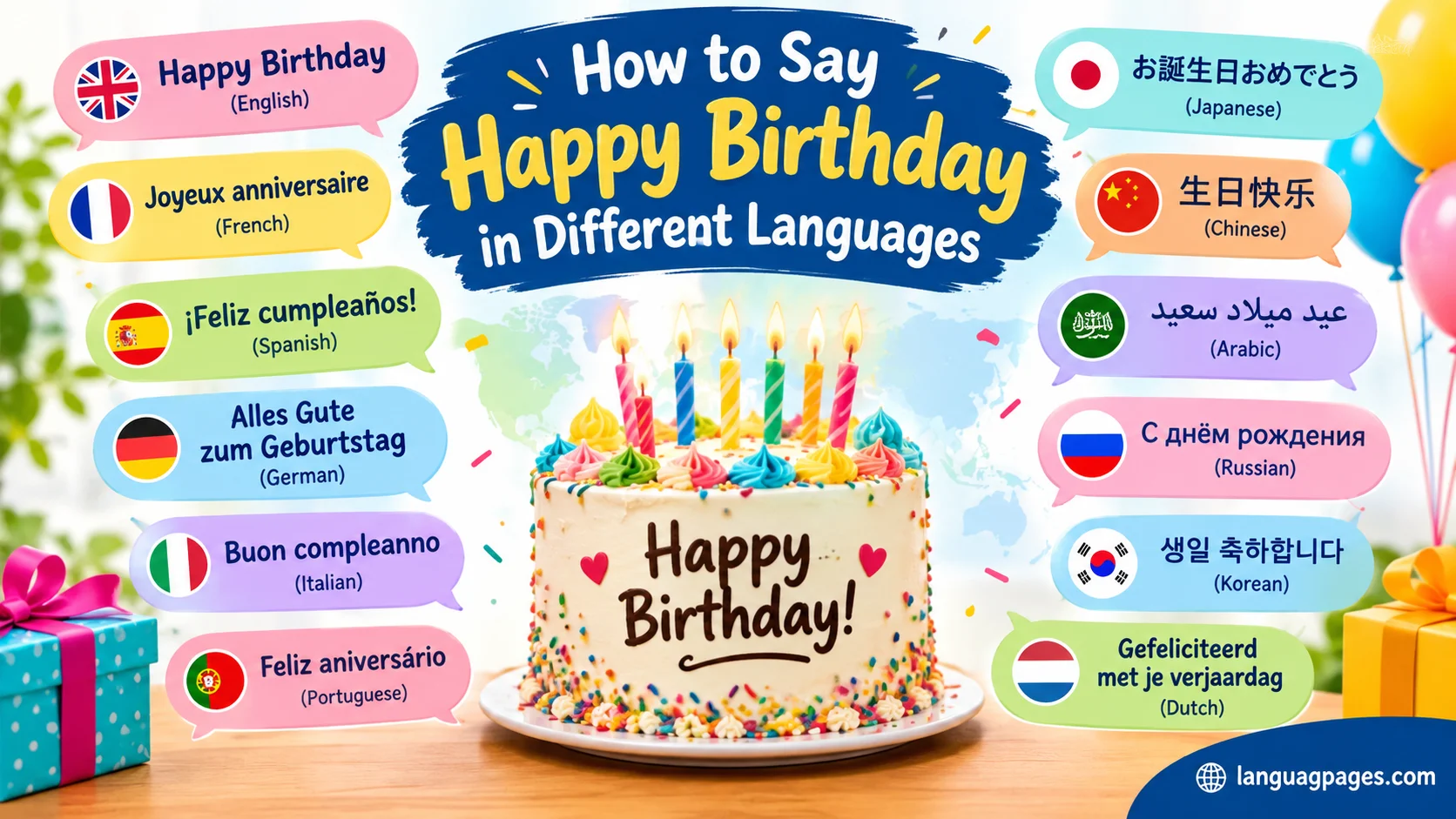
| Spanish | Spain, Latin America | Feliz cumpleaños | feh-LEES koom-pleh-AHN-yos | ¡Feliz cumpleaños! |
| French | France, Canada | Joyeux anniversaire | zhwa-YUH ah-nee-ver-SAIR | Joyeux anniversaire, Marie. |
| German | Germany, Austria | Alles Gute zum Geburtstag | AH-les GOO-te tsoom geh-BOORTS-tag | Alles Gute zum Geburtstag! |
| Italian | Italy | Buon compleanno | BWOHN kom-pleh-AHN-no | Buon compleanno! |
| Portuguese | Portugal, Brazil | Feliz aniversário | feh-LEEZ ah-nee-ver-SAH-ree-oo | Feliz aniversário! |
| Dutch | Netherlands | Gefeliciteerd | khe-feh-lee-see-TEERT | Gefeliciteerd met je verjaardag! |
| Swedish | Sweden | Grattis på födelsedagen | GRAH-tis paw FER-del-seh-dah-gen | Grattis på födelsedagen! |
| Norwegian | Norway | Gratulerer med dagen | gra-too-LEH-rer meh DAH-gen | Gratulerer med dagen! |
| Danish | Denmark | Tillykke med fødselsdagen | tee-LOO-ke meh FUR-sels-day-en | Tillykke med fødselsdagen! |
| Finnish | Finland | Hyvää syntymäpäivää | HUU-va syn-tu-ma-pai-va | Hyvää syntymäpäivää! |
| Polish | Poland | Wszystkiego najlepszego | fshist-KYE-go nai-LEP-she-go | Wszystkiego najlepszego! |
Cultural Note: In many European languages, birthday greetings may be longer than the English phrase and often include words meaning best wishes or congratulations.
Asian Languages
Asia contains hundreds of languages and writing systems. Birthday wishes often reflect cultural values such as happiness, respect, health, family, and prosperity.
| 🌍 Language | Country/Region | Translation | Pronunciation |
| Mandarin Chinese | China, Taiwan | 生日快乐 | Shēngrì kuàilè |
| Cantonese | Hong Kong, Guangdong | 生日快樂 | Saang yat faai lok |
| Japanese | Japan | お誕生日おめでとう | Otanjōbi omedetō |
| Korean | South Korea | 생일 축하합니다 | Saeng-il chukha hamnida |
| Hindi | India | जन्मदिन मुबारक हो | Janmadin mubarak ho |
| Urdu | Pakistan | سالگرہ مبارک | Saalgirah mubarak |
| Bengali | Bangladesh, India | শুভ জন্মদিন | Shubho jonmodin |
| Punjabi | Pakistan, India | ਜਨਮਦਿਨ ਮੁਬਾਰਕ | Janamdin mubarak |
| Gujarati | India | જન્મદિવસ મુબારક | Janmadivas mubarak |
| Marathi | India | वाढदिवसाच्या शुभेच्छा | Vaadhdivsachya shubhechha |
| Tamil | India, Sri Lanka | பிறந்தநாள் வாழ்த்துகள் | Pirandha naal vaazhthukkal |
| Telugu | India | పుట్టినరోజు శుభాకాంక్షలు | Puttina roju shubhakankshalu |
| Kannada | India | ಹುಟ್ಟುಹಬ್ಬದ ಶುಭಾಶಯಗಳು | Huttuhabbada shubhashayagalu |
| Malayalam | India | ജന്മദിനാശംസകൾ | Janmadinaashamsakal |
| Nepali | Nepal | जन्मदिनको शुभकामना | Janmadinko shubhakamana |
African Languages
Africa is home to extraordinary linguistic diversity. Birthday greetings may combine local traditions with expressions influenced by regional or international languages.
| 🌍 Language | Country/Region | Translation | Pronunciation |
| Swahili | East Africa | Heri ya siku ya kuzaliwa | HEH-ree yah SEE-koo yah koo-zah-LEE-wah |
| Afrikaans | South Africa, Namibia | Gelukkige verjaarsdag | khe-LUK-khe fer-YAARS-dakh |
| Zulu | South Africa | Usuku olumnandi lokuzalwa | oo-SOO-koo o-loo-MNAN-dee |
| Xhosa | South Africa | Uvuyo lokuzalwa | oo-VOY-oh lo-koo-ZAL-wa |
| Amharic | Ethiopia | መልካም ልደት | Melkam lidet |
| Yoruba | Nigeria | E ku ojo ibi | eh koo oh-joh ee-bee |
| Igbo | Nigeria | Ezi ụbọchị ọmụmụ | eh-zee oo-bo-chee |
| Hausa | West Africa | Barka da ranar haihuwa | BAR-ka da ra-NAR hai-HOO-wa |
| Somali | Somalia | Dhalasho wacan | dha-LA-sho wa-CHAN |
Middle Eastern Languages
The Middle East includes several distinct linguistic traditions. Birthday wishes may differ across countries, dialects, and levels of formality.
| 🌍 Language | Country/Region | Translation | Pronunciation |
| Arabic (MSA) | Arab World | عيد ميلاد سعيد | Eid milad sa’id |
| Persian (Farsi) | Iran | تولدت مبارک | Tavallodet mobarak |
| Hebrew | Israel | יום הולדת שמח | Yom huledet sameach |
| Kurdish | Iraq, Türkiye, Syria | Rojbûna te pîroz be | Roj-boo-na te pee-roz be |
| Turkish | Türkiye | Doğum günün kutlu olsun | Doh-oom goo-noon koot-loo ol-soon |
| Armenian | Armenia | Շնորհավոր ծնունդդ | Shnorhavor tsnundd |
Quick Reference: Happy Birthday in Different Languages
| Language | Translation |
| English | Happy Birthday |
| Spanish | Feliz cumpleaños |
| French | Joyeux anniversaire |
| German | Alles Gute zum Geburtstag |
| Italian | Buon compleanno |
| Portuguese | Feliz aniversário |
| Dutch | Gefeliciteerd |
| Mandarin Chinese | 生日快乐 |
| Japanese | お誕生日おめでとう |
| Korean | 생일 축하합니다 |
| Hindi | जन्मदिन मुबारक हो |
| Urdu | سالگرہ مبارک |
| Arabic | عيد ميلاد سعيد |
| Persian | تولدت مبارک |
| Hebrew | יום הולדת שמח |
| Turkish | Doğum günün kutlu olsun |
| Swahili | Heri ya siku ya kuzaliwa |
| Afrikaans | Gelukkige verjaarsdag |
How to Choose the Right Translation
The best birthday translation depends on:
- Who you are speaking to
- Regional preferences
- Formal or informal situations
- Written or spoken communication
- Cultural expectations
When possible, use the version commonly used in the recipient’s country or community.
Common Mistakes When Translating Happy Birthday
- Using a literal word-for-word translation.
- Mixing formal and informal forms.
- Ignoring regional differences.
- Assuming one translation works everywhere.
- Using incorrect pronunciation.
- Copying machine-generated translations without checking context.
Why Learn Happy Birthday in Different Languages?
Learning birthday greetings in multiple languages can help you:
- Connect with people from different cultures.
- Make celebrations feel more personal.
- Improve language-learning skills.
- Build vocabulary.
- Travel with greater confidence.
- Show respect for linguistic diversity.
FAQs:
How do you say Happy Birthday in different languages?
Different languages use unique expressions such as Feliz cumpleaños, Joyeux anniversaire.
Is a literal translation always correct?
No. Natural usage is usually more important than literal wording.
Does pronunciation matter?
Yes. Correct pronunciation helps your greeting sound more natural.
Can translations vary by country?
Yes. Regional differences are common.
Which language uses 生日快乐?
Mandarin Chinese.
How do you say Happy Birthday in Urdu?
سالگرہ مبارک (Saalgirah Mubarak).
How do you say Happy Birthday in Arabic?
عيد ميلاد سعيد (Eid Milad Sa’id).
Are birthday greetings formal?
Some are neutral, while others have formal and informal versions.
Can I use these phrases in messages?
Yes. They are commonly used in texts, cards, and social media posts.
Why learn birthday greetings in other languages?
They help create more meaningful and culturally aware communication.
Conclusion:
Whether you’re writing a card, message, or professional greeting, Happy Birthday remains a warm expression of celebration, kindness, and good wishes for someone special.
Understanding the right tone, grammar, and context helps you create meaningful birthday messages. By considering English usage, regional preferences, and communication style, you can express your wishes naturally while maintaining clarity, warmth, and consistency in every situation.