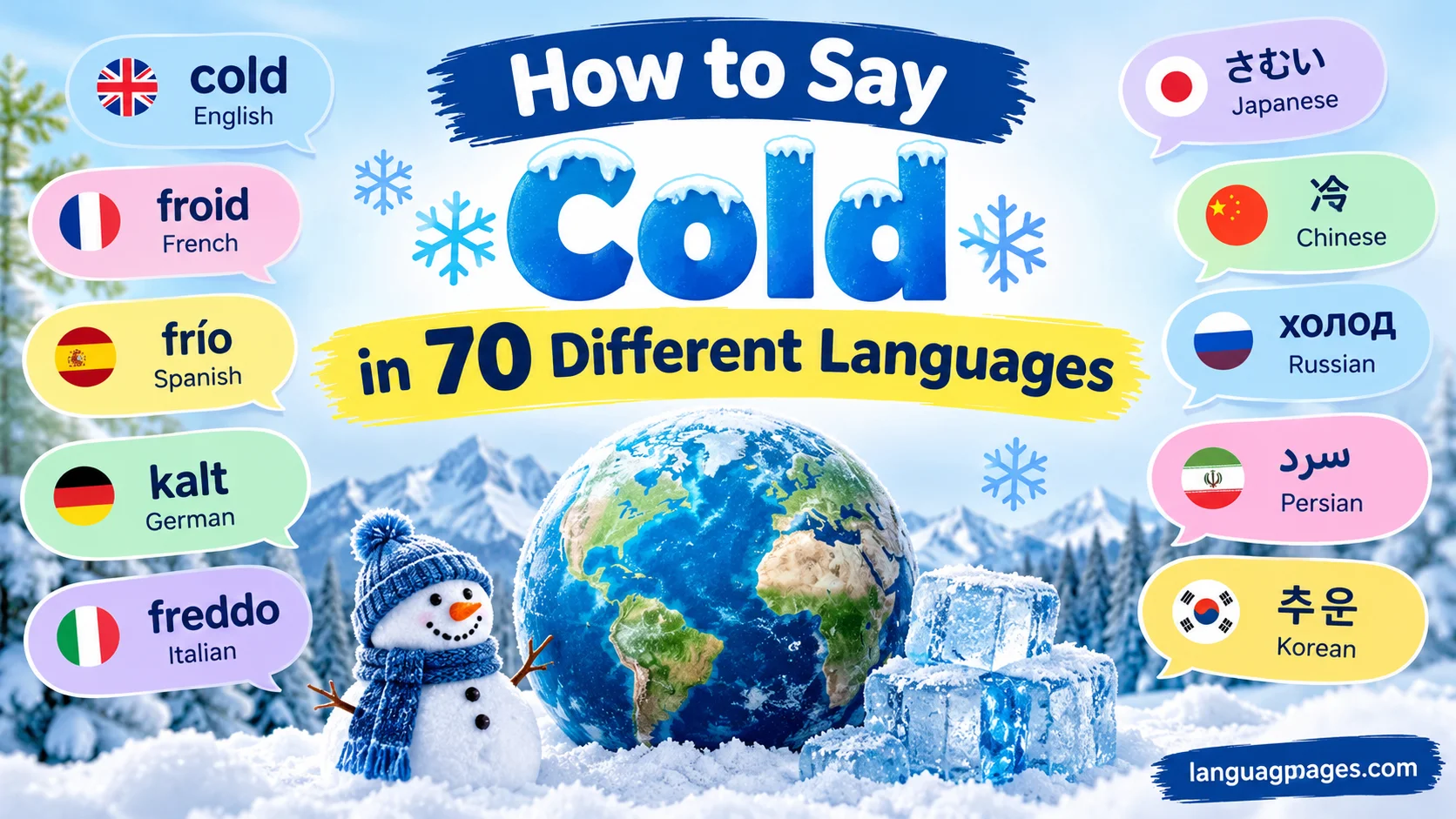
The word cold can describe icy water, chilly weather, or the feeling of a winter breeze against your skin. Learning how to say cold in 70 different languages helps you express everyday experiences and connect with people across cultures.
Understanding cold translations, pronunciation, and vocabulary makes conversations easier when traveling, studying languages, or communicating with international friends. Different languages may use distinct words for cold weather and cold objects, while grammar rules, adjective forms, and regional expressions influence natural usage. Exploring these differences builds practical language skills and deepens your understanding of how people describe temperature in everyday life.
This article explores cold in different languages, including translations, pronunciation guides, and useful example sentences. You will discover expressions from European, Asian, African, and Middle Eastern languages, along with regional variations and important language differences. The examples explain how context affects word choice and meaning, helping you develop useful multilingual vocabulary. Continue reading to discover how this familiar word appears across cultures and languages.
Interesting Facts About Cold
- Cold is relative: What feels cold to one person may feel comfortable to another, depending on clothing, activity, and surroundings.
- Grammar matters: Some languages change the form of an adjective to agree with a noun’s gender or number.
- Temperature and sensation differ: A language may use different constructions for a cold object and a person who feels cold.
- English has several related expressions: Words such as chilly, freezing, and cool describe different degrees or experiences of low temperature.
- Context shapes meaning: Calling a drink cold is not necessarily the same as describing cold weather.
- Pronunciation guides are approximations: English spelling cannot perfectly represent every sound in another language.
- Cold can be figurative: In English, a “cold response” can suggest a lack of warmth or friendliness rather than low temperature.
What Does Cold Mean?
Cold usually describes a low temperature or the sensation of being chilled. It can refer to cold air, water, food, objects, or the human body. For example, “The water is cold” describes the water’s temperature, while “I feel cold” describes a person’s physical sensation.
The word can also have a figurative meaning. A cold attitude may suggest emotional distance, while a cold color palette refers to colors often associated with ice, shade, or winter.
In this article, the main focus is the physical meaning of cold, especially when describing weather, objects, and everyday experiences.
Why Can Cold Have Different Translations?
Languages do not always organize temperature expressions in the same way. One language may use an adjective where another uses a verb or a phrase meaning “to feel cold.”
The best choice depends on context, grammar, and regional usage. Adjectives may change according to gender or number, and informal expressions can differ from textbook forms. Even within one language, speakers may choose different words for cool weather, freezing conditions, or something chilled.
The tables below provide practical translations of the idea of cold, rather than attempting to translate every possible English sentence with one word.
European Languages
European languages belong to several language families, including Germanic, Romance, Slavic, and Uralic. Their words for cold may change according to grammar, temperature, or the object being described. The following examples focus on ordinary physical cold.
| 🌍 Language | Country/Region | Translation | Pronunciation | Example Sentence |
| English | International | Cold | kohld | The water is cold. |
| American English 🇺🇸 | United States | Cold | kohld | It is cold outside. |
| British English 🇬🇧 | United Kingdom | Cold | kohld | The weather is cold. |
| Australian English 🇦🇺 | Australia | Cold | kohld | The water is cold. |
| Spanish | Spain, Latin America | Frío / fría | FREE-oh / FREE-ah | El agua está fría. — The water is cold. |
| French | France, Belgium, Canada | Froid / froide | frwah / frwad | L’eau est froide. — The water is cold. |
| German | Germany, Austria | Kalt | kahlt | Das Wasser ist kalt. — The water is cold. |
| Italian | Italy, Switzerland | Freddo / fredda | FRED-doh / FRED-dah | L’acqua è fredda. — The water is cold. |
| Portuguese | Portugal, Brazil | Frio / fria | FREE-oo / FREE-ah | A água está fria. — The water is cold. |
| Dutch | Netherlands, Belgium | Koud | kowt | Het water is koud. — The water is cold. |
| Swedish | Sweden, Finland | Kall | kahl | Vattnet är kallt. — The water is cold. |
| Norwegian | Norway | Kald | kahld | Vannet er kaldt. — The water is cold. |
| Danish | Denmark | Kold | kohl | Vandet er koldt. — The water is cold. |
| Finnish | Finland | Kylmä | KUEL-ma | Vesi on kylmää. — The water is cold. |
| Icelandic | Iceland | Kaldur / köld | KAL-dur / kulth | Vatnið er kalt. — The water is cold. |
| Irish | Ireland | Fuar | FOO-er | Tá sé fuar. — It is cold. |
| Welsh | Wales | Oer | oy-r | Mae hi’n oer. — It is cold. |
| Polish | Poland | Zimny / zimna | ZHEEM-nih / ZHEEM-nah | Woda jest zimna. — The water is cold. |
| Czech | Czechia | Studený / studená | STOO-deh-nee / STOO-deh-naa | Voda je studená. — The water is cold. |
| Slovak | Slovakia | Studený / studená | STOO-deh-nee / STOO-deh-naa | Voda je studená. — The water is cold. |
| Ukrainian | Ukraine | Холодний / холодна | kho-LOD-nyi / kho-LOD-na | Вода холодна. — The water is cold. |
| Russian | Russia, neighboring regions | Холодный / холодная | kha-LOD-ny / kha-LOD-na-ya | Вода холодная. — The water is cold. |
| Romanian | Romania, Moldova | Rece | REH-cheh | Apa este rece. — The water is cold. |
| Hungarian | Hungary | Hideg | HEE-deg | A víz hideg. — The water is cold. |
| Greek | Greece, Cyprus | Κρύος / κρύα | KREE-os / KREE-a | Το νερό είναι κρύο. — The water is cold. |
| Bulgarian | Bulgaria | Студен / студена | STOO-den / STOO-de-na | Водата е студена. — The water is cold. |
| Croatian | Croatia | Hladan / hladna | HLAH-dan / HLAH-dna | Voda je hladna. — The water is cold. |
| Serbian | Serbia, Balkans | Хладан / хладна | HLAH-dan / HLAH-dna | Вода је хладна. — The water is cold. |
| Slovenian | Slovenia | Mrzel / mrzla | MUR-zel / MUR-zla | Voda je mrzla. — The water is cold. |
| Lithuanian | Lithuania | Šaltas / šalta | SHAL-tas / SHAL-ta | Vanduo šaltas. — The water is cold. |
| Latvian | Latvia | Auksts / auksta | OWKSTS / OWK-sta | Ūdens ir auksts. — The water is cold. |
| Estonian | Estonia | Külm | kuelm | Vesi on külm. — The water is cold. |
English Varieties
American, British, and Australian English all use cold for low temperature. There is no separate standard translation simply because the speaker comes from a different English-speaking country. Accent and local expressions can vary, but “The water is cold” works in all three varieties.
European Cultural and Grammar Notes
- In Spanish, French, Italian, German, and several Slavic languages, adjective forms can depend on grammatical gender, number, or the noun being described.
- Cold and cool are not always interchangeable. Some languages distinguish mild coolness from stronger cold more explicitly in everyday vocabulary.
- In Finnish and Hungarian, the word itself does not change for grammatical gender because these languages do not have grammatical gender in the same way French or Spanish does.
Asian Languages
Asia includes languages with very different grammatical structures and writing systems. Some use characters, others use alphabets or abugidas, and several distinguish tones. These examples use common expressions for cold, especially cold weather or cold objects.
| 🌍 Language | Country/Region | Translation | Pronunciation | Example Sentence |
| Mandarin Chinese | China, Taiwan, Singapore | 冷 | lěng (third tone) | 水很冷。— The water is cold. |
| Cantonese | Hong Kong, Guangdong | 凍 | dung3 | 啲水好凍。— The water is very cold. |
| Japanese | Japan | 冷たい / 寒い | tsumetai / samui | 水が冷たい。— The water is cold. |
| Korean | South Korea, North Korea | 차갑다 | cha-gap-tta | 물이 차가워요. — The water is cold. |
| Hindi | India | ठंडा / ठंडी | THUN-daa / THUN-dee | पानी ठंडा है। — The water is cold. |
| Urdu | Pakistan, India | ٹھنڈا / ٹھنڈی | thun-daa / thun-dee | پانی ٹھنڈا ہے۔ — The water is cold. |
| Bengali | Bangladesh, India | ঠান্ডা | thanda | জল ঠান্ডা। — The water is cold. |
| Punjabi | India, Pakistan | ਠੰਢਾ / ٹھنڈا | thun-dhaa / thun-daa | ਪਾਣੀ ਠੰਢਾ ਹੈ۔ — The water is cold. |
| Gujarati | India | ઠંડું | than-dun | પાણી ઠંડું છે. — The water is cold. |
| Marathi | India | थंड | thun-d | पाणी थंड आहे. — The water is cold. |
| Tamil | India, Sri Lanka | குளிர்ந்த | ku-lirn-tha | தண்ணீர் குளிர்ந்திருக்கிறது. — The water is cold. |
| Telugu | India | చల్లని | chal-la-ni | నీళ్లు చల్లగా ఉన్నాయి. — The water is cold. |
| Kannada | India | ತಣ್ಣನೆಯ | tan-na-ne-ya | ನೀರು ತಣ್ಣಗಿದೆ. — The water is cold. |
| Malayalam | India | തണുത്ത | tha-nut-tha | വെള്ളം തണുത്തതാണ്. — The water is cold. |
| Nepali | Nepal, India | चिसो | chi-so | पानी चिसो छ। — The water is cold. |
| Sinhala | Sri Lanka | සීතල | see-tha-la | වතුර සීතලයි. — The water is cold. |
| Thai | Thailand | เย็น | yen | น้ำเย็น — Cold water. |
| Vietnamese | Vietnam | Lạnh | lahng | Nước lạnh. — Cold water. |
| Indonesian | Indonesia | Dingin | DEE-ngin | Airnya dingin. — The water is cold. |
| Malay | Malaysia, Brunei, Singapore | Sejuk / dingin | suh-jook / DEE-ngin | Air itu sejuk. — The water is cold. |
| Filipino/Tagalog | Philippines | Malamig | ma-la-MIG | Malamig ang tubig. — The water is cold. |
| Burmese | Myanmar | အေး | aye | ရေက အေးတယ်။ — The water is cold. |
| Khmer | Cambodia | ត្រជាក់ | traw-cheak | ទឹកត្រជាក់។ — The water is cold. |
| Lao | Laos | ເຢັນ | yen | ນ້ຳເຢັນ. — The water is cold. |
| Mongolian | Mongolia | Хүйтэн | khooy-ten | Ус хүйтэн байна. — The water is cold. |
| Kazakh | Kazakhstan | Суық | soo-ykh | Су суық. — The water is cold. |
| Uzbek | Uzbekistan | Sovuq | so-vooq | Suv sovuq. — The water is cold. |
Asian Cultural and Grammar Notes
Japanese distinguishes between cold things and cold weather. Tsumetai commonly describes something cold to the touch, such as water, while samui is used for cold weather or feeling cold in the environment.
Mandarin 冷 (lěng) can describe cold conditions, while 冰冷 (bīnglěng) emphasizes an icy or very cold quality. In Korean, 차갑다 commonly describes cold objects; 춥다 is used for cold weather or feeling cold.
In Hindi, Urdu, and related languages, adjective forms may change according to the noun. The transliterations above are practical reading aids rather than exact phonetic transcriptions.
Middle Eastern Languages
The Middle East contains several distinct language traditions, including Arabic, Persian, Hebrew, Kurdish, and Turkish. Words for cold may differ between formal writing and everyday conversation, particularly where regional dialects are widely used.
| 🌍 Language | Country/Region | Translation | Pronunciation | Example Sentence |
| Arabic (Modern Standard) | Middle East, North Africa | بارد / باردة | bārid / bārida | الماء بارد. — The water is cold. |
| Persian (Farsi) | Iran, Afghanistan, Tajikistan | سرد | sard | آب سرد است. — The water is cold. |
| Hebrew | Israel | קר / קרה | kar / kara | המים קרים. — The water is cold. |
| Kurdish (Kurmanji) | Türkiye, Iraq, Syria | Sar | sar | Av sar e. — The water is cold. |
| Turkish | Türkiye, Cyprus | Soğuk | soh-ook | Su soğuk. — The water is cold. |
| Armenian | Armenia, diaspora communities | Սառը | sa-ṙə | Ջուրը սառն է։ — The water is cold. |
Middle Eastern Cultural and Grammar Notes
- Arabic: Bārid is a masculine form, while bārida is feminine. Spoken dialects may use different everyday expressions.
- Persian: Sard is a widely understood word for cold and can describe weather, objects, or conditions, depending on the sentence.
- Hebrew: Adjective forms change with grammatical gender and number. The example uses the plural form קרִים (krim) in the phrase for cold water.
- Kurdish: Kurdish has several varieties. The example uses a simple Kurmanji construction and should not be assumed to represent every Kurdish dialect.
African Languages
Africa has remarkable linguistic diversity, with languages from several major families. The following translations represent selected languages spoken across different countries and communities; no single language represents the continent as a whole.
| 🌍 Language | Country/Region | Translation | Pronunciation | Example Sentence |
| Swahili | Tanzania, Kenya, East Africa | Baridi | ba-REE-dee | Maji ni baridi. — The water is cold. |
| Afrikaans | South Africa, Namibia | Koud | kowt | Die water is koud. — The water is cold. |
| Zulu | South Africa | -bandayo | ban-DAH-yo | Amanzi ayabanda. — The water is cold. |
| Xhosa | South Africa | -bandayo | ban-DAH-yo | Amanzi ayabanda. — The water is cold. |
| Amharic | Ethiopia | ቀዝቃዛ | kez-KEH-za | ውሃው ቀዝቃዛ ነው። — The water is cold. |
| Yoruba | Nigeria, Benin | Tútù | TOO-too | Omi náà tutù. — The water is cold. |
| Igbo | Nigeria | Oyi | oh-yee | Mmiri ahụ dị oyi. — The water is cold. |
| Hausa | Nigeria, Niger, West Africa | Sanyi | SAN-yee | Ruwan yana da sanyi. — The water is cold. |
| Somali | Somalia, Horn of Africa | Qabow | qa-bow | Biyuhu waa qabow. — The water is cold. |
| Shona | Zimbabwe | Kutonhora | koo-tohn-HOH-rah | Mvura inotonhora. — The water is cold. |
African Cultural and Grammar Notes
In Swahili, baridi is a useful everyday word for cold, while the construction around it depends on the sentence. In Zulu and Xhosa, related forms such as -bandayo occur in descriptions of cold conditions, with the full expression shaped by noun agreement and grammar.
Yoruba uses tútù for cold or cool conditions. As with other languages, context determines whether the speaker means chilled water, cool weather, or a more general sensation.
Other World Languages
These languages add perspectives from the Pacific, the Americas, and international constructed-language learning.
| 🌍 Language | Country/Region | Translation | Pronunciation | Example Sentence |
| Māori | New Zealand | Makariri | ma-ka-ri-ri | He makariri te wai. — The water is cold. |
| Samoan | Samoa, Pacific Islands | Mālūlū | maa-loo-loo | E mālūlū le vai. — The water is cold. |
| Hawaiian | Hawaiʻi, United States | Anu | AH-noo | Anu ka wai. — The water is cold. |
| Quechua | Andes, Peru, Bolivia, Ecuador | Chiri | CHEE-ree | Chiri-mi yaku. — The water is cold. |
| Guarani | Paraguay, neighboring regions | Ro’ysã | roy-SAH | Pe y ro’ysã. — The water is cold. |
| Haitian Creole | Haiti | Fwad | fwahd | Dlo a frèt. — The water is cold. |
| Esperanto | International language-learning communities | Malvarma | mal-VAR-ma | La akvo estas malvarma. — The water is cold. |
Note: Quechua and Guarani have regional varieties, so spelling and usage may differ by community. These examples are introductory and should be checked with a knowledgeable speaker for formal or region-specific use.
Quick Reference: Cold in Different Languages
Use this table to find the core translation quickly. Some entries show two adjective forms because the correct form depends on grammatical gender or the noun being described.
| Language | Translation |
| English | Cold |
| American English | Cold |
| British English | Cold |
| Australian English | Cold |
| Spanish | Frío / fría |
| French | Froid / froide |
| German | Kalt |
| Italian | Freddo / fredda |
| Portuguese | Frio / fria |
| Dutch | Koud |
| Swedish | Kall |
| Norwegian | Kald |
| Danish | Kold |
| Finnish | Kylmä |
| Icelandic | Kaldur / köld |
| Irish | Fuar |
| Welsh | Oer |
| Polish | Zimny / zimna |
| Czech | Studený / studená |
| Slovak | Studený / studená |
| Ukrainian | Холодний / холодна |
| Russian | Холодный / холодная |
| Romanian | Rece |
| Hungarian | Hideg |
| Greek | Κρύος / κρύα |
| Bulgarian | Студен / студена |
| Croatian | Hladan / hladna |
| Serbian | Хладан / хладна |
| Slovenian | Mrzel / mrzla |
| Lithuanian | Šaltas / šalta |
| Latvian | Auksts / auksta |
| Estonian | Külm |
| Mandarin Chinese | 冷 |
| Cantonese | 凍 |
| Japanese | 冷たい / 寒い |
| Korean | 차갑다 |
| Hindi | ठंडा / ठंडी |
| Urdu | ٹھنڈا / ٹھنڈی |
| Bengali | ঠান্ডা |
| Punjabi | ਠੰਢਾ / ٹھنڈا |
| Gujarati | ઠંડું |
| Marathi | थंड |
| Tamil | குளிர்ந்த |
| Telugu | చల్లని |
| Kannada | ತಣ್ಣನೆಯ |
| Malayalam | തണുത്ത |
| Nepali | चिसो |
| Sinhala | සීතල |
| Thai | เย็น |
| Vietnamese | Lạnh |
| Indonesian | Dingin |
| Malay | Sejuk / dingin |
| Filipino/Tagalog | Malamig |
| Burmese | အေး |
| Khmer | ត្រជាក់ |
| Lao | ເຢັນ |
| Mongolian | Хүйтэн |
| Kazakh | Суық |
| Uzbek | Sovuq |
| Arabic | بارد / باردة |
| Persian | سرد |
| Hebrew | קר / קרה |
| Kurdish (Kurmanji) | Sar |
| Turkish | Soğuk |
| Armenian | Սառը |
| Swahili | Baridi |
| Afrikaans | Koud |
| Zulu | -bandayo |
| Xhosa | -bandayo |
| Amharic | ቀዝቃዛ |
| Yoruba | Tútù |
| Igbo | Oyi |
| Hausa | Sanyi |
| Somali | Qabow |
| Shona | Kutonhora |
| Māori | Makariri |
| Samoan | Mālūlū |
| Hawaiian | Anu |
| Quechua | Chiri |
| Guarani | Ro’ysã |
| Haitian Creole | Fwad |
| Esperanto | Malvarma |
How to Choose the Right Translation
The best translation of cold depends on what you are describing and who you are speaking to.
- For weather: Choose the expression commonly used for chilly or cold conditions.
- For objects: Use the adjective appropriate for cold water, food, metal, or another object.
- For conversation: Learn a complete example sentence rather than memorizing a word alone.
- For travel: Check local pronunciation and common regional expressions.
- For writing: Confirm grammatical agreement, particularly in languages where adjectives change form.
A useful learning tip is to remember the word alongside a phrase, such as “The water is cold.” This helps you understand how the translation works in a real sentence.
Common Mistakes When Translating Cold
Avoid these common translation mistakes when learning a new language:
- Translating word for word: A dictionary equivalent may not fit every sentence.
- Confusing weather with objects: Japanese, for example, distinguishes samui for cold weather from tsumetai for cold objects.
- Ignoring grammar: Spanish frío and fría differ according to grammatical agreement.
- Mixing dialects: A phrase used in one region may not be the usual choice elsewhere.
- Guessing pronunciation: Romanized spelling is helpful, but it may not capture every sound.
- Ignoring context: Cold water, cold weather, and emotional coldness can require different expressions.
Best practice: Learn the word, its pronunciation, and one natural example together.
Why Learn Cold in Different Languages?
Learning cold in different languages expands your everyday vocabulary and helps you communicate in unfamiliar settings. You might use these expressions when ordering a cold drink, discussing winter weather, traveling abroad, or chatting with someone who speaks another language.
Comparing translations also reveals interesting differences in grammar, pronunciation, and cultural expression. You can learn how languages describe temperature without assuming that every language follows English sentence patterns.
For students, these words provide a manageable starting point for language learning. For travelers, they offer practical vocabulary for everyday conversations. For anyone interested in multilingual communication, they provide a simple way to explore how people describe the world around them.
FAQs:
How do you say cold in different languages?
The word varies by language. Examples include frío in Spanish, froid in French, kalt in German, 冷 (lěng) in Mandarin, and baridi in Swahili.
What is the most natural translation of cold?
There is no single translation that works in every language. The best choice depends on whether you mean cold weather, a cold object, or the sensation of feeling cold.
Can the translation change by country?
Yes. Regional dialects and local vocabulary can influence everyday usage. However, many standard-language words are understood across several countries.
Why do some languages have multiple translations for cold?
Languages may distinguish between cold weather, cold objects, cool temperatures, and freezing conditions. Grammar can also change an adjective’s form.
Does pronunciation change between regions?
Yes. Accents, dialects, and local speech patterns can affect pronunciation. Some languages also distinguish sounds or tones that English speakers may find unfamiliar.
How can I pronounce cold correctly in another language?
Start with the pronunciation guide and listen to reliable recordings when available. Pay attention to unfamiliar vowels, consonants, and tones rather than relying entirely on English spelling.
Is a literal translation always accurate?
No. A literal translation can sound unnatural or communicate the wrong meaning. A complete, context-appropriate sentence is often more useful than an isolated word.
Which languages use a different writing system?
Mandarin Chinese, Japanese, Korean, Hindi, Urdu, Arabic, Hebrew, Greek, and several others use writing systems different from the standard English alphabet or combine multiple scripts.
Can I use these translations in a message or conversation?
Yes, for basic learning and informal communication. Check the complete sentence and regional usage first if the message is important or requires precise wording.
What is the difference between cold and cool?
Cold generally describes a lower temperature, while cool often suggests a milder degree of coldness. The exact distinction varies by context and language.
How do you say cold weather in Japanese?
A common expression is 寒い天気 (samui tenki), meaning “cold weather.” Japanese uses samui for cold weather and tsumetai for cold objects or things that feel cold to the touch.
What is an easy way to remember cold in another language?
Practice the word in a short sentence, listen to its pronunciation, and review it in different contexts. Regular practice is more useful than memorizing a translation without understanding how it is used.
Conclusion:
Learning How to Say Cold in 70 Different Languages helps you build vocabulary, improve communication, and understand how different cultures describe temperature. These translations make everyday conversations easier and more meaningful.
Exploring cold translations introduces useful words, pronunciation tips, and cultural differences across languages. Practice these expressions in daily conversations to strengthen your language skills. With consistent learning, you can communicate more naturally and appreciate the rich diversity of languages worldwide.