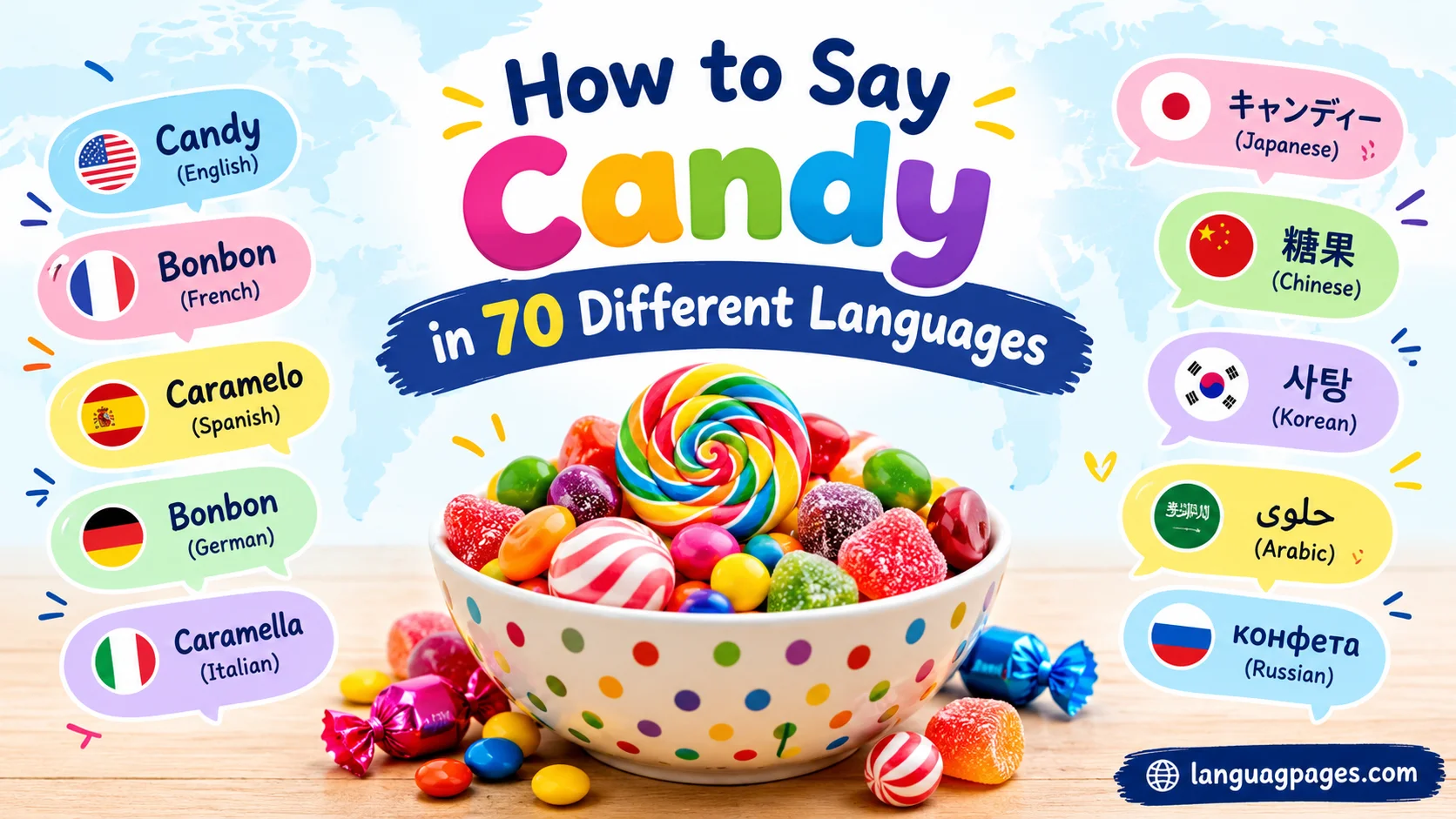
Candy brings people together through shared treats, sweet memories, and delicious discoveries. How to Say Candy in 70 Different Languages introduces the words people use for candy, sweets, and confectionery across cultures, making everyday vocabulary more interesting and useful.
Learning these translations helps you communicate while traveling, recognize foreign food labels, and explore how different languages describe sweet treats. From Spanish dulces to French bonbons, each expression adds something valuable to your multilingual vocabulary. Understanding regional differences between candy, sweets, and traditional confectionery also makes conversations more natural and helps language learners avoid common translation mistakes.
In this article, you will discover candy translations in 70 languages, including European, Asian, African, and Middle Eastern languages. Explore native words, pronunciation guides, regional variations, and practical example sentences to understand how these terms work in everyday situations. You will also learn why context matters when translating food vocabulary and how cultural differences influence word choice. Use this guide to expand your language-learning skills and discover new ways to talk about your favorite sweet treats around the world.
Interesting Facts About Candy
- Candy and sweets: American English commonly uses candy, while British English generally prefers sweets for small sugary treats.
- A broad category: Candy can include hard sweets, gummies, caramels, and sugar-based confections, but chocolate is sometimes classified separately.
- Different word choices: Some languages have a general word for confectionery rather than a direct equivalent of the American word candy.
- Regional vocabulary: The same language may use different terms across countries and communities.
- Native scripts: Languages such as Japanese, Korean, Arabic, and Hindi use writing systems different from the Latin alphabet.
- Borrowed vocabulary: Some languages use words influenced by international trade, cultural contact, or foreign-language borrowing.
- Context matters: A word used for candy in a shop may not describe every kind of dessert or sweet food.
What Does Candy Mean?
Candy is a general English term for sweet confectionery, often made with sugar or other sweeteners. Common examples include lollipops, gummies, hard sweets, toffees, and jelly beans.
The word can also carry a playful or affectionate feeling when people talk about favorite treats or give sweets as gifts. However, candy does not necessarily mean cake, pastries, or every kind of dessert.
In the United States, candy is common everyday vocabulary. In Britain, sweets is usually more natural for the same broad category. Other languages may use a word meaning sweet, confectionery, or sugary treat, depending on the product and context.
Why Can Candy Have Different Translations?
There is no single word that perfectly covers every type of candy in every language.
- Context: A word for confectionery may include sweets sold in shops but not necessarily chocolate.
- Regional usage: British sweets and American candy illustrate how vocabulary changes across English-speaking regions.
- Product type: Some languages have separate words for candy, chocolate, toffee, and boiled sweets.
- Formality: Everyday conversation may use a shorter or more familiar word than packaging or commercial descriptions.
- Grammar: The word may change form depending on whether the sentence refers to one sweet, several sweets, or a general category.
- Pronunciation: Sounds that do not exist in English can make a word challenging for beginners.
The translations below use a general candy or confectionery meaning where possible. Example sentences show how the vocabulary can appear naturally in conversation.
European Languages
Europe has many language families, including Germanic, Romance, Slavic, and Uralic languages. Words for candy can refer to sweets broadly or to particular types of confectionery. The examples below use common vocabulary for everyday contexts.
| 🌍 Language | Country/Region | Translation | Pronunciation | Example Sentence |
| English | International | Candy | KAN-dee | I like candy. |
| American English 🇺🇸 | United States | Candy | KAN-dee | I bought some candy. |
| British English 🇬🇧 | United Kingdom | Sweets | SWEETS | I bought some sweets. |
| Australian English 🇦🇺 | Australia | Lollies | LOL-eez | The children love lollies. |
| Spanish | Spain, Latin America | Dulces | DOOL-ses | Me gustan los dulces. — I like sweets. |
| French | France, Belgium, Canada | Bonbons | bon-BON | J’aime les bonbons. — I like candy. |
| German | Germany, Austria | Süßigkeiten | ZOOS-ikh-khy-ten | Ich mag Süßigkeiten. — I like sweets. |
| Italian | Italy, Switzerland | Caramelle | ka-ra-MEL-le | Mi piacciono le caramelle. — I like sweets. |
| Portuguese | Portugal, Brazil | Doces | DOH-ses | Gosto de doces. — I like sweets. |
| Dutch | Netherlands, Belgium | Snoep | snoop | Ik hou van snoep. — I like candy. |
| Swedish | Sweden | Godis | GOH-dees | Jag gillar godis. — I like candy. |
| Norwegian | Norway | Godteri | goo-TEH-ree | Jeg liker godteri. — I like candy. |
| Danish | Denmark | Slik | sleek | Jeg kan lide slik. — I like candy. |
| Finnish | Finland | Makeiset | MAH-keh-ee-set | Pidän makeisista. — I like candy. |
| Icelandic | Iceland | Nammi | NAH-mih | Mér finnst nammi gott. — I like candy. |
| Irish | Ireland | Milseáin | MIL-shawn | Is maith liom milseáin. — I like sweets. |
| Welsh | Wales | Melysion | meh-LUH-shon | Dw i’n hoffi melysion. — I like sweets. |
| Polish | Poland | Słodycze | swuh-DIH-cheh | Lubię słodycze. — I like sweets. |
| Czech | Czechia | Cukrovinky | tsoo-kroh-VEEN-kee | Mám rád cukrovinky. — I like confectionery. |
| Slovak | Slovakia | Cukrovinky | tsoo-kroh-VEEN-kee | Mám rád cukrovinky. — I like confectionery. |
| Ukrainian | Ukraine | Цукерки | tsoo-KER-ky | Я люблю цукерки. — I like candy. |
| Russian | Russia and neighboring regions | Конфеты | kon-FYEH-ty | Я люблю конфеты. — I like candy. |
| Romanian | Romania, Moldova | Bomboane | bom-BOAH-neh | Îmi plac bomboanele. — I like candy. |
| Hungarian | Hungary | Cukorka | TSOO-kor-kah | Szeretem a cukorkát. — I like candy. |
| Greek | Greece, Cyprus | Καραμέλες | ka-ra-ME-les | Μου αρέσουν οι καραμέλες. — I like sweets. |
| Bulgarian | Bulgaria | Бонбони | bon-BO-nee | Обичам бонбони. — I like candy. |
| Croatian | Croatia | Bomboni | bom-BO-nee | Volim bombone. — I like candy. |
| Serbian | Serbia and neighboring regions | Бомбоне | BOM-bo-neh | Волим бомбоне. — I like candy. |
| Slovenian | Slovenia | Bonboni | bon-BO-nee | Rad imam bonbone. — I like candy. |
| Lithuanian | Lithuania | Saldainiai | sal-dai-NYAI | Aš mėgstu saldainius. — I like candy. |
| Latvian | Latvia | Konfektes | kon-FEK-tes | Man garšo konfektes. — I like candy. |
| Estonian | Estonia | Kommid | KOM-mid | Mulle meeldivad kommid. — I like candy. |
Cultural Notes for Europe
Sweets, candy, and confectionery are not always interchangeable. British speakers often say sweets, Australians commonly say lollies, and Americans generally say candy. In French, bonbons usually refers to individual sweets, while confiseries can describe confectionery more broadly.
Some languages also distinguish between candy and chocolate. When shopping, naming the specific treat can help avoid confusion.
Asian Languages
Asia includes a wide range of language families and writing systems. Translations may differ depending on whether speakers mean individual sweets, candy in general, or confectionery as a product category. The examples below provide useful everyday vocabulary.
| 🌍 Language | Country/Region | Translation | Pronunciation | Example Sentence |
| Mandarin Chinese | China, Taiwan, Singapore | 糖果 (tángguǒ) | tahng-gwaw, rising then falling-rising tones | 我喜欢糖果。— I like candy. |
| Cantonese | Hong Kong, Guangdong | 糖果 (tong4 gwo2) | tong-gwoh, Cantonese tones 4 and 2 | 我鍾意食糖果。— I like eating candy. |
| Japanese | Japan | 飴 (あめ, ame) | AH-meh | 飴が好きです。— I like candy. |
| Korean | South Korea, North Korea | 사탕 (satang) | sah-tahng | 저는 사탕을 좋아해요. — I like candy. |
| Hindi | India | मिठाई (mithai) | mith-AI | मुझे मिठाई पसंद है। — I like sweets. |
| Urdu | Pakistan, India | ٹافیاں / مٹھائیاں | TAF-ee-yan / mith-AI-yan | مجھے ٹافیاں پسند ہیں۔ — I like toffees. |
| Bengali | Bangladesh, India | মিষ্টি (mishti) | MISH-tee | আমি মিষ্টি পছন্দ করি। — I like sweets. |
| Punjabi | Pakistan, India | ਟੌਫ਼ੀਆਂ / ٹافیاں | TOF-ee-yan | ਮੈਨੂੰ ਟੌਫ਼ੀਆਂ ਪਸੰਦ ਹਨ। — I like toffees. |
| Gujarati | India | મીઠાઈ (mithai) | mith-AI | મને મીઠાઈ ગમે છે. — I like sweets. |
| Marathi | India | मिठाई (mithai) | mith-AI | मला मिठाई आवडते. — I like sweets. |
| Tamil | India, Sri Lanka | மிட்டாய் (mittai) | mit-TAI | எனக்கு மிட்டாய் பிடிக்கும். — I like candy. |
| Telugu | India | మిఠాయి (mithayi) | mith-AI | నాకు మిఠాయి ఇష్టం. — I like sweets. |
| Kannada | India | ಮಿಠಾಯಿ (mithayi) | mith-AI | ನನಗೆ ಮಿಠಾಯಿ ಇಷ್ಟ. — I like sweets. |
| Malayalam | India | മിഠായി (mithayi) | mith-AI | എനിക്ക് മിഠായി ഇഷ്ടമാണ്. — I like candy. |
| Nepali | Nepal | मिठाई (mithai) | mith-AI | मलाई मिठाई मन पर्छ। — I like sweets. |
| Sinhala | Sri Lanka | ටොෆි (tofi) | TOH-fee | මම ටොෆිවලට කැමතියි. — I like toffees. |
| Thai | Thailand | ลูกอม (luk om) | look-om | ฉันชอบลูกอม — I like candy. |
| Vietnamese | Vietnam | Kẹo | keh-oh | Tôi thích kẹo. — I like candy. |
| Indonesian | Indonesia | Permen | PER-men | Saya suka permen. — I like candy. |
| Malay | Malaysia, Brunei, Singapore | Gula-gula | GOO-lah GOO-lah | Saya suka gula-gula. — I like candy. |
| Filipino/Tagalog | Philippines | Kendi | KEN-dee | Gusto ko ng kendi. — I like candy. |
| Burmese | Myanmar | သကြားလုံး | tha-JAH-lone | သကြားလုံး ကြိုက်တယ်။ — I like candy. |
| Khmer | Cambodia | ស្ករគ្រាប់ | skor-kroap | ខ្ញុំចូលចិត្តស្ករគ្រាប់។ — I like candy. |
| Lao | Laos | ເຂົ້າໜົມຫວານ | khao nom wan | ຂ້ອຍມັກເຂົ້າໜົມຫວານ. — I like sweets. |
| Mongolian | Mongolia | Чихэр | khi-kher | Би чихэрт дуртай. — I like candy. |
| Kazakh | Kazakhstan | Кәмпит | kem-PIT | Мен кәмпитті жақсы көремін. — I like candy. |
| Uzbek | Uzbekistan | Konfet | kon-FET | Men konfetni yaxshi ko’raman. — I like candy. |
Cultural Notes for Asia
In Hindi, Urdu, Bengali, and several related regional contexts, words associated with mithai or mishti can refer to traditional sweets, including milk-based desserts and festive confections. They do not always mean packaged candy.
Japanese ame often refers to hard candy, while Korean satang is a common word for candy. For a particular product, such as chocolate or gummies, using its specific name is often clearer.
African Languages
Africa is home to hundreds of languages and many distinct linguistic traditions. The words below represent selected languages from different parts of the continent, rather than a single shared African vocabulary.
| 🌍 Language | Country/Region | Translation | Pronunciation | Example Sentence |
| Swahili | Tanzania, Kenya, East Africa | Pipi | PEE-pee | Ninapenda pipi. — I like candy. |
| Afrikaans | South Africa, Namibia | Lekkers | LEK-ers | Ek hou van lekkers. — I like sweets. |
| Zulu | South Africa | Uswidi | oo-SWEE-dee | Ngithanda uswidi. — I like candy. |
| Xhosa | South Africa | Iilekese | ee-leh-KEH-seh | Ndiyazithanda iilekese. — I like sweets. |
| Amharic | Ethiopia | ከረሜላ (keremela) | keh-reh-MEH-lah | ከረሜላ እወዳለሁ። — I like candy. |
| Yoruba | Nigeria, Benin | Suwiti | soo-WEE-tee | Mo fẹ́ suwiti. — I like candy. |
| Igbo | Nigeria | Swiiti | SWEE-tee | A na m amasị swiiti. — I like candy. |
| Hausa | Nigeria, Niger, West Africa | Alawa | ah-LAH-wah | Ina son alawa. — I like candy. |
| Somali | Somalia, Horn of Africa | Nacnac | nahk-NAHK | Waxaan jeclahay nacnac. — I like candy. |
| Shona | Zimbabwe | Maswiti | mah-SWEE-tee | Ndinoda maswiti. — I like sweets. |
| Sesotho | Lesotho, South Africa | Lipompong | lee-pom-PONG | Ke rata lipompong. — I like sweets. |
| Setswana | Botswana, South Africa | Dimonamone | dee-moh-nah-MOH-neh | Ke rata dimonamone. — I like sweets. |
| Kinyarwanda | Rwanda | Bombo | BOM-boh | Nkunda bombo. — I like candy. |
| Malagasy | Madagascar | Vatomamy | vah-too-MAH-mee | Tiako ny vatomamy. — I like candy. |
Cultural Notes for Africa
Words for sweets can reflect local vocabulary, borrowing, and the types of confectionery commonly discussed. In multilingual communities, speakers may also use familiar borrowed terms. Regional context matters, so a specific product name can be more useful than a general translation.
Middle Eastern Languages
The Middle East contains several distinct language traditions, including Arabic, Persian, Hebrew, Kurdish, and Turkish. Everyday vocabulary can differ by country, dialect, and the type of sweet being discussed.
| 🌍 Language | Country/Region | Translation | Pronunciation | Example Sentence |
| Arabic (Modern Standard Arabic) | Middle East, North Africa | حلوى (ḥalwā) | HAL-wah | أحب الحلوى. — I like sweets. |
| Persian | Iran, Afghanistan, Tajikistan in related varieties | آبنبات (ābnabāt) | aab-na-BAAT | من آبنبات دوست دارم. — I like candy. |
| Hebrew | Israel | ממתק (mamtak) | mam-TAK | אני אוהב ממתקים. — I like candy. |
| Kurdish (Kurmanji) | Türkiye, Iraq, Syria, Iran | Şîrînî | shee-ree-NEE | Ez şîrîniyan hez dikim. — I like sweets. |
| Turkish | Türkiye, Cyprus | Şekerleme | sheh-ker-leh-MEH | Şekerleme severim. — I like candy. |
| Armenian | Armenia and diaspora communities | Կոնֆետ (konfet) | kon-FET | Ես կոնֆետ սիրում եմ։ — I like candy. |
Cultural Notes for the Middle East
In Arabic, ḥalwā is a broad word associated with sweets and sweet foods; regional speech may use other terms for candy. Persian ābnabāt refers particularly to hard sugar candy in common usage. Turkish şekerleme is a general term for confectionery.
Hebrew examples may change according to the speaker’s gender. The masculine form ohev means “like,” while a female speaker would commonly use ohevet.
Other World Languages
The following languages add perspectives from the Pacific, the Americas, and international language learning.
| 🌍 Language | Country/Region | Translation | Pronunciation | Example Sentence |
| Māori | New Zealand | Ngā rare | ngah RAH-reh | He pai ki ahau ngā rare. — I like sweets. |
| Samoan | Samoa, Pacific communities | Lole | LOH-leh | Ou te fiafia i lole. — I like candy. |
| Hawaiian | Hawaii | Mea ʻono | meh-ah OH-noh | Makemake au i nā mea ʻono. — I like sweet treats. |
| Quechua | Andean regions of South America | Caramelo (loanword usage varies) | kah-rah-MEH-loh | The word may vary by Quechua variety; a Spanish loanword can be used in some contexts. |
| Guarani | Paraguay and neighboring regions | Dulsé (regional borrowing varies) | dool-SEH | Borrowed vocabulary varies by speaker and context. |
| Haitian Creole | Haiti | Sirèt | see-RET | Mwen renmen sirèt. — I like candy. |
| Esperanto | International constructed language | Bombono | bom-BOH-noh | Mi ŝatas bombonojn. — I like candy. |
Quick Reference: Candy in Different Languages
| Language | Translation |
| English | Candy |
| British English | Sweets |
| Australian English | Lollies |
| Spanish | Dulces |
| French | Bonbons |
| German | Süßigkeiten |
| Italian | Caramelle |
| Portuguese | Doces |
| Dutch | Snoep |
| Swedish | Godis |
| Norwegian | Godteri |
| Danish | Slik |
| Finnish | Makeiset |
| Icelandic | Nammi |
| Irish | Milseáin |
| Welsh | Melysion |
| Polish | Słodycze |
| Czech | Cukrovinky |
| Slovak | Cukrovinky |
| Ukrainian | Цукерки |
| Russian | Конфеты |
| Romanian | Bomboane |
| Hungarian | Cukorka |
| Greek | Καραμέλες |
| Bulgarian | Бонбони |
| Croatian | Bomboni |
| Serbian | Бомбоне |
| Slovenian | Bonboni |
| Lithuanian | Saldainiai |
| Latvian | Konfektes |
| Estonian | Kommid |
| Mandarin Chinese | 糖果 |
| Cantonese | 糖果 |
| Japanese | 飴 |
| Korean | 사탕 |
| Hindi | मिठाई |
| Urdu | ٹافیاں |
| Bengali | মিষ্টি |
| Punjabi | ਟੌਫ਼ੀਆਂ |
| Gujarati | મીઠાઈ |
| Marathi | मिठाई |
| Tamil | மிட்டாய் |
| Telugu | మిఠాయి |
| Kannada | ಮಿಠಾಯಿ |
| Malayalam | മിഠായി |
| Nepali | मिठाई |
| Sinhala | ටොෆි |
| Thai | ลูกอม |
| Vietnamese | Kẹo |
| Indonesian | Permen |
| Malay | Gula-gula |
| Filipino/Tagalog | Kendi |
| Burmese | သကြားလုံး |
| Khmer | ស្ករគ្រាប់ |
| Lao | ເຂົ້າໜົມຫວານ |
| Mongolian | Чихэр |
| Kazakh | Кәмпит |
| Uzbek | Konfet |
| Swahili | Pipi |
| Afrikaans | Lekkers |
| Zulu | Uswidi |
| Xhosa | Iilekese |
| Amharic | ከረሜላ |
| Yoruba | Suwiti |
| Igbo | Swiiti |
| Hausa | Alawa |
| Somali | Nacnac |
| Shona | Maswiti |
| Sesotho | Lipompong |
| Setswana | Dimonamone |
| Kinyarwanda | Bombo |
| Malagasy | Vatomamy |
| Arabic | حلوى |
| Persian | آبنبات |
| Hebrew | ממתק |
| Kurdish | Şîrînî |
| Turkish | Şekerleme |
| Armenian | Կոնֆետ |
| Māori | Ngā rare |
| Samoan | Lole |
| Hawaiian | Mea ʻono |
| Haitian Creole | Sirèt |
| Esperanto | Bombono |
How to Choose the Right Translation
Choose the word that fits the specific sweet and situation.
- Check the region: British sweets and American candy refer to similar categories but reflect different everyday vocabulary.
- Name the product: If you mean chocolate, a lollipop, or a gummy, use the specific word when possible.
- Consider the audience: A general confectionery term may work in a shop, while a familiar everyday term may sound more natural with friends.
- Listen to pronunciation: Native audio recordings can help you learn stress, rhythm, and unfamiliar sounds.
- Check local usage: When traveling, packaging and local shop labels can clarify which term people commonly use.
When accuracy matters, consult a reliable dictionary or a fluent speaker, especially for less widely documented languages and regional varieties.
Common Mistakes When Translating Candy
One common mistake is assuming that every language has an exact equivalent of candy. A word may refer to sweets generally, hard candy specifically, or confectionery as a commercial category.
Another mistake is translating word for word without considering how people actually speak. A dictionary entry may not fit a conversation naturally.
Be careful not to mix regional varieties or assume that a term used in one country is universal. Pronunciation can also change the way a word is understood. Finally, remember that candy, chocolate, dessert, and traditional sweets are related but not identical categories.
Why Learn Candy in Different Languages?
Learning candy vocabulary is a simple way to build practical language skills. It can help you recognize products in foreign shops, talk about favorite snacks, read labels, and share food experiences while traveling.
It also introduces you to differences in everyday vocabulary, writing systems, and cultural food traditions. Comparing words across languages helps learners notice patterns, discover borrowed terms, and understand why direct translation does not always work.
Even a small word can make an interaction more personal. Asking for candy politely in another language, for example, gives you a chance to practice pronunciation and communicate more confidently.
FAQs:
How do you say candy in different languages?
Candy has different translations around the world. Examples include dulces in Spanish, bonbons in French, Süßigkeiten in German, 糖果 (tángguǒ) in Mandarin Chinese, and pipi in Swahili.
What is the difference between candy and sweets?
The terms usually refer to similar sugary treats. Candy is especially common in American English, while sweets is more common in British English.
Is chocolate considered candy?
It depends on the context. Chocolate is sometimes grouped with candy in everyday conversation, but it is also treated as a separate confectionery category.
Can the translation change by country?
Yes. Speakers of the same language may use different words according to regional habits, local products, and everyday vocabulary.
How do I pronounce foreign candy words correctly?
Use the pronunciation guides as a starting point, then listen to recordings from reliable language-learning resources. Pay attention to syllable stress and unfamiliar sounds.
Which languages use different writing systems for candy?
Mandarin Chinese, Japanese, Korean, Hindi, Urdu, Arabic, Greek, and many other languages use writing systems that differ from standard English spelling.
Is a literal translation always accurate?
No. A literal translation can sound unnatural or describe a different type of sweet. The intended meaning and local context are important.
What is candy called in Japanese?
A common word for hard candy is 飴 (ame). Other sweets and confectionery may be described with different vocabulary.
What is candy called in Hindi and Urdu?
Hindi commonly uses mithai for sweets, especially traditional confections. Urdu has several options depending on the product, including words for toffees and broader categories of sweets.
Can I use these words when shopping abroad?
Yes, these words can help you get started. For the clearest communication, point to the product or learn its specific name if you want chocolate, gummies, or another particular treat.
Why do some languages have several words for candy?
Languages may distinguish between hard candy, chocolate, traditional sweets, and packaged confectionery. Regional and cultural differences also influence vocabulary.
Conclusion:
Learning How to Say Candy in 70 Different Languages helps you explore global vocabulary, understand cultural differences, and communicate more naturally when discussing sweets and treats.
Every language offers unique expressions for candy, reflecting regional traditions and everyday usage. By learning these translations, pronunciations, and meanings, you can improve your vocabulary, enjoy cultural discoveries, and make conversations more engaging.