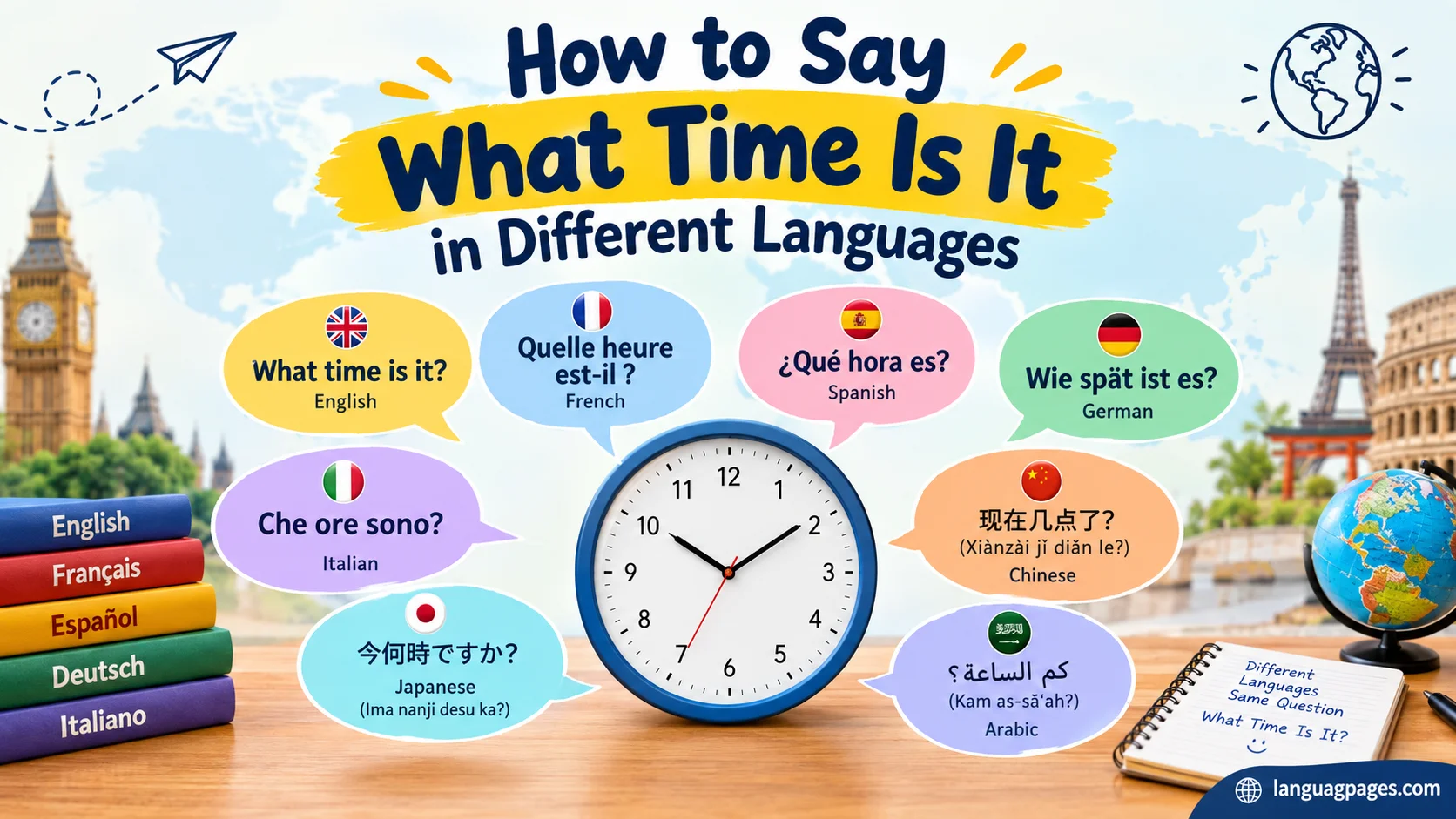
Ever noticed how a simple question can connect people instantly? What Time Is It becomes essential when traveling, coordinating plans, or navigating daily conversations across languages, cultures, and regions worldwide.
Understanding this expression goes beyond basic translation and pronunciation. It supports scheduling, time management, business communication, online booking, broadcasting, meetings, calendar planning, and project management. Learning how different languages phrase the same idea improves cultural awareness and practical communication skills in everyday and professional settings.
This article explores translations across numerous languages while highlighting English usage, grammar, and formal writing considerations. It also touches on consistency, regional preferences, and common differences between US and UK styles, helping readers choose natural, context-appropriate expressions for international communication and language learning.
Interesting Facts About What Time Is It?
- Many languages ask this question using a structure that literally means “Which hour is it?”
- Some languages use formal and informal versions depending on who is being addressed.
- In everyday conversation, speakers often shorten the question.
- Certain languages rely heavily on context and may omit words that English requires.
- Regional dialects can influence pronunciation even when the wording remains similar.
- Some writing systems use non-Latin scripts, requiring transliteration for learners.
What Does What Time Is It Mean?
“What Time Is It?” is a question used to ask for the current time.
People commonly use it when:
- Checking schedules
- Planning meetings
- Traveling
- Attending events
- Managing daily activities
The phrase is usually neutral and can be used in both casual and formal situations.
Why Can What Time Is It Have Different Translations?
A phrase rarely has one perfect translation in every language. Differences may occur because of:
- Grammar rules
- Formality levels
- Regional dialects
- Cultural conventions
- Literal versus natural wording
- Spoken and written language differences
For example, some languages ask “Which hour is it?” while others ask “What is the time?”
European Languages
Europe contains many language families and traditions. Even when the meaning remains the same, languages may use different grammatical structures and levels of formality.
| 🌍 Language | Country/Region | Translation | Pronunciation | Example Sentence |
| English | Worldwide | What time is it? | what time iz it | What time is it now? |
| American English 🇺🇸 | USA | What time is it? | same | What time is it there? |
| British English 🇬🇧 | UK | What time is it? | same | What time is it now? |
| Australian English 🇦🇺 | Australia | What time is it? | same | What time is it, mate? |
| Spanish | Spain, Latin America | ¿Qué hora es? | keh OH-rah es | ¿Qué hora es ahora? |
| French | France, Canada | Quelle heure est-il ? | kel ur eh-teel | Quelle heure est-il ? |
| German | Germany, Austria | Wie spät ist es? | vee shpate ist es | Wie spät ist es jetzt? |
| Italian | Italy | Che ora è? | kay OH-ra eh | Che ora è adesso? |
| Portuguese | Portugal, Brazil | Que horas são? | keh OR-as sow | Que horas são agora? |
| Dutch | Netherlands | Hoe laat is het? | hoo lat is hut | Hoe laat is het nu? |
| Swedish | Sweden | Vad är klockan? | va er klokan | Vad är klockan nu? |
| Norwegian | Norway | Hva er klokken? | hva er klokken | Hva er klokken nå? |
| Danish | Denmark | Hvad er klokken? | veth er klokken | Hvad er klokken nu? |
| Finnish | Finland | Mitä kello on? | mita kello on | Mitä kello on nyt? |
| Icelandic | Iceland | Hvað er klukkan? | kvath er klutlan | Hvað er klukkan núna? |
| Irish | Ireland | Cén t-am é? | kayn tam ay | Cén t-am é anois? |
| Welsh | Wales | Faint o’r gloch ydy hi? | vaynt or gloch | Faint o’r gloch ydy hi? |
| Polish | Poland | Która godzina? | kto-ra god-jina | Która godzina jest? |
| Czech | Czech Republic | Kolik je hodin? | kolik ye hodin | Kolik je hodin teď? |
| Slovak | Slovakia | Koľko je hodín? | kolko ye hodeen | Koľko je hodín? |
| Ukrainian | Ukraine | Котра година? | kotra hodyna | Котра година зараз? |
| Russian | Russia | Который час? | katoriy chas | Который сейчас час? |
| Romanian | Romania | Cât este ceasul? | kut este cheasul | Cât este ceasul acum? |
| Hungarian | Hungary | Mennyi az idő? | menyi az idoo | Mennyi az idő most? |
| Greek | Greece | Τι ώρα είναι; | ti ora ine | Τι ώρα είναι τώρα; |
Cultural Note: Many European languages use structures equivalent to “Which hour is it?” rather than a direct word-for-word translation of English.
Asian Languages
Asia contains thousands of languages and numerous writing systems. Asking for the time is a common daily expression across the continent.
| 🌍 Language | Country/Region | Translation | Pronunciation | Example Sentence |
| Mandarin Chinese | China, Taiwan | 现在几点? | xiànzài jǐ diǎn | 现在几点了? |
| Cantonese | Hong Kong | 而家幾點? | yi-ga gei dim | 而家幾點呀? |
| Japanese | Japan | 今何時ですか? | ima nanji desu ka | 今何時ですか。 |
| Korean | South Korea | 지금 몇 시예요? | jigeum myeot siyeyo | 지금 몇 시예요? |
| Hindi | India | क्या समय हुआ है? | kya samay hua hai | अभी क्या समय हुआ है? |
| Urdu | Pakistan | کیا وقت ہوا ہے؟ | kya waqt hua hai | ابھی کیا وقت ہوا ہے؟ |
| Bengali | Bangladesh, India | এখন কয়টা বাজে? | ekhon koyta baje | এখন কয়টা বাজে? |
| Punjabi | Pakistan, India | ਕੀ ਵਕਤ ਹੋਇਆ ਹੈ? | ki wakt hoya hai | ਹੁਣ ਕੀ ਵਕਤ ਹੋਇਆ ਹੈ? |
| Gujarati | India | કેટલા વાગ્યા છે? | ketla vagya che | અત્યારે કેટલા વાગ્યા છે? |
| Marathi | India | किती वाजले आहेत? | kiti vajle ahet | आता किती वाजले आहेत? |
| Tamil | India, Sri Lanka | இப்போது மணி என்ன? | ippodu mani enna | இப்போது மணி என்ன? |
| Telugu | India | ఇప్పుడు సమయం ఎంత? | ippudu samayam entha | ఇప్పుడు సమయం ఎంత? |
| Kannada | India | ಈಗ ಸಮಯ ಎಷ್ಟು? | iga samaya eshtu | ಈಗ ಸಮಯ ಎಷ್ಟು? |
| Malayalam | India | സമയം എത്രയായി? | samayam ethrayayi | സമയം എത്രയായി? |
| Nepali | Nepal | अहिले कति बज्यो? | ahile kati bajyo | अहिले कति बज्यो? |
| Sinhala | Sri Lanka | දැන් වෙලාව කීයද? | dan velava kiyeda | දැන් වෙලාව කීයද? |
| Thai | Thailand | ตอนนี้กี่โมง | ton-ni gi mong | ตอนนี้กี่โมงแล้ว |
| Vietnamese | Vietnam | Mấy giờ rồi? | may zyo roi | Bây giờ mấy giờ rồi? |
| Indonesian | Indonesia | Jam berapa sekarang? | jam berapa sekarang | Jam berapa sekarang? |
| Malay | Malaysia | Pukul berapa sekarang? | pukul berapa sekarang | Pukul berapa sekarang? |
| Filipino | Philippines | Anong oras na? | anong oras na | Anong oras na ngayon? |
| Burmese | Myanmar | ဘယ်နှနာရီရှိပြီလဲ | be hna yi shi bi le | ဘယ်နှနာရီရှိပြီလဲ |
| Khmer | Cambodia | ម៉ោងប៉ុន្មានហើយ? | maong ponman | ម៉ោងប៉ុន្មានហើយ? |
| Lao | Laos | ຈັກໂມງແລ້ວ? | jak mong leo | ຈັກໂມງແລ້ວ? |
| Mongolian | Mongolia | Хэдэн цаг вэ? | heden tsag ve | Хэдэн цаг вэ? |
| Kazakh | Kazakhstan | Сағат қанша? | sagat kansha | Қазір сағат қанша? |
| Uzbek | Uzbekistan | Soat necha bo‘ldi? | soat necha boldy | Hozir soat necha? |
Cultural Note: In several Asian languages, the phrase often translates more literally as “How many hours?” or “Which hour?”
African Languages
Africa is home to remarkable linguistic diversity. The same concept may be expressed differently even within neighboring regions.
| 🌍 Language | Country/Region | Translation | Pronunciation |
| Swahili | East Africa | Saa ngapi? | saa ngapi |
| Afrikaans | South Africa | Hoe laat is dit? | hoo laat is dit |
| Zulu | South Africa | Yisikhathi sini? | yi-sikati sini |
| Xhosa | South Africa | Lixesha lini? | li-kesha lini |
| Amharic | Ethiopia | ስንት ሰዓት ነው? | sint seat new |
| Yoruba | Nigeria | Ago melo ni? | ago melo ni |
| Igbo | Nigeria | Oge ole ka ọ bụ? | oge ole ka o bu |
| Hausa | West Africa | Karfe nawa ne? | karfe nawa ne |
| Somali | Somalia | Saacaddu waa imisa? | saacadu waa imisa |
| Shona | Zimbabwe | Nguva dzani? | nguva dzani |
| Sesotho | Lesotho | Ke nako mang? | ke nako mang |
| Setswana | Botswana | Ke nako mang? | ke nako mang |
| Kinyarwanda | Rwanda | Ni saa zingahe? | ni saa zingahe |
| Malagasy | Madagascar | Amin’ny firy izao? | amin firy izao |
Middle Eastern Languages
The Middle East includes several major language traditions. Usage can differ between standard and regional forms.
| 🌍 Language | Country/Region | Translation | Pronunciation |
| Arabic (MSA) | Middle East | كم الساعة؟ | kam as-sa’ah |
| Persian | Iran | ساعت چند است؟ | saat chand ast |
| Hebrew | Israel | מה השעה? | ma ha-sha’a |
| Kurdish | Iraq, Türkiye | Dem çend e? | dem chend e |
| Turkish | Türkiye | Saat kaç? | saat kach |
| Armenian | Armenia | Ժամը քանի՞սն է | zhame kani sn e |
Cultural Note: Arabic dialects may use slightly different wording, although كم الساعة؟ is widely understood in formal contexts.
Other World Languages
| 🌍 Language | Region | Translation | Pronunciation |
| Māori | New Zealand | He aha te wā? | he aha te waa |
| Samoan | Samoa | O le ā le taimi? | o le aa le taimi |
| Tongan | Tonga | Ko e hā e taimi? | ko e haa e taimi |
| Hawaiian | Hawaii | He aha ka manawa? | he aha ka manawa |
| Haitian Creole | Haiti | Ki lè li ye? | ki leh li ye |
| Esperanto | International | Kioma horo estas? | kioma horo estas |
| Guarani | Paraguay | Mba’e aravo pa? | mbae aravo pa |
| Quechua | Andes | Ima hora kashan? | ima hora kashan |
Quick Reference: What Time Is It in Different Languages
| Language | Translation |
| Spanish | ¿Qué hora es? |
| French | Quelle heure est-il ? |
| German | Wie spät ist es? |
| Italian | Che ora è? |
| Portuguese | Que horas são? |
| Russian | Который час? |
| Mandarin Chinese | 现在几点? |
| Japanese | 今何時ですか? |
| Korean | 지금 몇 시예요? |
| Hindi | क्या时间 हुआ है? |
| Urdu | کیا وقت ہوا ہے؟ |
| Arabic | كم الساعة؟ |
| Turkish | Saat kaç? |
| Swahili | Saa ngapi? |
| Hebrew | מה השעה? |
| Persian | ساعت چند است؟ |
How to Choose the Right Translation
The best translation depends on:
- Context
- Formality
- Region
- Audience
- Relationship between speakers
- Spoken or written communication
When speaking with native speakers, choose the version commonly used in that region rather than relying solely on a literal translation.
Common Mistakes When Translating What Time Is It?
- Translating each word separately.
- Ignoring regional differences.
- Using formal wording in casual situations.
- Assuming one version works everywhere.
- Mispronouncing key words.
- Mixing dialects and standard forms.
- Using machine-translated phrases without context.
Why Learn What Time Is It in Different Languages?
Learning this expression helps you:
- Communicate during travel.
- Build everyday vocabulary.
- Understand cultural differences.
- Improve listening skills.
- Feel more confident in conversations.
- Connect with speakers of other languages.
- Develop broader cross-cultural awareness.
FAQs:
How do you say “What Time Is It?” in Spanish?
How do you say it in French?
Is a literal translation always correct?
No. Natural usage is often more important than literal wording.
Can translations vary by country?
Yes. Regional preferences may influence wording and pronunciation.
Why do some languages ask “Which hour is it?”
That structure is simply the natural grammatical form in those languages.
Does pronunciation change between regions?
Yes. Accents and dialects can affect pronunciation.
Can I use these phrases while traveling?
Yes. They are common everyday expressions.
Which languages use non-Latin scripts?
Examples include Arabic, Chinese, Japanese, Korean, Hindi, Urdu, Russian, and Greek.
Are formal and informal versions different?
In some languages, yes. Context determines the best choice.
Does learning common phrases improve language skills?
Yes. Everyday expressions provide practical vocabulary and cultural insight.
Conclusion:
What Time Is It is more than a simple question; it helps people communicate effectively, manage schedules, and navigate daily situations across languages, cultures, regions, and diverse social settings worldwide.
Learning this expression in different languages builds communication skills, improves cultural understanding, and strengthens language learning. Paying attention to pronunciation, regional variation, and context helps ensure more natural conversations while making international interactions smoother, clearer, and more meaningful.