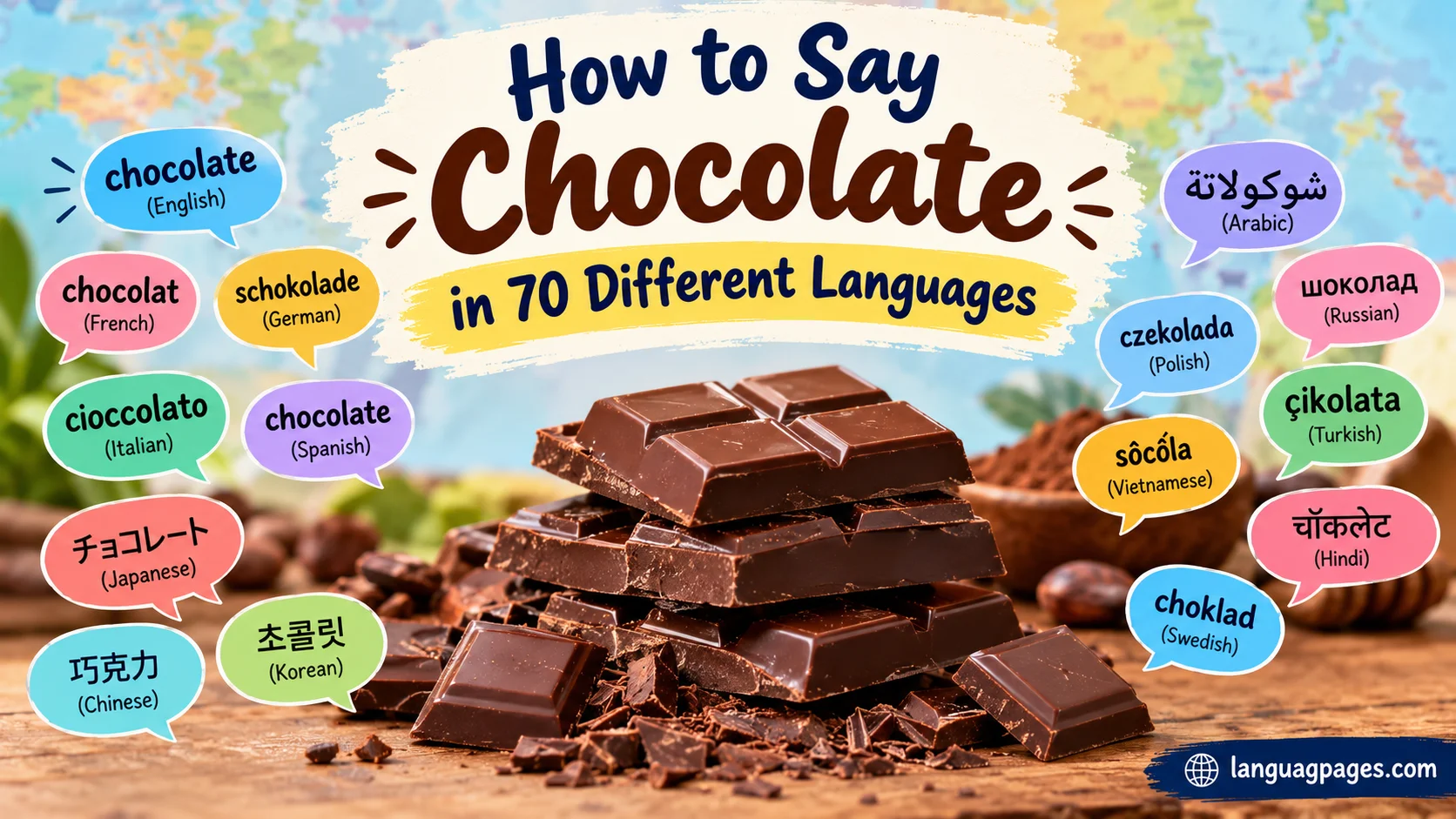
Chocolate is more than a sweet treat; it is a familiar word that connects food, culture, and everyday conversation. Learning how to say chocolate in 70 different languages helps you explore international vocabulary and discover how people express this delicious favorite.
Understanding chocolate translations, pronunciation, and regional vocabulary can make language learning more enjoyable and practical. Whether you’re traveling, reading menus, shopping abroad, or chatting with international friends, knowing the right foreign language words can improve communication. Exploring spelling differences, borrowed words, and cultural expressions also reveals how languages adapt familiar foods while preserving their unique sounds and grammatical patterns.
In this article, you’ll discover chocolate in different languages, including European, Asian, African, and Middle Eastern translations. Each entry introduces the native word, an easy pronunciation guide, and a useful example sentence with its English meaning. You’ll also explore regional variations, writing systems, and common translation mistakes to help you use the vocabulary naturally. Continue reading to expand your multilingual knowledge and enjoy learning this familiar word across cultures.
Interesting Facts About Chocolate
- Chocolate is an international word: Many languages use forms resembling chocolate, although spelling and pronunciation differ.
- Borrowed vocabulary is common: Words for familiar foods often travel between languages through trade, cultural contact, and changing food traditions.
- Writing systems affect spelling: Chinese, Japanese, Korean, Arabic, and other languages may represent chocolate using their own scripts.
- Pronunciation isn’t universal: The same or similar spelling can sound different in Spanish, French, German, and English.
- Chocolate and cocoa are different concepts: Chocolate generally refers to the prepared food, while cocoa can refer to the powder or ingredients used to make it.
- Hot chocolate has its own name: Many languages distinguish a chocolate drink from solid chocolate.
- Context matters: A word used for a chocolate bar may also refer to chocolate as an ingredient, but some expressions are more specific.
What Does Chocolate Mean?
Chocolate is a sweet food typically made from ingredients derived from cacao beans, often combined with sugar and, in many varieties, milk. It appears in bars, desserts, drinks, sauces, and confectionery.
The word can describe chocolate as a general food, a particular piece of chocolate, or an ingredient in a recipe. Its precise meaning depends on context. For example, asking for chocolate in a shop differs from ordering a cup of hot chocolate in a café.
When translating the word, the goal is usually to identify the natural everyday term rather than translate its historical origin or individual sounds. Most examples below use the ordinary word for chocolate as a food or ingredient.
Why Can Chocolate Have Different Translations?
Languages adapt borrowed words to their spelling rules, sounds, and grammatical patterns. As a result, translations may look similar without being pronounced identically.
- Spelling: A language may use a different alphabet or writing system.
- Pronunciation: Sounds that exist in one language may be unfamiliar in another.
- Grammar: Some languages change nouns according to grammatical gender, number, or case.
- Regional variation: Local vocabulary and pronunciation may differ between countries.
- Context: Chocolate as a food, a drink, or a flavor may require a more specific expression.
For everyday conversation, learning the standard word is a useful starting point. If you’re ordering a specific product, you may need an additional word such as bar, cake, drink, or dark.
European Languages
Europe has many language families, including Romance, Germanic, Slavic, and Uralic languages. Words for chocolate often resemble one another, but spelling, stress, and pronunciation differ. The following examples use common forms for chocolate as a food.
| 🌍 Language | Country/Region | Translation | Pronunciation | Example Sentence |
| American English 🇺🇸 | United States | Chocolate | CHAWK-lit | I love chocolate. |
| British English 🇬🇧 | United Kingdom | Chocolate | CHOK-lit | I love chocolate. |
| Australian English 🇦🇺 | Australia | Chocolate | CHOK-lit | I love chocolate. |
| Spanish 🇪🇸 | Spain, Latin America | Chocolate | cho-ko-LAH-teh | Me gusta el chocolate. — I like chocolate. |
| French 🇫🇷 | France, parts of Europe and Africa | Chocolat | sho-ko-LAH | J’aime le chocolat. — I love chocolate. |
| German 🇩🇪 | Germany, Austria, Switzerland | Schokolade | sho-ko-LAH-duh | Ich mag Schokolade. — I like chocolate. |
| Italian 🇮🇹 | Italy, Switzerland | Cioccolato | chok-ko-LAH-toh | Mi piace il cioccolato. — I like chocolate. |
| Portuguese 🇵🇹 | Portugal, Brazil | Chocolate | sho-ko-LAH-tuh; Brazilian final sound often resembles “chee” | Eu gosto de chocolate. — I like chocolate. |
| Dutch 🇳🇱 | Netherlands, Belgium | Chocolade | sho-ko-LAH-duh | Ik hou van chocolade. — I love chocolate. |
| Swedish 🇸🇪 | Sweden, Finland | Choklad | approximately SHOOK-lahd | Jag gillar choklad. — I like chocolate. |
| Norwegian 🇳🇴 | Norway | Sjokolade | shoo-kuh-LAH-duh | Jeg liker sjokolade. — I like chocolate. |
| Danish 🇩🇰 | Denmark | Chokolade | ko-ko-LAH-thuh, approximately | Jeg kan lide chokolade. — I like chocolate. |
| Finnish 🇫🇮 | Finland | Suklaa | SOOK-laa | Pidän suklaasta. — I like chocolate. |
| Icelandic 🇮🇸 | Iceland | Súkkulaði | SOOK-oo-lath-ee, approximately | Mér finnst súkkulaði gott. — I like chocolate. |
| Irish 🇮🇪 | Ireland | Seacláid | shak-LAWJ | Is maith liom seacláid. — I like chocolate. |
| Welsh 🏴 | Wales | Siocled | SHOK-led | Dw i’n hoffi siocled. — I like chocolate. |
| Polish 🇵🇱 | Poland | Czekolada | cheh-koh-LAH-dah | Lubię czekoladę. — I like chocolate. |
| Czech 🇨🇿 | Czechia | Čokoláda | cho-ko-LAA-dah | Mám rád čokoládu. — I like chocolate. |
| Slovak 🇸🇰 | Slovakia | Čokoláda | cho-ko-LAA-dah | Mám rád čokoládu. — I like chocolate. |
| Ukrainian 🇺🇦 | Ukraine | Шоколад | shoh-ko-LAHD | Я люблю шоколад. — I love chocolate. |
| Russian 🇷🇺 | Russia and other Russian-speaking communities | Шоколад | shuh-kuh-LAHT | Я люблю шоколад. — I love chocolate. |
| Romanian 🇷🇴 | Romania, Moldova | Ciocolată | cho-ko-LAH-tuh | Îmi place ciocolata. — I like chocolate. |
| Hungarian 🇭🇺 | Hungary | Csokoládé | cho-ko-LAA-day | Szeretem a csokoládét. — I like chocolate. |
| Greek 🇬🇷 | Greece, Cyprus | Σοκολάτα | so-ko-LAH-tah | Μου αρέσει η σοκολάτα. — I like chocolate. |
| Bulgarian 🇧🇬 | Bulgaria | Шоколад | sho-ko-LAHT | Обичам шоколад. — I love chocolate. |
| Croatian 🇭🇷 | Croatia | Čokolada | cho-ko-LAH-dah | Volim čokoladu. — I love chocolate. |
| Serbian 🇷🇸 | Serbia and neighboring communities | Чоколада | cho-ko-LAH-dah | Волим чоколаду. — I love chocolate. |
| Slovenian 🇸🇮 | Slovenia | Čokolada | cho-ko-LAH-dah | Rad imam čokolado. — I like chocolate. |
| Lithuanian 🇱🇹 | Lithuania | Šokoladas | shoh-koh-LAH-dahs | Aš mėgstu šokoladą. — I like chocolate. |
| Latvian 🇱🇻 | Latvia | Šokolāde | shoh-koh-LAA-deh | Man garšo šokolāde. — I like chocolate. |
| Estonian 🇪🇪 | Estonia | Šokolaad | SHOH-ko-laad | Mulle meeldib šokolaad. — I like chocolate. |
| Albanian 🇦🇱 | Albania, Kosovo | Çokollatë | cho-koh-LAH-tuh | Më pëlqen çokollata. — I like chocolate. |
| Basque | Basque Country, Spain and France | Txokolate | cho-ko-LAH-teh | Txokolatea gustatzen zait. — I like chocolate. |
English Varieties: What Changes?
American, British, and Australian English all use chocolate. The spelling is the same, and the basic meaning does not change. However, accents can affect the vowel sounds and the way speakers pronounce the unstressed middle syllable. You do not need to memorize three different words.
Cultural note: In French, chocolat has a silent final t. In German, Schokolade has more syllables than English chocolate. Paying attention to these small differences makes speaking more natural.
Asian Languages
Asia includes a wide range of language families, scripts, and sound systems. Some languages use borrowed forms of the word, while others adapt it to their own writing conventions. Pronunciation guides below are approximate; tone marks and recognized romanization systems are included where useful.
| 🌍 Language | Country/Region | Translation | Pronunciation | Example Sentence |
| Mandarin Chinese 🇨🇳 | China, Taiwan, Singapore | 巧克力 | qiǎokèlì | 我喜欢巧克力。 — I like chocolate. |
| Cantonese | Hong Kong, Guangdong | 朱古力 | zyu1 gu2 lik6 (Jyutping) | 我鍾意朱古力。 — I like chocolate. |
| Japanese 🇯🇵 | Japan | チョコレート | chokorēto | チョコレートが好きです。 — I like chocolate. |
| Korean 🇰🇷 | Korea | 초콜릿 | chokollit | 저는 초콜릿을 좋아해요. — I like chocolate. |
| Hindi 🇮🇳 | India | चॉकलेट | chॉकलेट, approximately chok-let | मुझे चॉकलेट पसंद है। — I like chocolate. |
| Urdu 🇵🇰 | Pakistan, India | چاکلیٹ | chok-let | مجھے چاکلیٹ پسند ہے۔ — I like chocolate. |
| Bengali 🇧🇩 | Bangladesh, India | চকোলেট | cho-ko-let | আমি চকোলেট পছন্দ করি। — I like chocolate. |
| Punjabi | Pakistan, India | ਚਾਕਲੇਟ / چاکلیٹ | chaak-let | ਮੈਨੂੰ ਚਾਕਲੇਟ ਪਸੰਦ ਹੈ। — I like chocolate. |
| Gujarati 🇮🇳 | India | ચોકલેટ | chok-let | મને ચોકલેટ ગમે છે. — I like chocolate. |
| Marathi 🇮🇳 | India | चॉकलेट | chok-let | मला चॉकलेट आवडते. — I like chocolate. |
| Tamil 🇮🇳 | India, Sri Lanka | சாக்லேட் | saak-layt | எனக்கு சாக்லேட் பிடிக்கும். — I like chocolate. |
| Telugu 🇮🇳 | India | చాక్లెట్ | chaak-let | నాకు చాక్లెట్ ఇష్టం. — I like chocolate. |
| Kannada 🇮🇳 | India | ಚಾಕೊಲೇಟ್ | chaa-ko-layt | ನನಗೆ ಚಾಕೊಲೇಟ್ ಇಷ್ಟ. — I like chocolate. |
| Malayalam 🇮🇳 | India | ചോക്ലേറ്റ് | chok-layt | എനിക്ക് ചോക്ലേറ്റ് ഇഷ്ടമാണ്. — I like chocolate. |
| Nepali 🇳🇵 | Nepal | चकलेट | cha-ko-let | मलाई चकलेट मन पर्छ। — I like chocolate. |
| Sinhala 🇱🇰 | Sri Lanka | චොකලට් | cho-ko-lat | මම චොකලට්වලට කැමතියි. — I like chocolate. |
| Thai 🇹🇭 | Thailand | ช็อกโกแลต | chok-ko-laet | ฉันชอบช็อกโกแลต — I like chocolate. |
| Vietnamese 🇻🇳 | Vietnam | Sô cô la | soh koh lah | Tôi thích sô cô la. — I like chocolate. |
| Indonesian 🇮🇩 | Indonesia | Cokelat | cho-ke-lat | Saya suka cokelat. — I like chocolate. |
| Malay 🇲🇾 | Malaysia, Brunei, Singapore | Coklat | chok-lat | Saya suka coklat. — I like chocolate. |
| Filipino/Tagalog 🇵🇭 | Philippines | Tsokolate | tso-ko-LAH-teh | Gusto ko ang tsokolate. — I like chocolate. |
| Burmese 🇲🇲 | Myanmar | ချောကလက် | approximately chау-ka-let | ချောကလက်ကို ကြိုက်တယ်။ — I like chocolate. |
| Khmer 🇰🇭 | Cambodia | សូកូឡា | so-ko-laa | ខ្ញុំចូលចិត្តសូកូឡា។ — I like chocolate. |
| Lao 🇱🇦 | Laos | ຊັອກໂກແລັດ | approximately sok-ko-laet | ຂ້ອຍມັກຊັອກໂກແລັດ. — I like chocolate. |
| Mongolian 🇲🇳 | Mongolia | Шоколад | sho-ko-laad | Би шоколаданд дуртай. — I like chocolate. |
| Kazakh 🇰🇿 | Kazakhstan | Шоколад | sho-ko-LAHD | Мен шоколадты жақсы көремін. — I like chocolate. |
| Uzbek 🇺🇿 | Uzbekistan | Shokolad | sho-ko-LAD | Men shokoladni yaxshi ko‘raman. — I like chocolate. |
Cultural note: Mandarin uses the characters 巧克力, while Japanese generally writes the borrowed word in katakana as チョコレート. Cantonese uses 朱古力, a different written form. These distinctions matter even when the food is the same.
In South Asia, chocolate is often represented by a borrowed word written in the local script. Everyday pronunciation may vary, and the examples above are practical starting points rather than a substitute for listening to local speakers.
African Languages
Africa’s languages belong to several distinct language families, and many are spoken across national borders. Chocolate vocabulary often reflects borrowed international food terms adapted to local spelling and pronunciation. These examples represent particular languages and communities, not the whole continent.
| 🌍 Language | Country/Region | Translation | Pronunciation | Example Sentence |
| Swahili 🇹🇿 | Tanzania, Kenya, East Africa | Chokoleti | cho-ko-LEH-tee | Ninapenda chokoleti. — I like chocolate. |
| Afrikaans 🇿🇦 | South Africa, Namibia | Sjokolade | sho-ko-LAH-duh | Ek hou van sjokolade. — I like chocolate. |
| Zulu 🇿🇦 | South Africa | Ushokoledi | oo-sho-ko-LEH-dee | Ngiyawuthanda ushokoledi. — I like chocolate. |
| Xhosa 🇿🇦 | South Africa | Itshokolethi | ee-tsho-ko-LEH-tee | Ndiyayithanda itshokolethi. — I like chocolate. |
| Amharic 🇪🇹 | Ethiopia | ቸኮሌት | che-ko-let | ቸኮሌት እወዳለሁ። — I like chocolate. |
| Yoruba 🇳🇬 | Nigeria, Benin | Ṣokoláti | sho-ko-LAH-tee | Mo fẹ́ràn ṣokoláti. — I like chocolate. |
| Igbo 🇳🇬 | Nigeria | Chocolate | approximately CHAWK-lit | Chocolate na-atọ m ụtọ. — Chocolate tastes good to me. |
| Hausa 🇳🇬 | Nigeria, Niger, West Africa | Cakulan | cha-koo-lan | Ina son cakulan. — I like chocolate. |
| Somali 🇸🇴 | Somalia, Horn of Africa | Shukulaato | shoo-koo-LAA-toh | Waxaan jeclahay shukulaato. — I like chocolate. |
| Shona 🇿🇼 | Zimbabwe | Chokoreti | cho-ko-REH-tee | Ndinoda chokoreti. — I like chocolate. |
| Sesotho 🇱🇸 | Lesotho, South Africa | Tsokolate | tso-ko-LAH-teh | Ke rata tsokolate. — I like chocolate. |
| Malagasy 🇲🇬 | Madagascar | Sôkôla | SOO-koo-lah, approximately | Tiako ny sôkôla. — I like chocolate. |
Cultural note: Some languages use a word closely related to international chocolate, while others have adapted its sounds more noticeably. In Zulu and Xhosa, the noun forms follow the sound and noun-class patterns of their respective languages. Avoid treating similar-looking words as proof that two languages share the same grammar.
Middle Eastern Languages
The Middle East includes Arabic, Persian, Hebrew, Kurdish, Turkish, and Armenian, among other languages. These languages have different grammatical structures and writing systems, and everyday vocabulary may vary between regions.
| 🌍 Language | Country/Region | Translation | Pronunciation | Example Sentence |
| Modern Standard Arabic 🇸🇦 | Arabic-speaking countries | شوكولاتة | shaw-kuh-LAA-tah | أحب الشوكولاتة. — I like chocolate. |
| Persian (Farsi) 🇮🇷 | Iran and Persian-speaking communities | شکلات | shek-o-LAAT | من شکلات دوست دارم. — I like chocolate. |
| Hebrew 🇮🇱 | Israel | שוקולד | sho-ko-LAHD | אני אוהב שוקולד. — I like chocolate. |
| Kurdish (Kurmanji) | Kurdish-speaking communities in Türkiye, Syria, Iraq, and elsewhere | Çîkolata | chee-ko-LAH-ta, approximately | Ez çîkolata hez dikim. — I like chocolate. |
| Turkish 🇹🇷 | Türkiye, neighboring communities | Çikolata | chi-ko-LAH-ta | Çikolatayı severim. — I like chocolate. |
| Armenian 🇦🇲 | Armenia and Armenian-speaking communities | Շոկոլադ | sho-ko-LAD | Ես շոկոլադ եմ սիրում։ — I like chocolate. |
Important distinction: Modern Standard Arabic is useful in formal writing and many educational contexts, but spoken Arabic differs considerably by region. The word shown here is widely recognizable, while its pronunciation and the wording of a complete sentence may vary between dialects.
Hebrew also changes some sentence forms according to the speaker’s gender. For example, אני אוהב שוקולד uses a masculine form of “I like/love,” while אני אוהבת שוקולד uses the feminine form.
How to Choose the Right Translation
The best translation depends on where you’re speaking, what you’re discussing, and who you’re talking to. For everyday conversations, start with the standard word for chocolate in the language you’re learning.
Here are five practical tips:
- Check the region: Portuguese is spoken in Portugal and Brazil, but pronunciation differs between them.
- Learn the writing system: Practice reading the native spelling alongside the romanized form.
- Use the right food term: Chocolate, cocoa powder, and hot chocolate aren’t always interchangeable.
- Practice a complete sentence: Saying I like chocolate helps you learn how the noun works in context.
- Listen to local pronunciation: Written guides are helpful, but listening to reliable audio can reveal sounds that English spelling cannot represent accurately.
If you’re ordering chocolate while traveling, a short, polite sentence is often more useful than memorizing the word alone.
Common Mistakes When Translating Chocolate
Learning food vocabulary is straightforward, but a few mistakes can make your speech less natural.
- Assuming similar spelling means identical pronunciation: French chocolat and English chocolate look alike, but they sound different.
- Confusing chocolate with cocoa: Cocoa may refer to powder or a drink, depending on context.
- Ignoring grammatical endings: Some languages change a noun when it appears in a sentence.
- Mixing regional forms: Cantonese and Mandarin, for example, use different words for chocolate.
- Relying only on English-style pronunciation: This can obscure tones, vowel length, or unfamiliar consonants.
- Treating one dialect as universal: Arabic pronunciation and everyday speech vary by region.
Learning tip: Memorize the native spelling, practice the pronunciation, and then use the word in a simple sentence. This approach helps you remember both its meaning and its natural usage.
Why Learn Chocolate in Different Languages?
Learning food vocabulary is a practical way to build confidence in a new language. The word chocolate is especially useful because it appears in menus, supermarkets, bakeries, recipes, and everyday conversations.
Knowing the translation can help you ask questions about desserts, describe your preferences, and understand product labels when traveling. It also gives you an easy starting point for learning related words, such as sweet, dark chocolate, milk chocolate, candy, and hot chocolate.
Comparing translations can also introduce you to different writing systems and pronunciation patterns. You may notice that some languages borrow a recognizable form of the word while others adapt it to their own spelling conventions.
Most importantly, learning a few words in another language shows a willingness to communicate thoughtfully. Even a small vocabulary can make an interaction more enjoyable when you take the time to pronounce words carefully and respect local language differences.
FAQs:
How do you say chocolate in different languages?
Chocolate is chocolate in Spanish, chocolat in French, Schokolade in German, cioccolato in Italian, and suklaa in Finnish. Other languages use different spellings and scripts.
What is the most natural translation of chocolate?
The natural translation depends on the language. For example, French uses chocolat, Japanese uses チョコレート, and Mandarin Chinese uses 巧克力.
Can the word for chocolate change by country?
Yes. Regional vocabulary and pronunciation can differ, even when people speak the same language. Portuguese pronunciation, for example, varies between Brazil and Portugal.
Why do some languages have similar words for chocolate?
Many languages adopted related forms of the word through historical contact and the spread of chocolate as a food. Similar spelling does not necessarily mean identical pronunciation.
Does chocolate pronunciation change between regions?
Yes. Accents can affect vowel sounds, stress, and syllable timing. Local pronunciation may also differ from a simplified English pronunciation guide.
How can I pronounce chocolate correctly?
Start with the native spelling and the pronunciation guide for your chosen language. Then listen to audio from reliable language-learning resources and practice the word in a complete sentence.
Is a literal translation always accurate?
No. A borrowed food name may have an established local form, and translating its sounds or individual letters directly can produce an incorrect result. Use the accepted word for the food in the target language.
Which languages use a different writing system for chocolate?
Mandarin Chinese, Japanese, Korean, Hindi, Urdu, Arabic, Greek, and several other languages use writing systems different from the English alphabet. Learning the native script alongside romanization can help you recognize the word.
Can I use these translations in a message or conversation?
Yes. Most of the listed words are suitable for ordinary conversations about food. For more specific requests, such as ordering a chocolate cake or asking for hot chocolate, learn the complete phrase.
Is chocolate the same word in American and British English?
Yes. Both use chocolate with the same spelling and meaning. The main differences are related to accent and pronunciation rather than vocabulary.
What is the difference between chocolate and hot chocolate?
Chocolate usually refers to the food or ingredient, while hot chocolate refers to a warm chocolate drink. Many languages use a separate expression for the drink.
How can learning food words improve my language skills?
Food vocabulary helps you practice pronunciation, sentence structure, and everyday conversation. It is also useful when traveling, reading menus, shopping, and speaking with people from other cultures.
Conclusion:
Learning How to Say Chocolate in 70 Different Languages helps you explore global vocabulary, improve pronunciation, and understand how different cultures express familiar foods through their unique languages and traditions.
Keep practicing these translations, learning native pronunciations, and exploring regional differences. Understanding language variations, cultural expressions, and everyday vocabulary can make conversations more enjoyable. Every new word brings you closer to appreciating the world’s rich linguistic diversity.