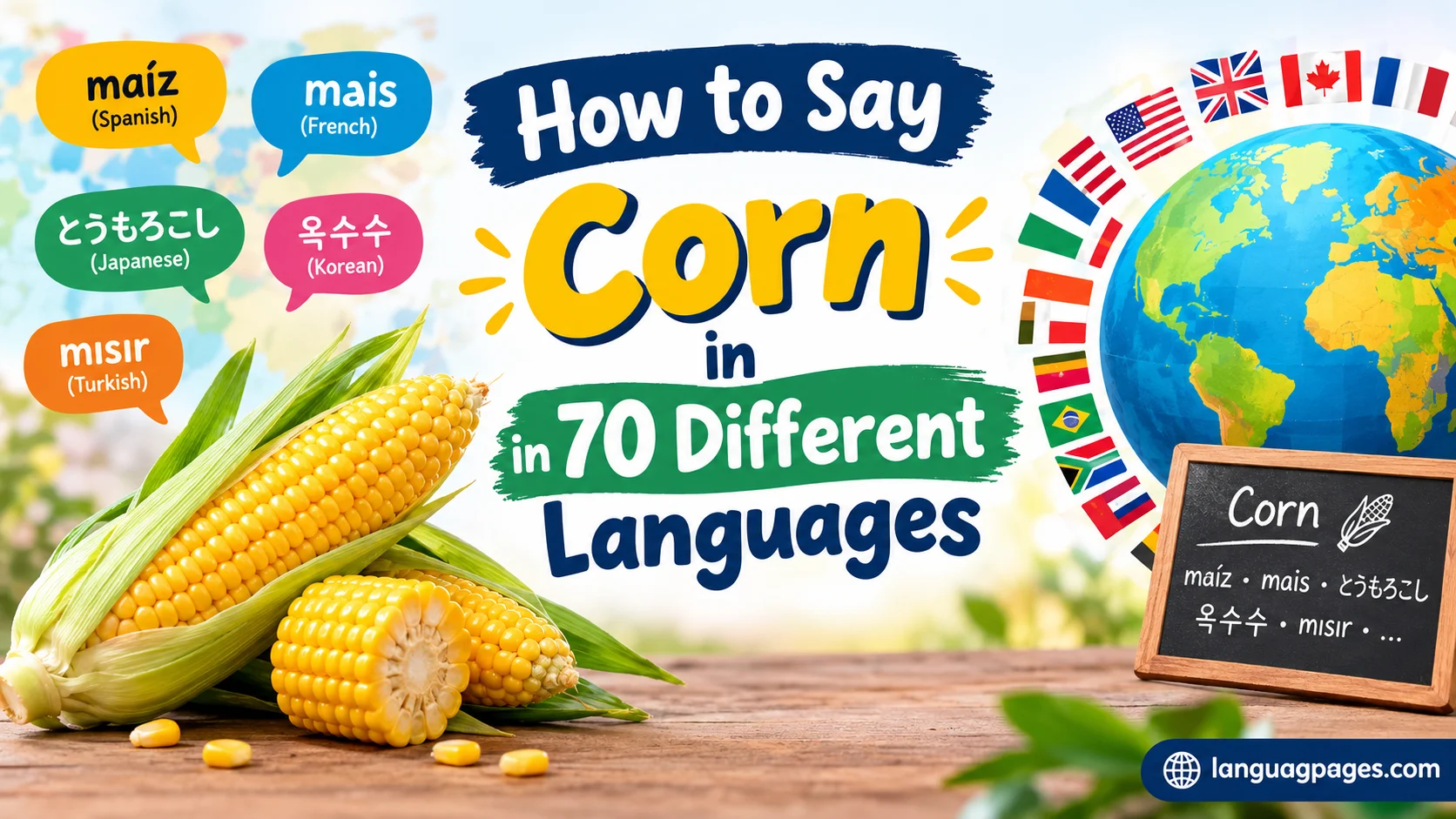
Corn is a familiar crop found in meals across the world, but its name changes from one language to another. How to Say Corn in 70 Different Languages explores these translations and helps you discover how people describe this versatile food across cultures.
Learning corn vocabulary, pronunciation, and regional expressions can make conversations about cooking, shopping, and traditional dishes more meaningful. From maíz in Spanish to milho in Portuguese, different languages offer useful words for discussing maize. Understanding these language differences, word meanings, and regional variations also helps you avoid confusion when reading recipes or exploring international cuisines with friends and family.
In this article, you’ll discover corn translations in different languages, including European, Asian, African, and Middle Eastern examples. You’ll also explore pronunciation guides, native writing systems, regional vocabulary, and simple example sentences that demonstrate everyday usage. Whether you’re a traveler, student, or curious language learner, these practical expressions will help you expand your multilingual vocabulary and appreciate the cultural connections behind familiar foods.
Interesting Facts About Corn
- Corn and maize can mean the same crop: American English commonly uses corn, while maize is widely used internationally and in scientific contexts.
- British English has a broader meaning: Depending on context, corn may refer to wheat, oats, or other cereal grains rather than maize specifically.
- Corn is central to many cuisines: Maize is used to make tortillas, polenta, cornbread, porridge, and numerous regional foods.
- Translations depend on the product: A language may distinguish fresh corn, dried kernels, cornmeal, and popcorn with separate words.
- Writing systems differ: Some languages write the word using Latin letters, while others use Chinese characters, Devanagari, Arabic script, or other systems.
- Regional vocabulary matters: Spanish speakers may use maíz for maize, while elote is common for fresh corn on the cob in Mexico.
- Pronunciation is not universal: Even when two languages share similar spellings, their vowel sounds and stress patterns may differ.
What Does Corn Mean?
Corn most commonly refers to maize, a cereal crop that produces edible kernels on an ear. People eat it fresh, dried, ground into flour, or processed into foods such as popcorn and cornmeal.
The word’s meaning depends on the variety of English being used. In the United States, corn normally means maize. In the United Kingdom, the term can also describe grain crops more generally, although maize is understood when the context makes it clear.
When learning another language, decide whether you mean the maize plant, the kernels, fresh corn on the cob, or a prepared product. This small distinction can help you choose a more natural translation.
Why Can Corn Have Different Translations?
Languages organize food vocabulary in different ways. One language may use a single word for maize, while another distinguishes the plant from its edible kernels or cooked forms.
Context is especially important. Asking for corn at a market is different from discussing corn cultivation or ordering popcorn at a cinema. Regional vocabulary can also change the preferred term.
Formality usually matters less for a basic food name than it does for greetings or personal expressions. However, dialect, local food traditions, grammatical gender, and pronunciation can still affect how a word is used in a sentence.
The translations below generally refer to maize. Where a term has a narrower meaning, a regional variation, or a possible ambiguity, a note helps explain it.
European Languages
European languages belong to several language families, including Germanic, Romance, and Slavic. Although some words for maize look similar, pronunciation and grammatical forms can differ. The examples below use natural sentences about eating or buying corn.
| 🌍 Language | Country/Region | Translation | Pronunciation | Example sentence |
| English (US) 🇺🇸 | United States | Corn | korn | I like sweet corn. |
| British English 🇬🇧 | United Kingdom | Maize / sweetcorn | mayz / sweet-korn | I bought some sweetcorn. |
| Australian English 🇦🇺 | Australia | Corn | korn | We cooked corn for dinner. |
| Spanish 🇪🇸 | Spain, Latin America | Maíz | mah-EES | Me gusta el maíz. — I like corn. |
| French 🇫🇷 | France, parts of Canada | Maïs | mah-EES | J’aime le maïs. — I like corn. |
| German 🇩🇪 | Germany, Austria | Mais | mice | Ich esse gern Mais. — I enjoy eating corn. |
| Italian 🇮🇹 | Italy, Switzerland | Mais | mah-EES | Mi piace il mais. — I like corn. |
| Portuguese 🇵🇹 | Portugal, Brazil | Milho | MEEL-yoo | Gosto de milho. — I like corn. |
| Dutch 🇳🇱 | Netherlands, Belgium | Maïs | mahys | Ik eet graag maïs. — I like eating corn. |
| Swedish 🇸🇪 | Sweden, Finland | Majs | myce | Jag tycker om majs. — I like corn. |
| Norwegian 🇳🇴 | Norway | Mais | mice | Jeg liker mais. — I like corn. |
| Danish 🇩🇰 | Denmark | Majs | myce | Jeg kan godt lide majs. — I like corn. |
| Finnish 🇫🇮 | Finland | Maissi | MAI-see | Pidän maissista. — I like corn. |
| Icelandic 🇮🇸 | Iceland | Maís | mah-ees | Mér finnst maís gott. — I think corn tastes good. |
| Irish 🇮🇪 | Ireland | Arbhar | AR-wer | Is maith liom arbhar. — I like corn. |
| Welsh 🏴 | Wales | Indrawn | in-DROWN | Dw i’n hoffi indrawn. — I like sweetcorn. |
| Polish 🇵🇱 | Poland | Kukurydza | koo-koo-RIH-dzah | Lubię kukurydzę. — I like corn. |
| Czech 🇨🇿 | Czechia | Kukuřice | koo-koo-RZHIT-seh | Mám rád kukuřici. — I like corn. |
| Slovak 🇸🇰 | Slovakia | Kukurica | koo-koo-REET-sah | Mám rád kukuricu. — I like corn. |
| Ukrainian 🇺🇦 | Ukraine | Кукурудза | koo-koo-ROOD-zah | Я люблю кукурудзу. — I like corn. |
| Russian 🇷🇺 | Russia, neighboring regions | Кукуруза | koo-koo-ROO-zah | Я люблю кукурузу. — I like corn. |
| Romanian 🇷🇴 | Romania, Moldova | Porumb | poh-ROOMB | Îmi place porumbul. — I like corn. |
| Hungarian 🇭🇺 | Hungary | Kukorica | koo-koh-ree-tsah | Szeretem a kukoricát. — I like corn. |
| Greek 🇬🇷 | Greece, Cyprus | Καλαμπόκι | kah-lahm-BOH-kee | Μου αρέσει το καλαμπόκι. — I like corn. |
| Bulgarian 🇧🇬 | Bulgaria | Царевица | tsah-reh-VEE-tsah | Обичам царевица. — I like corn. |
| Croatian 🇭🇷 | Croatia | Kukuruz | koo-koo-ROOZ | Volim kukuruz. — I like corn. |
| Serbian 🇷🇸 | Serbia, neighboring regions | Кукуруз | koo-koo-ROOZ | Волим кукуруз. — I like corn. |
| Slovenian 🇸🇮 | Slovenia | Koruza | koh-ROO-zah | Rad imam koruzo. — I like corn. |
| Lithuanian 🇱🇹 | Lithuania | Kukurūzai | koo-koo-ROO-zai | Mėgstu kukurūzus. — I like corn. |
| Latvian 🇱🇻 | Latvia | Kukurūza | koo-koo-ROO-zah | Man garšo kukurūza. — I like corn. |
| Estonian 🇪🇪 | Estonia | Mais | mice | Mulle meeldib mais. — I like corn. |
| Albanian 🇦🇱 | Albania, Kosovo | Misër | MEE-sər | Më pëlqen misri. — I like corn. |
English varieties: What changes?
The word corn is standard in American and Australian English. British English often uses sweetcorn for the kernels sold as food and maize for the crop. These are useful tendencies, not strict rules for every speaker or situation.
In Welsh, indrawn is associated with sweetcorn, while yd can refer more broadly to grain or corn. The best choice depends on the intended meaning.
Asian Languages
Asia contains many language families and writing systems. Some languages use words that distinguish maize from other grains, while others have familiar terms used in markets, kitchens, and agricultural settings. Pronunciation guides below are approximate.
| 🌍 Language | Country/Region | Translation | Pronunciation | Example sentence |
| Mandarin Chinese 🇨🇳 | China, Taiwan, Singapore | 玉米 | yù-mǐ | 我喜欢玉米。— I like corn. |
| Cantonese | Hong Kong, Guangdong | 粟米 | suk-mai | 我鍾意食粟米。— I like eating corn. |
| Japanese 🇯🇵 | Japan | とうもろこし | toh-moh-roh-koh-shee | とうもろこしが好きです。— I like corn. |
| Korean 🇰🇷 | Korea | 옥수수 | ok-soo-soo | 옥수수를 좋아해요. — I like corn. |
| Hindi 🇮🇳 | India | मक्का | muk-kah | मुझे मक्का पसंद है।— I like corn. |
| Urdu 🇵🇰 | Pakistan, India | مکئی | muk-ka-ee | مجھے مکئی پسند ہے۔— I like corn. |
| Bengali 🇧🇩 | Bangladesh, India | ভুট্টা | bhut-ta | আমি ভুট্টা পছন্দ করি।— I like corn. |
| Punjabi | Pakistan, India | ਮੱਕੀ / مکئی | mak-kee | ਮੈਨੂੰ ਮੱਕੀ ਪਸੰਦ ਹੈ।— I like corn. |
| Gujarati 🇮🇳 | India | મકાઈ | muh-kai | મને મકાઈ ગમે છે. — I like corn. |
| Marathi 🇮🇳 | India | मका | muh-kah | मला मका आवडतो. — I like corn. |
| Tamil 🇮🇳 | India, Sri Lanka | மக்காச்சோளம் | muk-kah-choh-lum | எனக்கு மக்காச்சோளம் பிடிக்கும். — I like corn. |
| Telugu 🇮🇳 | India | మొక్కజొన్న | mok-ka-jon-na | నాకు మొక్కజొన్న ఇష్టం. — I like corn. |
| Kannada 🇮🇳 | India | ಮೆಕ್ಕೆಜೋಳ | mek-keh-joh-luh | ನನಗೆ ಮೆಕ್ಕೆಜೋಳ ಇಷ್ಟ. — I like corn. |
| Malayalam 🇮🇳 | India | ചോളം | choh-lum | എനിക്ക് ചോളം ഇഷ്ടമാണ്. — I like corn. |
| Nepali 🇳🇵 | Nepal | मकै | muh-kai | मलाई मकै मन पर्छ।— I like corn. |
| Sinhala 🇱🇰 | Sri Lanka | බඩ ඉරිඟු | bah-dah ee-rin-goo | මම බඩ ඉරිඟු කන්න කැමතියි. — I like eating corn. |
| Thai 🇹🇭 | Thailand | ข้าวโพด | khao-phot | ฉันชอบข้าวโพด — I like corn. |
| Vietnamese 🇻🇳 | Vietnam | Ngô / bắp | ngoh / buhp | Tôi thích ngô. — I like corn. |
| Indonesian 🇮🇩 | Indonesia | Jagung | jah-goong | Saya suka jagung. — I like corn. |
| Malay 🇲🇾 | Malaysia, Brunei | Jagung | jah-goong | Saya suka jagung. — I like corn. |
| Filipino/Tagalog 🇵🇭 | Philippines | Mais | mah-ees | Gusto ko ang mais. — I like corn. |
| Burmese 🇲🇲 | Myanmar | ပြောင်းဖူး | pyaung-bu | ပြောင်းဖူးကို ကြိုက်တယ်။— I like corn. |
| Khmer 🇰🇭 | Cambodia | ពោត | poht | ខ្ញុំចូលចិត្តពោត។— I like corn. |
| Lao 🇱🇦 | Laos | ສາລີ | sah-lee | ຂ້ອຍມັກສາລີ. — I like corn. |
| Mongolian 🇲🇳 | Mongolia | Эрдэнэ шиш | er-deh-neh sheesh | Би эрдэнэ шишид дуртай. — I like corn. |
| Kazakh 🇰🇿 | Kazakhstan | Жүгері | zhü-geh-ree | Мен жүгеріні жақсы көремін. — I like corn. |
| Uzbek 🇺🇿 | Uzbekistan | Makkajoʻxori | mak-kah-joh-khoh-ree | Men makkajoʻxorini yaxshi ko‘raman. — I like corn. |
Cultural and regional notes
Mandarin uses yùmǐ (玉米), while Cantonese commonly uses suk-mai (粟米). In Vietnamese, ngô is common in northern usage, whereas bắp is common in the south. Hindi, Urdu, and Punjabi have closely related maize terms, but their scripts and pronunciation differ.
The word jagung is used in both Indonesian and Malay. Shared vocabulary does not mean the languages are identical; sentence patterns and everyday usage still vary.
African Languages
Africa has extraordinary linguistic diversity, with languages from several major families and many regional traditions. Maize is an important food in numerous communities, and its name may differ between countries or even neighboring regions.
| 🌍 Language | Country/Region | Translation | Pronunciation | Example sentence |
| Swahili 🇹🇿 | Tanzania, Kenya, East Africa | Mahindi | mah-HIN-dee | Ninapenda mahindi. — I like corn. |
| Afrikaans 🇿🇦 | South Africa, Namibia | Mielies | MEE-lees | Ek hou van mielies. — I like corn. |
| Zulu 🇿🇦 | South Africa | Ummbila | oom-BEE-lah | Ngiyawuthanda umbila. — I like corn. |
| Xhosa 🇿🇦 | South Africa | Umbona | oom-BOH-nah | Ndiyawuthanda umbona. — I like corn. |
| Amharic 🇪🇹 | Ethiopia | በቆሎ | beh-koh-loh | በቆሎ እወዳለሁ። — I like corn. |
| Yoruba 🇳🇬 | Nigeria, neighboring communities | Agbado | ag-BAH-doh | Mo fẹ́ràn agbado. — I like corn. |
| Igbo 🇳🇬 | Nigeria | Ọka | aw-kah | Ọka na-atọ m ụtọ. — I enjoy corn. |
| Hausa 🇳🇬 | Nigeria, Niger, West Africa | Masara | mah-SAH-rah | Ina son masara. — I like corn. |
| Somali 🇸🇴 | Somalia, Horn of Africa | Galley | GAL-ley | Waxaan jeclahay galleyda. — I like corn. |
| Shona 🇿🇼 | Zimbabwe | Chibage | chee-BAH-geh | Ndinoda chibage. — I like corn. |
| Sesotho 🇱🇸 | Lesotho, South Africa | Poone | poh-neh | Ke rata poone. — I like corn. |
| Setswana 🇧🇼 | Botswana, South Africa | Mabele | mah-BEH-leh | Ke rata mabele. — I like maize. |
| Kinyarwanda 🇷🇼 | Rwanda | Ibigori | ee-bee-GOH-ree | Nkunda ibigori. — I like corn. |
| Malagasy 🇲🇬 | Madagascar | Katsaka | kat-SAH-kah | Tiako ny katsaka. — I like corn. |
African vocabulary notes
The terms above reflect particular languages rather than a single African naming tradition. Mahindi, mielies, and katsaka are distinct examples of how maize vocabulary varies across regions.
Some words can refer to maize in a broad sense or to a familiar prepared form, depending on local usage. When shopping or discussing recipes, showing a picture or naming the dish can help clarify what you mean.
Middle Eastern Languages
The Middle East includes Arabic, Persian, Hebrew, Kurdish, Turkish, and other distinct language traditions. Some languages have regional varieties that use different everyday words, so these examples identify a representative form.
| 🌍 Language | Country/Region | Translation | Pronunciation | Example sentence |
| Arabic (Modern Standard) 🇸🇦 | Middle East, North Africa | ذرة | dhur-rah | أحب الذرة. — I like corn. |
| Persian 🇮🇷 | Iran, Persian-speaking communities | ذرت | zor-rat | من ذرت دوست دارم. — I like corn. |
| Hebrew 🇮🇱 | Israel | תירס | tee-ras | אני אוהב תירס. — I like corn. |
| Kurdish (Kurmanji) | Türkiye, Iraq, Syria, Iran | Gêzerê me | Approximate: geh-zeh-reh meh | Ez ji bacinê hez dikim. — I like corn. |
| Turkish 🇹🇷 | Türkiye | Mısır | muh-sır | Mısırı severim. — I like corn. |
| Armenian 🇦🇲 | Armenia, diaspora communities | Եգիպտացորեն | yeh-geep-tah-tsor-en | Ես սիրում եմ եգիպտացորեն։ — I like corn. |
Important distinction: In Turkish, Mısır means maize and is also the Turkish name for Egypt. Context makes the intended meaning clear. In Arabic, dhurra is a common term for corn or maize, but the everyday word can vary by dialect and food context.
The Kurdish example is included cautiously because maize vocabulary and everyday usage can differ among Kurdish varieties. If you need a precise local term, specify the dialect and region rather than relying on a generalized phrase.
Other World Languages
Several languages outside the main regional groupings offer useful additional examples. Their vocabulary reflects local food traditions, language contact, and different ways of naming crops.
| 🌍 Language | Country/Region | Translation | Pronunciation | Example sentence |
| Māori 🇳🇿 | New Zealand | Kānga | KAH-ngah | He pai ki ahau te kānga. — I like corn. |
| Samoan 🇼🇸 | Samoa, Pacific communities | Saga | SAH-ngah | Ou te fiafia i le saga. — I like corn. |
| Hawaiian 🇺🇸 | Hawaiʻi | Kōlea / corn is often called kānga in modern usage | KOH-leh-ah / KAH-ngah | The term depends on community and context. |
| Quechua 🇵🇪 | Andes, especially Peru and Bolivia | Sara | SAH-rah | Sara is a widely recognized word for maize. |
| Guarani 🇵🇾 | Paraguay, neighboring regions | Avati | ah-VAH-tee | Avati is the common maize term. |
| Haitian Creole 🇭🇹 | Haiti | Mayi | mah-YEE | Mwen renmen mayi. — I like corn. |
| Esperanto 🌍 | International constructed language | Maizo | mah-EE-zoh | Mi ŝatas maizon. — I like corn. |
Note: Indigenous languages often have regional varieties, and vocabulary may differ between communities. The Hawaiian entry is particularly context-dependent, so confirm the local term with a reliable speaker before using it in formal educational or cultural material.
Quick Reference: Corn in Different Languages
Use this compact list to find common translations quickly. Some entries use a regional variety of English or a specific regional language form.
| Language | Translation |
| American English | Corn |
| British English | Maize / sweetcorn |
| Australian English | Corn |
| Spanish | Maíz |
| French | Maïs |
| German | Mais |
| Italian | Mais |
| Portuguese | Milho |
| Dutch | Maïs |
| Swedish | Majs |
| Norwegian | Mais |
| Danish | Majs |
| Finnish | Maissi |
| Icelandic | Maís |
| Irish | Arbhar |
| Welsh | Indrawn |
| Polish | Kukurydza |
| Czech | Kukuřice |
| Slovak | Kukurica |
| Ukrainian | Кукурудза |
| Russian | Кукуруза |
| Romanian | Porumb |
| Hungarian | Kukorica |
| Greek | Καλαμπόκι |
| Bulgarian | Царевица |
| Croatian | Kukuruz |
| Serbian | Кукуруз |
| Slovenian | Koruza |
| Lithuanian | Kukurūzai |
| Latvian | Kukurūza |
| Estonian | Mais |
| Albanian | Misër |
| Mandarin Chinese | 玉米 |
| Cantonese | 粟米 |
| Japanese | とうもろこし |
| Korean | 옥수수 |
| Hindi | मक्का |
| Urdu | مکئی |
| Bengali | ভুট্টা |
| Punjabi | ਮੱਕੀ / مکئی |
| Gujarati | મકાઈ |
| Marathi | मका |
| Tamil | மக்காச்சோளம் |
| Telugu | మొక్కజొన్న |
| Kannada | ಮೆಕ್ಕೆಜೋಳ |
| Malayalam | ചോളം |
| Nepali | मकै |
| Sinhala | බඩ ඉරිඟු |
| Thai | ข้าวโพด |
| Vietnamese | Ngô / bắp |
| Indonesian | Jagung |
| Malay | Jagung |
| Filipino/Tagalog | Mais |
| Burmese | ပြောင်းဖူး |
| Khmer | ពោត |
| Lao | ສາລີ |
| Mongolian | Эрдэнэ шиш |
| Kazakh | Жүгері |
| Uzbek | Makkajoʻxori |
| Swahili | Mahindi |
| Afrikaans | Mielies |
| Zulu | Umbila |
| Xhosa | Umbona |
| Amharic | በቆሎ |
| Yoruba | Agbado |
| Igbo | Ọka |
| Hausa | Masara |
| Somali | Galley |
| Shona | Chibage |
| Sesotho | Poone |
| Setswana | Mabele |
| Kinyarwanda | Ibigori |
| Malagasy | Katsaka |
| Arabic | ذرة |
| Persian | ذرت |
| Hebrew | תירס |
| Turkish | Mısır |
| Armenian | Եգիպտացորեն |
| Māori | Kānga |
| Samoan | Saga |
| Quechua | Sara |
| Guarani | Avati |
| Haitian Creole | Mayi |
| Esperanto | Maizo |
The vocabulary above is a practical starting point, not a claim that each language has only one correct word. Reference dictionaries also list alternative forms for maize in several languages.
maize
+1
How to Choose the Right Translation
Choose a word according to what you want to describe. For example, maíz is a useful general word for maize in Spanish, but elote is commonly used in Mexico for fresh corn on the cob.
For a recipe, check whether the word means fresh kernels, dried grain, or cornmeal. For a conversation, listen to how local speakers use the term and pay attention to pronunciation.
If you’re writing for an international audience, maize can reduce ambiguity between American and British meanings of corn. For travel, learn the local word alongside a short sentence such as “I would like some corn.”
Common Mistakes When Translating Corn
- Assuming every language uses one word: Fresh corn, popcorn, and cornmeal may have different names.
- Ignoring regional differences: Spanish maíz and Mexican elote are not interchangeable in every situation.
- Confusing spelling with pronunciation: Similar-looking words may sound different across languages.
- Using an unsuitable regional form: A word familiar in one country may be less common elsewhere.
- Forgetting grammar: A noun may change form when used as the object of a sentence.
- Trusting an approximate pronunciation too much: Simple English spellings cannot capture every sound or tone accurately.
- Treating every translation as universal: Ask about the specific product or context when accuracy matters.
Why Learn Corn in Different Languages?
Learning food vocabulary is a practical way to build language skills. Knowing how to say corn can help you read menus, shop at markets, understand recipes, and talk with people while traveling.
Comparing translations also introduces you to different writing systems, sounds, and regional expressions. You may notice shared words between neighboring languages or discover that one familiar English word covers several concepts elsewhere.
Start with a few languages that interest you. Practise each word aloud, read the example sentence, and use it in a simple conversation. Learning vocabulary in context is usually more useful than memorizing isolated word lists.
FAQs:
How do you say corn in different languages?
Corn has different names across the world. Common examples include maíz in Spanish, maïs in French, milho in Portuguese, 玉米 (yùmǐ) in Mandarin, and jagung in Indonesian.
What is the most natural translation of corn?
The most natural translation depends on the language and context. For general maize vocabulary, examples include maíz, Mais, milho, and kukurydza.
Can the word for corn change by country?
Yes. Spanish speakers may use elote for fresh corn on the cob in Mexico, while maíz is widely understood across the Spanish-speaking world.
Why do some languages have multiple translations?
Languages distinguish foods according to their preparation, use, or regional traditions. A word for maize kernels may differ from the term for popcorn or cornmeal.
Does pronunciation change between regions?
Yes. Regional accents can affect vowel sounds, consonants, and stress. Even when spelling remains the same, spoken pronunciation may differ.
How can I pronounce corn correctly in another language?
Start with the pronunciation guide, then listen to a reliable recording of the word. Practise slowly and pay attention to stress, vowel sounds, and tones where relevant.
Is a literal translation always accurate?
No. A literal translation may refer to the wrong grain or food product. Choose a word that matches the intended meaning and local usage.
Which languages use a different writing system?
Mandarin Chinese, Japanese, Korean, Hindi, Urdu, Arabic, Greek, and several other languages use writing systems different from standard English spelling. Romanization can help beginners read unfamiliar words.
Can I use these translations in a conversation?
Yes. You can use them when discussing food, shopping, cooking, or learning vocabulary. For a specific product, clarify whether you mean fresh corn, dried maize, or cornmeal.
What is the difference between corn and maize?
In American English, corn usually means maize. In British English, corn can refer more broadly to grain crops, while maize specifically identifies the crop known scientifically as Zea mays.
definition in the Cambridge English Dictionary
+1
How can learning food words help with language learning?
Food vocabulary provides practical opportunities to practise pronunciation, grammar, listening, and everyday conversation. It also helps you understand local menus and culinary traditions.
Conclusion:
How to Say Corn in 70 Different Languages helps you explore useful translations, discover new vocabulary, and understand how people around the world describe this familiar food in their everyday conversations and cultures.
Learning corn translations, pronunciation, and regional expressions makes language learning more engaging and practical. These words help you discuss food, recipes, and traditions with confidence while appreciating the linguistic diversity that connects people across different countries and cultures.












