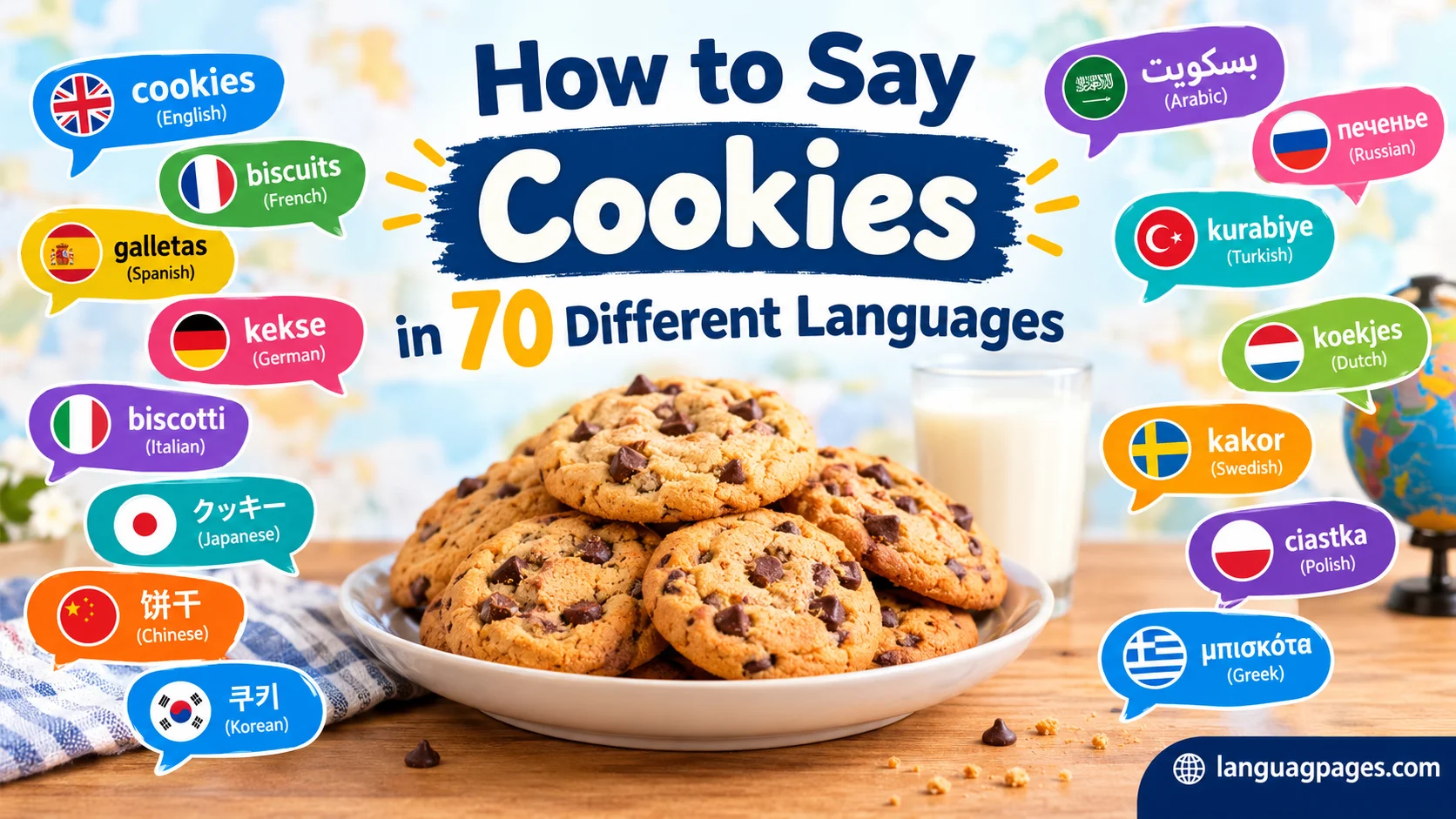
Cookies are more than a sweet snack; their names reveal interesting differences between languages and cultures. How to Say Cookies in 70 Different Languages helps you discover useful translations while exploring how people describe this familiar treat around the world.
Learning these food vocabulary words can make conversations easier when traveling, shopping, sharing recipes, or meeting people from different backgrounds. From translation and pronunciation to regional expressions, understanding the right word helps you communicate clearly. Comparing terms such as cookies, biscuits, and traditional baked treats also highlights how language and culture influence everyday vocabulary and meaning.
In this article, you’ll explore 70 language translations, including their native scripts, pronunciation guides, and example sentences. You’ll also discover regional differences, common meanings, and practical ways to use these words in everyday conversations. Whether you’re a beginner or an experienced language learner, this guide will help you expand your multilingual vocabulary and understand how different languages describe cookies naturally.
Interesting Facts About Cookies
- Cookies and biscuits: American English generally uses cookies, while British English usually uses biscuits for many similar sweet baked goods.
- One food, different categories: A soft cookie and a crisp biscuit may have different names in languages that distinguish them by texture or preparation.
- Borrowed vocabulary: Some languages use words borrowed from other languages, especially when describing internationally familiar foods.
- Plural forms differ: A word that means one cookie may change its ending or form when referring to several cookies.
- Writing systems matter: Languages such as Japanese, Chinese, Korean, Arabic, and Greek use writing systems different from the English alphabet.
- Food vocabulary reflects local traditions: A translation for a generic cookie may not describe every traditional sweet found in a country.
- Context improves accuracy: When shopping or ordering food, a phrase such as “chocolate chip cookies” can be more useful than the general word cookies.
What Does “Cookies” Mean?
Cookies are small baked treats, often sweet and made with ingredients such as flour, sugar, butter, eggs, chocolate, or nuts. They can be soft, chewy, crisp, filled, or decorated.
The word may also have a broader meaning depending on the country. In the United States, cookies is the usual term for many small baked sweets. In Britain, similar products are frequently called biscuits, although the terms can describe different styles.
When translating the word, consider whether you mean a general sweet biscuit, a chocolate chip cookie, or a particular traditional treat. The best translation communicates the food you actually want.
Why Can “Cookies” Have Different Translations?
There isn’t always a perfect one-word equivalent for cookies in every language. Food terminology depends on context, local traditions, and the way speakers categorize baked goods.
For example, the French word biscuit can refer to several kinds of biscuits or baked products, while cookie is also used for a recognizable style of cookie. In German, Keks is a common word for a biscuit or cookie, while Plätzchen often refers to small cookies, particularly homemade or seasonal varieties.
Regional differences matter, too. A term commonly used in one country may sound less familiar in another. Pronunciation can vary by accent, and borrowed words may be adapted to local spelling. The translations below provide practical, representative equivalents rather than claiming that each word covers every possible type of cookie.
European Languages
Europe has several language families, including Germanic, Romance, Slavic, and Uralic languages. Words for cookies vary in spelling, pronunciation, and meaning. Some refer broadly to biscuits, while others describe particular kinds of small baked treats.
| 🌍 Language | Country/Region | Translation | Pronunciation | Example Sentence |
| English | International | Cookies | KOO-keez | These cookies are delicious. |
| American English 🇺🇸 | United States | Cookies | KOO-keez | I baked chocolate chip cookies. |
| British English 🇬🇧 | United Kingdom | Biscuits | BIS-kits | Would you like some biscuits? |
| Australian English 🇦🇺 | Australia | Biscuits / cookies | BIS-kits / KOO-keez | I bought some biscuits. |
| Spanish | Spain, Latin America | Galletas | gah-YEH-tahs | Me gustan las galletas. (I like cookies.) |
| French | France, Belgium | Biscuits | bees-KWEE | J’aime les biscuits. (I like cookies.) |
| German | Germany, Austria | Kekse | KEK-suh | Ich esse gern Kekse. (I like eating cookies.) |
| Italian | Italy, Switzerland | Biscotti | bee-SKOT-tee | Mi piacciono i biscotti. (I like cookies.) |
| Portuguese | Portugal, Brazil | Biscoitos | bees-KOY-toosh | Gosto de biscoitos. (I like cookies.) |
| Dutch | Netherlands, Belgium | Koekjes | KOO-kyuhs | Ik eet graag koekjes. (I like eating cookies.) |
| Swedish | Sweden, Finland | Kakor | KAH-kor | Jag gillar kakor. (I like cookies.) |
| Norwegian | Norway | Kjeks | sheks | Jeg liker kjeks. (I like cookies.) |
| Danish | Denmark | Småkager | SMOH-kay-er | Jeg kan godt lide småkager. (I like cookies.) |
| Finnish | Finland | Keksit | KEK-sit | Pidän kekseistä. (I like cookies.) |
| Icelandic | Iceland | Smákökur | SMAU-kur | Mér finnst smákökur góðar. (I like cookies.) |
| Irish | Ireland | Fianáin | fee-uh-NAWN | Is maith liom fianáin. (I like cookies.) |
| Welsh | Wales | Bisgedi | bis-GEH-dee | Dw i’n hoffi bisgedi. (I like biscuits.) |
| Polish | Poland | Ciasteczka | chahs-TEHCH-kah | Lubię ciasteczka. (I like cookies.) |
| Czech | Czechia | Sušenky | SOO-shen-kee | Mám rád sušenky. (I like cookies.) |
| Slovak | Slovakia | Sušienky | SOO-shyen-kee | Mám rád sušienky. (I like cookies.) |
| Ukrainian | Ukraine | Печиво | peh-CHEE-vo | Я люблю печиво. (I like cookies.) |
| Russian | Russia and neighboring regions | Печенье | pee-CHEN-ye | Я люблю печенье. (I like cookies.) |
| Romanian | Romania, Moldova | Biscuiți | bis-KWITS | Îmi plac biscuiții. (I like cookies.) |
| Hungarian | Hungary | Kekszek | KEK-sek | Szeretem a kekszeket. (I like cookies.) |
| Greek | Greece, Cyprus | Μπισκότα | bees-KOH-tah | Μου αρέσουν τα μπισκότα. (I like cookies.) |
| Bulgarian | Bulgaria | Бисквити | bis-KVEE-tee | Обичам бисквити. (I like cookies.) |
| Croatian | Croatia | Keksi | KEK-see | Volim kekse. (I like cookies.) |
| Serbian | Serbia and neighboring regions | Кекси | KEK-see | Волим кексе. (I like cookies.) |
| Slovenian | Slovenia | Piškoti | peesh-KOH-tee | Rad imam piškote. (I like cookies.) |
| Lithuanian | Lithuania | Sausainiai | sow-SAI-nyai | Man patinka sausainiai. (I like cookies.) |
| Latvian | Latvia | Cepumi | TSEH-poo-mee | Man garšo cepumi. (I like cookies.) |
| Estonian | Estonia | Küpsised | KÜP-see-sed | Mulle meeldivad küpsised. (I like cookies.) |
English varieties
American, British, and Australian English are not three separate languages. Their vocabulary overlaps, but everyday food terminology can differ. Cookies is the usual American term, while biscuits is common in Britain and Australia. In Australia, cookie is also understood and may be used for particular styles.
Cultural note
The Italian word biscotti can refer to cookies or biscuits generally in everyday use, although it also names particular baked products. Similarly, German Plätzchen often describes small homemade cookies, especially around Christmas. The best choice depends on the food and situation.
African Languages
Africa has extraordinary linguistic diversity, with languages influenced by local food traditions and contact between communities. Some cookie terms resemble borrowed European words, while others are adapted to local pronunciation. These examples represent specific languages and regions, not the entire continent.
| 🌍 Language | Country/Region | Translation | Pronunciation | Example Sentence |
| Swahili | Kenya, Tanzania, East Africa | Biskuti | bis-KOO-tee | Ninapenda biskuti. (I like cookies.) |
| Afrikaans | South Africa, Namibia | Koekies | KOO-kees | Ek hou van koekies. (I like cookies.) |
| Zulu | South Africa | Amabhisikidi | ah-mah-bee-see-KEE-dee | Ngithanda amabhisikidi. (I like biscuits.) |
| Xhosa | South Africa | Iibhisikithi | ee-bee-see-KEE-tee | Ndiyazithanda iibhisikithi. (I like biscuits.) |
| Amharic | Ethiopia | ብስኩት | bis-kut | ብስኩት እወዳለሁ። (I like biscuits.) |
| Yoruba | Nigeria | Bísíkítì | bee-see-KEE-tee | Mo fẹ́ràn bísíkítì. (I like biscuits.) |
| Hausa | Nigeria, Niger, West Africa | Biskit | bis-kit | Ina son biskit. (I like biscuits.) |
| Somali | Somalia, Horn of Africa | Buskud | boos-kud | Waxaan jeclahay buskudka. (I like cookies.) |
| Shona | Zimbabwe | Mabhisikiti | mah-bee-see-KEE-tee | Ndinoda mabhisikiti. (I like biscuits.) |
| Kinyarwanda | Rwanda | Bisikiti | bee-see-KEE-tee | Nkunda ibisuguti. (I like biscuits.) |
Cultural note
In many African languages, everyday food vocabulary includes words borrowed or adapted from other languages. The precise term can vary with the product, community, and local usage. When shopping, showing a picture or naming the flavor can help clarify which kind of cookie you mean.
Middle Eastern Languages
The Middle East includes Arabic-speaking communities, Persian speakers, Hebrew speakers, and Kurdish-speaking regions. Although some of these languages share writing influences or borrowed vocabulary, they are distinct languages with their own grammar and pronunciation.
| 🌍 Language | Country/Region | Translation | Pronunciation | Example Sentence |
| Modern Standard Arabic | Across the Arab world | بسكويت | bis-kweet | أحب البسكويت. (I like cookies.) |
| Egyptian Arabic | Egypt | بسكويت | bes-kweet | أنا بحب البسكويت. (I like cookies.) |
| Persian (Farsi) | Iran | بیسکویت | bees-kweet | من بیسکویت دوست دارم. (I like cookies.) |
| Hebrew | Israel | עוגיות | oo-gee-YOT | אני אוהב עוגיות. (I like cookies; masculine speaker.) |
| Kurdish (Kurmanji) | Türkiye, Syria, Iraq, other Kurdish-speaking areas | Biskuvît | bis-koo-VEET | Ez biskuvîtan hez dikim. (I like cookies.) |
| Armenian | Armenia and Armenian communities worldwide | Թխվածքաբլիթներ | tkh-vats-kah-bliht-ner | Ես սիրում եմ թխվածքաբլիթներ։ (I like cookies.) |
Cultural note
Arabic بسكويت is widely understood for biscuits or cookies, but local food vocabulary differs across countries. Persian بیسکویت is a related loanword used in Persian, not Arabic. In Hebrew, עוגיות is a common word for cookies. The speaker’s gender can affect the Hebrew example sentence, even though the noun remains the same.
Other World Languages
Some languages are associated with Indigenous communities, islands, or international language-learning communities. The following examples expand the list while showing how food vocabulary can differ across cultural settings.
| 🌍 Language | Country/Region | Translation | Pronunciation | Example Sentence |
| Māori | New Zealand | Pihikete | pee-hee-KEH-teh | He pai ki ahau ngā pihikete. (I like biscuits.) |
| Samoan | Samoa and Pacific communities | Masi | MAH-see | Ou te fiafia i masi. (I like biscuits.) |
| Hawaiian | Hawaiʻi | Kuki | KOO-kee | Makemake au i nā kuki. (I like cookies.) |
| Haitian Creole | Haiti | Bonbon | bon-bon | Mwen renmen bonbon. (I like sweets/cookies.) |
| Esperanto | International language community | Kuketoj | koo-KEH-toy | Mi ŝatas kuketojn. (I like cookies.) |
A note on meaning: In some of these languages, the closest everyday term can also mean biscuits, crackers, or sweets more generally. Haitian Creole bonbon, for instance, can refer to candy or other sweet treats, so it may not identify a baked cookie precisely. Use a more specific description when the distinction matters.
Quick Reference: Cookies in Different Languages
Use this compact list to find a translation quickly. Some entries are broad equivalents rather than exact names for American-style cookies.
| Language | Translation |
| English | Cookies |
| American English | Cookies |
| British English | Biscuits |
| Australian English | Biscuits / cookies |
| Spanish | Galletas |
| French | Biscuits |
| German | Kekse |
| Italian | Biscotti |
| Portuguese | Biscoitos |
| Dutch | Koekjes |
| Swedish | Kakor |
| Norwegian | Kjeks |
| Danish | Småkager |
| Finnish | Keksit |
| Icelandic | Smákökur |
| Irish | Fianáin |
| Welsh | Bisgedi |
| Polish | Ciasteczka |
| Czech | Sušenky |
| Slovak | Sušienky |
| Ukrainian | Печиво |
| Russian | Печенье |
| Romanian | Biscuiți |
| Hungarian | Kekszek |
| Greek | Μπισκότα |
| Bulgarian | Бисквити |
| Croatian | Keksi |
| Serbian | Кекси |
| Slovenian | Piškoti |
| Lithuanian | Sausainiai |
| Latvian | Cepumi |
| Estonian | Küpsised |
| Mandarin Chinese | 饼干 |
| Cantonese | 曲奇 / 餅乾 |
| Japanese | クッキー |
| Korean | 쿠키 |
| Hindi | कुकीज़ / बिस्कुट |
| Urdu | کوکیز / بسکٹ |
| Bengali | কুকিজ / বিস্কুট |
| Punjabi | ਕੁਕੀਜ਼ / ਬਿਸਕੁਟ |
| Gujarati | કૂકીઝ / બિસ્કિટ |
| Marathi | कुकीज / बिस्किटे |
| Tamil | குக்கீகள் / பிஸ்கட்டுகள் |
| Telugu | కుకీలు / బిస్కెట్లు |
| Kannada | ಕುಕೀಸ್ / ಬಿಸ್ಕತ್ತುಗಳು |
| Malayalam | കുക്കീസ് / ബിസ്കറ്റ് |
| Nepali | कुकीज / बिस्कुट |
| Sinhala | කුකීස් / බිස්කට් |
| Thai | คุกกี้ |
| Vietnamese | Bánh quy |
| Indonesian | Kue kering |
| Malay | Biskut |
| Filipino/Tagalog | Biskwit |
| Burmese | ဘီစကွတ် |
| Khmer | នំឃុកឃី |
| Lao | ຄຸກກີ້ |
| Mongolian | Жигнэмэг |
| Kazakh | Печенье |
| Uzbek | Pechenye |
| Turkish | Kurabiye |
| Swahili | Biskuti |
| Afrikaans | Koekies |
| Zulu | Amabhisikidi |
| Xhosa | Iibhisikithi |
| Amharic | ብስኩት |
| Yoruba | Bísíkítì |
| Hausa | Biskit |
| Somali | Buskud |
| Shona | Mabhisikiti |
| Kinyarwanda | Bisikiti |
| Modern Standard Arabic | بسكويت |
| Egyptian Arabic | بسكويت |
| Persian | بیسکویت |
| Hebrew | עוגיות |
| Kurdish (Kurmanji) | Biskuvît |
| Armenian | Թխվածքաբլիթներ |
| Māori | Pihikete |
| Samoan | Masi |
| Hawaiian | Kuki |
| Haitian Creole | Bonbon |
| Esperanto | Kuketoj |
How to Choose the Right Translation
Choose a translation based on the type of cookie, the country, and the situation.
- For everyday conversation: Use the familiar general term, such as Spanish galletas or Japanese クッキー.
- For shopping: Check whether the word refers to cookies, biscuits, crackers, or another baked product.
- For recipes: Include the cookie type, such as chocolate chip, butter, or oatmeal cookies.
- For travel: Learn a complete phrase, such as “I would like some cookies,” rather than memorizing only one word.
- For messages and gifts: Consider the recipient’s language and regional preferences.
When accuracy matters, check a reliable dictionary or ask a fluent speaker about the specific product.
Common Mistakes When Translating Cookies
Avoid these common translation mistakes:
- Translating word for word: A literal translation may not be the everyday name for a food.
- Ignoring regional differences: American cookie and British biscuit overlap but aren’t always interchangeable.
- Confusing similar foods: A wafer, cracker, cake, and cookie may belong to different food categories.
- Using misleading pronunciation: Romanized spellings are learning aids, not exact substitutes for listening to native speakers.
- Assuming one word works everywhere: A translation can be understood across a region without being the preferred local term.
- Overlooking context: The word used for a packaged snack might differ from the name of a traditional homemade sweet.
Tip: Learn the word alongside a picture or example sentence to remember its meaning more accurately.
FAQs:
How do you say cookies in different languages?
Common translations include galletas in Spanish, Kekse in German, biscuits in French, 饼干 in Mandarin Chinese, and クッキー in Japanese.
What is the most natural translation of cookies?
It depends on the language and the type of baked treat. Choose the local term that best describes the cookie you mean.
Can the translation change by country?
Yes. Regional vocabulary and food traditions can influence whether speakers use a word meaning cookies, biscuits, or another baked sweet.
Why do some languages have multiple translations?
Some languages distinguish between cookie styles, while others use broad terms for several kinds of biscuits and baked goods.
Does pronunciation change between regions?
Yes. Accents can affect pronunciation, and borrowed words may be pronounced differently across communities.
How can I pronounce cookie translations correctly?
Use the pronunciation guides as a starting point, then listen to fluent speakers and practice the words in complete sentences.
Is a literal translation always accurate?
No. Natural meaning matters more than word-for-word translation, particularly when different languages categorize food differently.
Which languages use a different writing system?
Mandarin Chinese, Japanese, Korean, Hindi, Urdu, Arabic, Greek, and many others use scripts that differ from the English alphabet.
Can I use these translations in a conversation?
Yes. They are useful starting points for everyday conversations, although regional preferences may vary.
How do you say chocolate chip cookies in Spanish?
One understandable translation is galletas con chispas de chocolate. Wording can vary by region.
Are cookies and biscuits the same thing?
Not always. American English commonly uses cookies, while British English often uses biscuits. The distinction depends on local usage and the product.
Conclusion:
How to Say Cookies in 70 Different Languages helps you explore useful translations, learn new vocabulary, and understand how different cultures name this popular sweet treat in everyday conversations.
Learning cookie translations can make your language journey more enjoyable and practical. Use these words when traveling, sharing recipes, or talking with international friends. Keep practicing pronunciation and spelling to improve your communication skills and discover the delicious connection between food, culture, and language.












