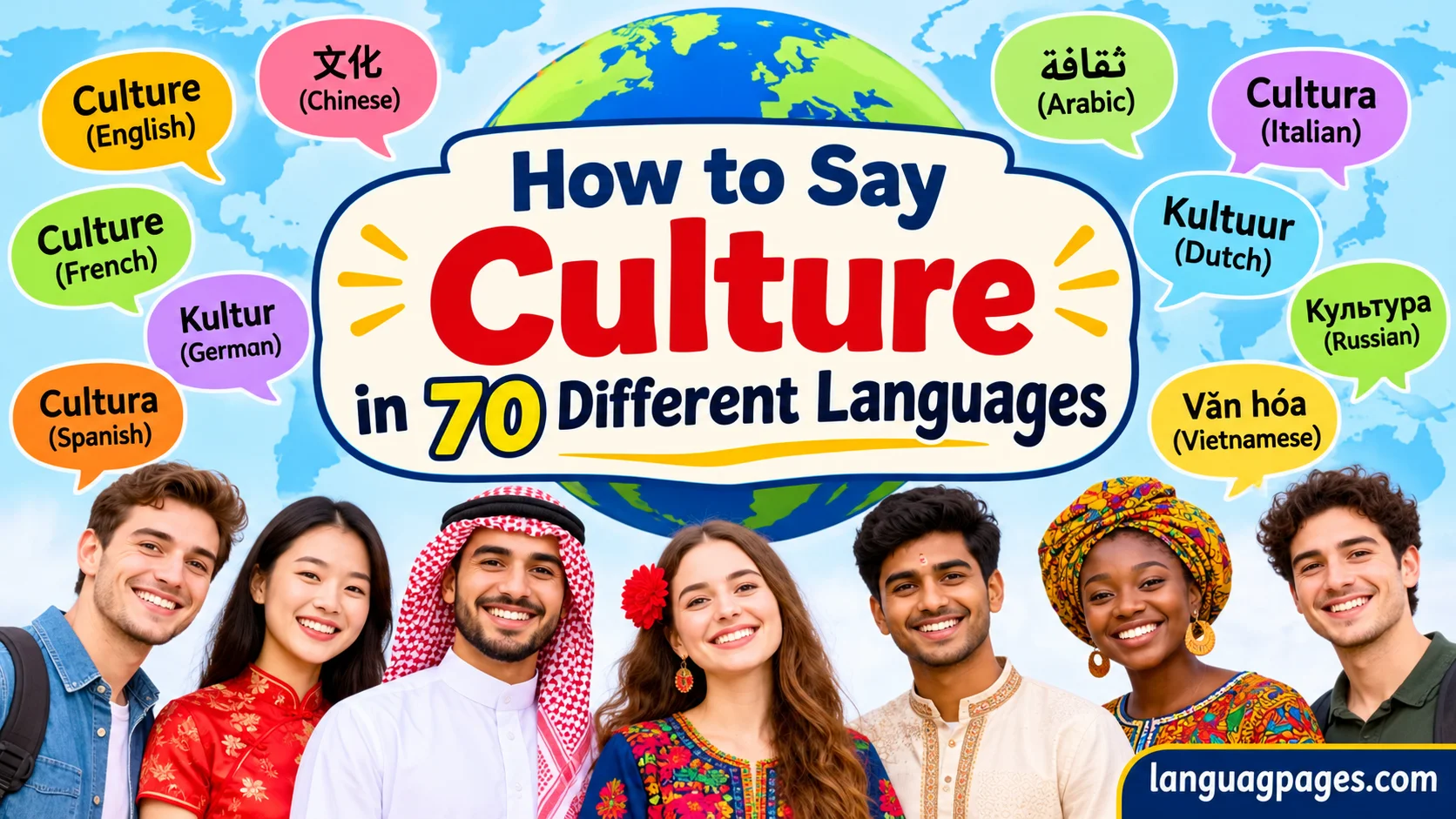
Culture shapes how communities celebrate traditions, share values, and preserve their heritage. How to Say Culture in 70 Different Languages explores how different languages express this meaningful concept, helping readers discover vocabulary and appreciate cultural diversity through translation.
Learning the word culture in different languages makes conversations about traditions, identity, and heritage more meaningful. From translation and pronunciation to vocabulary and regional variation, each language offers useful ways to describe shared experiences. Understanding these differences can improve language learning, support international communication, and help you recognize how words express customs, beliefs, and values across communities worldwide.
In this guide, you’ll discover culture translations in 70 languages, including European, Asian, African, and Middle Eastern languages. Explore native words, pronunciation guides, and example sentences that demonstrate natural usage. You’ll also learn about meaning, context, and regional differences to understand when translations may vary. Whether you’re studying vocabulary, traveling, or exploring global traditions, these examples will help you communicate with greater confidence and cultural awareness.
Interesting Facts About Culture
- Culture includes more than art: It can encompass language, food, clothing, traditions, social values, music, and everyday practices.
- Translation depends on context: A word meaning culture in one sentence may be better translated as customs, civilization, or way of life in another.
- Languages reflect different histories: Words for cultural practices may carry historical or social associations that have no exact equivalent elsewhere.
- Culture changes over time: Communities adapt traditions and vocabulary as people move, communicate, and interact.
- One language can have regional differences: Speakers may choose different expressions depending on their location and the situation.
- Writing systems vary widely: The word for culture can appear in Latin, Cyrillic, Arabic, Devanagari, Chinese, Japanese, and other scripts.
- Language is part of culture: Learning a word in its original language can reveal how people describe identity, heritage, and shared experiences.
What Does Culture Mean?
Culture refers to the shared practices, knowledge, beliefs, values, traditions, and creative expressions associated with a person or community. It can include festivals, family customs, architecture, literature, religion, food, music, and language.
The word also has more specific meanings. Popular culture refers to widely shared entertainment and trends, while traditional culture emphasizes practices passed between generations. In education, cultural awareness means understanding how cultural backgrounds influence people’s experiences and perspectives.
For example, “Japanese culture includes traditional arts and modern popular entertainment” uses culture in a broad social sense. The intended meaning helps determine the most suitable translation.
Why Can Culture Have Different Translations?
Most languages have a word that broadly corresponds to culture, but the words do not always cover identical meanings.
- Context: Academic discussions may use a different expression from everyday conversations.
- Formality: A scholarly text may favor a technical term, while casual speech may use a familiar expression.
- Regional variation: Countries and communities sometimes prefer different words or spellings.
- Cultural conventions: Some expressions emphasize customs, while others focus on civilization or artistic achievement.
- Grammar: A translation may need a different grammatical form when used in a sentence.
- Written versus spoken language: A dictionary equivalent may be correct in writing but less natural in a particular conversation.
The translations below generally represent the broad meaning of culture as a community’s shared way of life, traditions, and expressions. Pronunciation guides are simplified for English readers, so they cannot capture every sound perfectly.
African Languages
Africa has exceptional linguistic diversity, with languages from several major language families spoken across its countries and communities. The words below represent the general concept of culture, including shared customs, traditions, and ways of life.
| 🌍 Language | Country/Region | Translation | Pronunciation | Example Sentence |
| Swahili | Tanzania, Kenya, East Africa | Utamaduni | oo-tah-mah-doo-nee | Utamaduni wetu ni tajiri. — Our culture is rich. |
| Afrikaans | South Africa, Namibia | Kultuur | kul-TEER | Kultuur verbind mense. — Culture connects people. |
| Zulu | South Africa | Isiko / amasiko | ee-SEE-koh / ah-mah-SEE-koh | Amasiko ethu abalulekile. — Our traditions are important. |
| Xhosa | South Africa | Inkcubeko | een-khoo-BEH-koh | Inkcubeko yethu ibalulekile. — Our culture is important. |
| Amharic | Ethiopia | ባህል | bāhəl | ባህላችን አስፈላጊ ነው። — Our culture is important. |
| Yoruba | Nigeria, Benin | Àṣà | ah-SHAH | Àṣà wa ṣe pàtàkì. — Our culture is important. |
| Igbo | Nigeria | Omenala | oh-meh-nah-lah | Omenala anyị dị mkpa. — Our culture is important. |
| Hausa | Nigeria, Niger, West Africa | Al’ada | al-AH-dah | Al’adarmu tana da muhimmanci. — Our culture is important. |
| Somali | Somalia, Horn of Africa | Dhaqan | dha-KHAN | Dhaqankeennu waa muhiim. — Our culture is important. |
| Shona | Zimbabwe | Tsika | TSEE-kah | Tsika dzedu dzakakosha. — Our traditions are important. |
| Kinyarwanda | Rwanda | Umuco | oo-MOO-cho | Umuco wacu ni ingenzi. — Our culture is important. |
| Malagasy | Madagascar | Kolontsaina | koo-loon-TSAY-nah | Zava-dehibe ny kolontsaina. — Culture is important. |
Cultural note: Some African languages distinguish between a broad concept of culture and specific customs or traditions. For example, Zulu isiko can refer to a custom or tradition, while amasiko is the plural. These words are useful in context but are not interchangeable in every sentence with the broad English word culture.
Middle Eastern Languages
The Middle East includes Arabic, Persian, Hebrew, Kurdish, Turkish, and other distinct language traditions. Their vocabularies reflect different histories and grammatical systems, so translations should be chosen for the intended meaning rather than geographical proximity alone.
| 🌍 Language | Country/Region | Translation | Pronunciation | Example Sentence |
| Arabic (Modern Standard Arabic) | Middle East, North Africa | ثقافة | thaqāfa | الثقافة مهمة. — Culture is important. |
| Persian (Farsi) | Iran and Persian-speaking communities | فرهنگ | far-hang | فرهنگ ما غنی است. — Our culture is rich. |
| Hebrew | Israel | תרבות | tar-BOOT | התרבות שלנו עשירה. — Our culture is rich. |
| Kurdish (Kurmanji) | Kurdish regions of Türkiye, Iraq, Syria, Iran | Çand | chahnd | Çanda me girîng e. — Our culture is important. |
| Turkish | Türkiye, Cyprus | Kültür | kül-TÜR | Kültürümüz zengindir. — Our culture is rich. |
| Armenian | Armenia and Armenian communities worldwide | Մշակույթ | mə-sha-KOYT | Մեր մշակույթը հարուստ է։ — Our culture is rich. |
Cultural note: Arabic ثقافة (thaqāfa) is the general term for culture in Modern Standard Arabic. Spoken Arabic varies considerably by region, and sentence structure or everyday vocabulary may differ in Egyptian, Levantine, Gulf, and other dialects. Persian فرهنگ (farhang) is a separate word from Arabic thaqāfa, even though both can express the same broad idea.
Other World Languages
Languages outside the main regional groups add further perspectives on culture, identity, and heritage. The examples below provide additional options for readers exploring multilingual vocabulary.
| 🌍 Language | Country/Region | Translation | Pronunciation | Example Sentence |
| Māori | New Zealand | Ahurea | ah-hoo-REH-ah | He mea nui te ahurea. — Culture is important. |
| Samoan | Samoa, Pacific communities | Aganuʻu | ah-gah-noo-oo | E tāua la tatou aganuʻu. — Our culture is important. |
| Hawaiian | Hawaiʻi | Moʻomeheu | moh-oh-meh-HEH-oo | He waiwai ko ka moʻomeheu. — Culture is a treasure. |
| Haitian Creole | Haiti | Kilti | keel-TEE | Kilti nou enpòtan. — Our culture is important. |
| Esperanto | International constructed language | Kulturo | kool-TOO-roh | Kulturo kunigas homojn. — Culture connects people. |
Quick Reference: Culture in Different Languages
Use this compact list to find the word culture quickly. English varieties share the same spelling; the other entries reflect the general meanings described in their regional tables.
| Language | Translation |
| English, American English, British English, Australian English | Culture |
| Spanish | Cultura |
| French | Culture |
| German | Kultur |
| Italian | Cultura |
| Portuguese | Cultura |
| Dutch | Cultuur |
| Swedish, Norwegian | Kultur |
| Danish | Kultur |
| Finnish | Kulttuuri |
| Icelandic | Menning |
| Irish | Cultúr |
| Welsh | Diwylliant |
| Polish, Czech, Bulgarian | Kultura / Култура |
| Slovak | Kultúra |
| Ukrainian | Культура |
| Russian | Культура |
| Romanian | Cultură |
| Hungarian | Kultúra |
| Greek | Πολιτισμός |
| Croatian, Slovenian | Kultura |
| Serbian | Култура / Kultura |
| Lithuanian | Kultūra |
| Latvian | Kultūra |
| Estonian | Kultuur |
| Mandarin Chinese, Cantonese | 文化 |
| Japanese | 文化 |
| Korean | 문화 |
| Hindi, Nepali | संस्कृति |
| Urdu | ثقافت |
| Bengali | সংস্কৃতি |
| Punjabi | ਸਭਿਆਚਾਰ / ثقافت |
| Gujarati | સંસ્કૃતિ |
| Marathi | संस्कृती |
| Tamil | பண்பாடு |
| Telugu | సంస్కృతి |
| Kannada | ಸಂಸ್ಕೃತಿ |
| Malayalam | സംസ്കാരം |
| Sinhala | සංස්කෘතිය |
| Thai | วัฒนธรรม |
| Vietnamese | Văn hóa |
| Indonesian, Malay | Budaya |
| Filipino/Tagalog | Kultura |
| Burmese | ယဉ်ကျေးမှု |
| Khmer | វប្បធម៌ |
| Lao | ວັດທະນະທຳ |
| Mongolian | Соёл |
| Kazakh | Мәдениет |
| Uzbek | Madaniyat |
| Swahili | Utamaduni |
| Afrikaans | Kultuur |
| Zulu | Isiko / amasiko |
| Xhosa | Inkcubeko |
| Amharic | ባህል |
| Yoruba | Àṣà |
| Igbo | Omenala |
| Hausa | Al’ada |
| Somali | Dhaqan |
| Shona | Tsika |
| Kinyarwanda | Umuco |
| Malagasy | Kolontsaina |
| Arabic | ثقافة |
| Persian | فرهنگ |
| Hebrew | תרבות |
| Kurdish (Kurmanji) | Çand |
| Turkish | Kültür |
| Armenian | Մշակույթ |
| Māori | Ahurea |
| Samoan | Aganuʻu |
| Hawaiian | Moʻomeheu |
| Haitian Creole | Kilti |
| Esperanto | Kulturo |
How to Choose the Right Translation
Choosing the right translation depends on what you want to communicate and who will read or hear it.
- Check the context: Decide whether you mean traditional customs, artistic culture, or a community’s general way of life.
- Consider your audience: Use vocabulary appropriate for the reader’s language and region.
- Check pronunciation: Listen to reliable language-learning recordings when possible, especially for tonal languages.
- Use the correct script: Include native writing alongside romanization when practical.
- Check natural usage: A word that appears in a dictionary may require a different form in a complete sentence.
Tip: When preparing an academic paper, presentation, or public message, verify important translations with a reliable dictionary or a knowledgeable speaker. This is particularly helpful when cultural identity or heritage is central to your message.
FAQs:
How do you say culture in different languages?
The word varies by language. Examples include cultura in Spanish, Kultur in German, 文化 (wénhuà) in Mandarin Chinese, संस्कृति (sanskriti) in Hindi, and ثقافة (thaqāfa) in Arabic.
What is the most natural translation of culture?
The most natural translation depends on the language and context. A general word for culture may work for everyday discussion, while a more specific term may suit traditions, heritage, or artistic expression.
Can the translation change by country?
Yes. Regional vocabulary, dialects, and writing conventions can affect how speakers express cultural concepts. The broad meaning may remain similar even when everyday usage differs.
Why do some languages have multiple translations?
Languages may use different words for culture, customs, heritage, civilization, or artistic life. These meanings overlap, but each word can emphasize a different aspect of the concept.
Does pronunciation change between regions?
Yes. Accents and regional speech patterns can change pronunciation. Mandarin and Cantonese, for example, use the same characters for culture but pronounce them differently.
How can I pronounce culture correctly in another language?
Start with the pronunciation guide, then listen to recordings from reliable dictionaries or language-learning resources. Pay attention to tones, stress, vowel sounds, and unfamiliar consonants.
Is a literal translation always accurate?
No. A literal translation may be grammatically awkward or express the wrong nuance. Check how the word is used in a complete sentence before relying on it.
Which languages use a different writing system?
Mandarin Chinese, Japanese, Korean, Hindi, Urdu, Arabic, Greek, and many other languages use writing systems that differ from the English alphabet. Romanization can help beginners read unfamiliar scripts.
Can I use these translations in a message or conversation?
Yes, for general learning and conversation. For important, formal, or sensitive messages, verify the wording and context before using it.
How can learning this word help with language learning?
It helps build vocabulary, supports reading comprehension, and introduces differences in grammar and meaning. It can also lead you to related words for tradition, identity, history, and heritage.
Is culture the same as tradition in every language?
No. Culture is generally broader than tradition. Tradition usually refers to practices or beliefs passed between generations, while culture can include art, language, social values, and everyday behavior.
Conclusion:
Learning How to Say Culture in 70 Different Languages helps you explore traditions, heritage, and identity worldwide. These translations expand your vocabulary and encourage meaningful cross-cultural communication.
Remember that context, pronunciation, and regional differences can influence how people express cultural ideas. Explore each language with curiosity, respect, and an open mind. Understanding these differences makes language learning more rewarding and helps you appreciate the diverse ways communities share their values and traditions.












