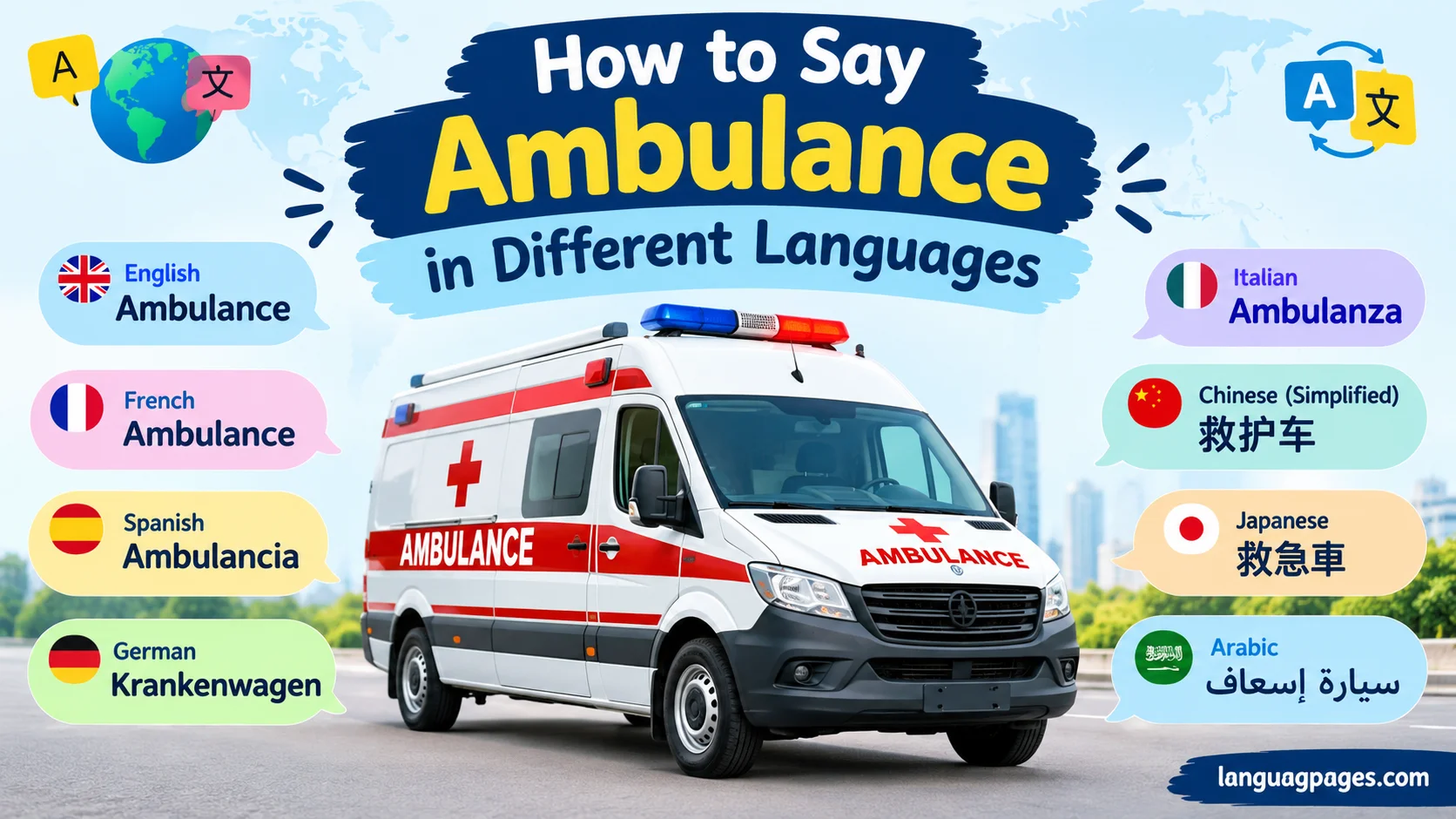
How do you describe an Ambulance clearly across languages when emergency vocabulary must remain precise, natural, and culturally appropriate for travelers, learners, families, and international communication situations everywhere today?
This article explores how ambulance and related expressions differ across languages, regions, and contexts, while connecting language choices with English usage, grammar, and formal writing. You’ll see how style guides and US versus UK preferences can influence wording, consistency, and practical communication today clearly and effectively.
We also examine how precise language supports business communication, scheduling, time management, online booking, broadcasting, meetings, calendar planning, and project management. Each section focuses on meaning, usage, pronunciation, and regional context, helping readers understand translations without forcing literal equivalents across languages, cultures, and everyday situations.
Interesting Facts About Ambulance
- The English word ambulance has close relatives in many European languages, including French ambulance, Spanish ambulancia, Italian ambulanza, and Portuguese ambulância.
- Several languages use a completely different expression. German Krankenwagen, for example, refers to a vehicle associated with transporting sick people, while Russian скорая помощь means emergency aid.
- Mandarin Chinese uses 救护车 (jiùhùchē), while Japanese uses 救急車 (kyūkyūsha). Both use compounds rather than simply borrowing the English word.
- In Urdu, ایمبولینس (ambulance) is widely understandable, while the fuller dictionary explanation describes it as a vehicle for taking sick or injured people to hospital.
- Some languages have separate expressions for an ambulance vehicle and emergency medical assistance itself. Context therefore matters when translating the English noun.
- English regional varieties generally retain the same spelling ambulance, although pronunciation can differ between British and American English.
- Many modern ambulance terms are international-looking because the concept and the word have spread between languages, but each language may adapt the spelling or grammar differently.
What Does Ambulance Mean?
An ambulance is a specially equipped vehicle used to transport sick or injured people and, in many emergency systems, provide medical care during transport. The word can refer to the vehicle itself or, depending on context, the emergency medical service associated with it.
In everyday English, people commonly say “Call an ambulance” when someone needs urgent medical assistance. The equivalent expression is not always a literal translation in another language. Some languages name the vehicle, while others emphasize emergency help or medical rescue.
Why Can Ambulance Have Different Translations?
There is no single translation pattern for ambulance because languages describe the concept differently. A Romance language may use a form related to ambulance, while a Slavic language may use a phrase connected with emergency assistance.
Context also matters. A dictionary may list several forms, but the most natural everyday term can depend on country, region, formality, and healthcare vocabulary. German, for example, has Krankenwagen and Rettungswagen, with usage depending partly on the type and function of the vehicle.
For this article, the translation column gives the ordinary term for the ambulance vehicle, rather than forcing a literal translation of every English word.
European Languages
Europe contains Romance, Germanic, Slavic, Uralic, Celtic, and other language families. As a result, the word for ambulance may look familiar in one language but completely different in another. The forms below focus on commonly understood modern terms.
| 🌍 Language | Country/Region | Translation | Pronunciation | Example Sentence |
| English | International | ambulance | AM-byuh-luhns | Call an ambulance. |
| American English 🇺🇸 | United States | ambulance | AM-byuh-luhns | The ambulance is coming. |
| British English 🇬🇧 | UK | ambulance | AM-byuh-luhns | An ambulance has arrived. |
| Australian English 🇦🇺 | Australia | ambulance | AM-byuh-luhns | The ambulance is outside. |
| Spanish | Spain, Latin America | ambulancia | am-boo-LAN-see-ah | La ambulancia está llegando. — The ambulance is arriving. |
| French | France, Francophone regions | ambulance | am-byoo-LAHNS | L’ambulance arrive. — The ambulance is arriving. |
| German | Germany, Austria | Krankenwagen | KRAHNG-kuhn-vah-gen | Der Krankenwagen kommt. — The ambulance is coming. |
| Italian | Italy | ambulanza | am-boo-LANT-sa | L’ambulanza sta arrivando. — The ambulance is arriving. |
| Portuguese | Portugal, Brazil | ambulância | am-boo-LAHN-see-ah | A ambulância chegou. — The ambulance arrived. |
| Dutch | Netherlands, Belgium | ambulance | am-bu-LAN-suh | De ambulance komt. — The ambulance is coming. |
| Swedish | Sweden | ambulans | am-boo-LAHNS | Ambulansen kommer. — The ambulance is coming. |
| Norwegian | Norway | ambulanse | am-boo-LAHN-suh | Ambulansen kommer snart. — The ambulance is coming soon. |
| Danish | Denmark | ambulance | am-boo-LAN-suh | Ambulancen kommer nu. — The ambulance is coming now. |
| Finnish | Finland | ambulanssi | am-boo-LAHN-see | Ambulanssi saapuu pian. — The ambulance will arrive soon. |
| Icelandic | Iceland | sjúkrabíll | SHOOK-ra-beetl | Sjúkrabíllinn kemur. — The ambulance is coming. |
| Irish | Ireland | otharcharr | OH-hur-khar | Tá an t-otharcharr ag teacht. — The ambulance is coming. |
| Welsh | Wales | ambiwlans | am-BEE-wlans | Mae’r ambiwlans yn dod. — The ambulance is coming. |
| Polish | Poland | karetka pogotowia | ka-RET-ka po-go-TOH-vyah | Karetka pogotowia już jedzie. — The ambulance is already coming. |
| Czech | Czechia | sanitka | SA-NEET-ka | Sanitka přijede brzy. — The ambulance will arrive soon. |
| Slovak | Slovakia | ambulancia | am-boo-LAN-tsee-ah | Ambulancia už prichádza. — The ambulance is arriving. |
| Ukrainian | Ukraine | швидка допомога | SHVYD-ka do-po-MOH-ha | Швидка допомога вже їде. — The ambulance is already coming. |
| Russian | Russia, other Russian-speaking regions | скорая помощь | SKO-ra-ya PO-moshch | Скорая помощь уже едет. — The ambulance is on its way. |
| Romanian | Romania, Moldova | ambulanță | am-boo-LANTS-uh | Ambulanța a sosit. — The ambulance has arrived. |
| Hungarian | Hungary | mentőautó | MEN-toh-ow-toh | A mentőautó megérkezett. — The ambulance arrived. |
| Greek | Greece, Cyprus | ασθενοφόρο | as-the-no-FO-ro | Το ασθενοφόρο έρχεται. — The ambulance is coming. |
| Bulgarian | Bulgaria | линейка | lee-NAY-ka | Линейката идва. — The ambulance is coming. |
| Croatian | Croatia | hitna pomoć | HEET-na PO-moch | Hitna pomoć stiže. — The ambulance is arriving. |
| Serbian | Serbia | хитна помоћ | HEET-na PO-moch | Хитна помоћ стиже. — The ambulance is arriving. |
| Slovenian | Slovenia | reševalno vozilo | reh-she-VAL-no vo-ZEE-lo | Reševalno vozilo prihaja. — The ambulance is coming. |
| Lithuanian | Lithuania | greitoji pagalba | GRAY-to-yee pa-ga-LBA | Greitoji pagalba atvyksta. — The ambulance is arriving. |
| Latvian | Latvia | ātrā palīdzība | AA-tra pa-LID-zee-ba | Ātrā palīdzība ierodas. — The ambulance is arriving. |
| Estonian | Estonia | kiirabi | KEE-ra-bee | Kiirabi tuleb. — The ambulance is coming. |
English Varieties
American, British, and Australian English all normally use ambulance. The spelling is not meaningfully different, although pronunciation and some emergency-service terminology can vary by region. There is no need to invent separate translations simply because the varieties are geographically different.
Asian Languages
Asia contains hundreds of languages and several major writing systems. The word for an ambulance may be a direct loanword, a native compound, or a phrase describing emergency medical transport. Scripts and pronunciation systems also vary considerably.
| 🌍 Language | Country/Region | Translation | Pronunciation | Example Sentence |
| Mandarin Chinese | China, Taiwan, Singapore | 救护车 / 救護車 | jiù-hù-chē | 救护车来了。 — The ambulance is here. |
| Cantonese | Hong Kong, Guangdong | 救護車 | gau3 wu6 ce1 | 救護車嚟喇。 — The ambulance is here. |
| Japanese | Japan | 救急車 | kyūkyūsha | 救急車が来ました。 — The ambulance has arrived. |
| Korean | South Korea, North Korea | 구급차 | gu-geup-cha | 구급차가 왔어요. — The ambulance has arrived. |
| Hindi | India | एम्बुलेंस | em-boo-lens | एम्बुलेंस आ रही है। — The ambulance is coming. |
| Urdu | Pakistan, India | ایمبولینس | am-boo-lens | ایمبولینس آ رہی ہے۔ — The ambulance is coming. |
| Bengali | Bangladesh, India | অ্যাম্বুলেন্স | am-boo-lens | অ্যাম্বুলেন্স আসছে। — The ambulance is coming. |
| Punjabi | India, Pakistan | ਐਂਬੂਲੈਂਸ / ایمبولینس | am-boo-lens | ਐਂਬੂਲੈਂਸ ਆ ਰਹੀ ਹੈ। — The ambulance is coming. |
| Gujarati | India | એમ્બ્યુલન્સ | em-byoo-lans | એમ્બ્યુલન્સ આવી રહી છે. — The ambulance is coming. |
| Marathi | India | रुग्णवाहिका | rug-na-vaa-hi-ka | रुग्णवाहिका आली आहे. — The ambulance has arrived. |
| Tamil | India, Sri Lanka | ஆம்புலன்ஸ் | aam-bu-lans | ஆம்புலன்ஸ் வருகிறது. — The ambulance is coming. |
| Telugu | India | అంబులెన్స్ | am-bu-lens | అంబులెన్స్ వస్తోంది. — The ambulance is coming. |
| Kannada | India | ಆಂಬ್ಯುಲೆನ್ಸ್ | aam-byoo-lens | ಆಂಬ್ಯುಲೆನ್ಸ್ ಬರುತ್ತಿದೆ. — The ambulance is coming. |
| Malayalam | India | ആംബുലൻസ് | aam-bu-lans | ആംബുലൻസ് വരുന്നു. — The ambulance is coming. |
| Nepali | Nepal | एम्बुलेन्स | em-boo-lens | एम्बुलेन्स आउँदैछ। — The ambulance is coming. |
| Sinhala | Sri Lanka | ගිලන් රථය | gi-lan ra-tha-ya | ගිලන් රථය එනවා. — The ambulance is coming. |
| Thai | Thailand | รถพยาบาล | rot pha-yaa-baan | รถพยาบาลกำลังมา। — The ambulance is coming. |
| Vietnamese | Vietnam | xe cứu thương | seh koo-thuong | Xe cứu thương đang đến. — The ambulance is coming. |
| Indonesian | Indonesia | ambulans | am-boo-lans | Ambulans itu datang. — The ambulance is coming. |
| Malay | Malaysia, Brunei | ambulans | am-boo-lans | Ambulans itu sedang datang. — The ambulance is coming. |
| Filipino/Tagalog | Philippines | ambulansya | am-boo-LAN-sya | Dumating na ang ambulansya. — The ambulance has arrived. |
| Burmese | Myanmar | လူနာတင်ယာဉ် | lu-na-tin-yan | လူနာတင်ယာဉ်လာနေတယ်။ — The ambulance is coming. |
| Khmer | Cambodia | រថយន្តសង្គ្រោះបន្ទាន់ | rot-yon sang-kroh ban-toan | រថយន្តសង្គ្រោះបន្ទាន់មកដល់ហើយ។ — The ambulance has arrived. |
| Lao | Laos | ລົດໂຮງໝໍ | lot hong-mor | ລົດໂຮງໝໍມາແລ້ວ. — The ambulance has arrived. |
| Mongolian | Mongolia | түргэн тусламжийн машин | türgen tuslamjiin mashin | Түргэн тусламж ирж байна. — The ambulance is coming. |
| Kazakh | Kazakhstan | жедел жәрдем | zhe-del zhar-dem | Жедел жәрдем келе жатыр. — The ambulance is coming. |
| Uzbek | Uzbekistan | tez yordam mashinasi | tez yor-dam ma-shi-na-si | Tez yordam mashinasi kelyapti. — The ambulance is coming. |
| Turkish | Türkiye, Cyprus | ambulans | am-boo-lans | Ambulans geliyor. — The ambulance is coming. |
Major dictionary references confirm forms such as 救护车, 救急車, 구급차, Hindi एम्बुलेंस, Turkish ambulans, Thai รถพยาบาล, and Vietnamese xe cứu thương.
African Languages
Africa’s linguistic diversity means that no single expression can represent the continent. Some languages use adapted forms of ambulance, while others use descriptive phrases connected with patients, rescue, or emergency transport.
| 🌍 Language | Country/Region | Translation | Pronunciation | Example Sentence |
| Afrikaans | South Africa, Namibia | ambulans | am-boo-LANS | Die ambulans kom. — The ambulance is coming. |
| Swahili | East Africa | gari la wagonjwa | GA-ri la wa-gon-jwa | Gari la wagonjwa linakuja. — The ambulance is coming. |
| Zulu | South Africa | i-ambulensi | am-boo-LEN-see | I-ambulensi iyeza. — The ambulance is coming. |
| Xhosa | South Africa | i-ambulensi | am-boo-LEN-see | I-ambulensi iyeza. — The ambulance is coming. |
| Amharic | Ethiopia | አምቡላንስ | am-bu-lan-is | አምቡላንስ እየመጣ ነው። — The ambulance is coming. |
| Yoruba | Nigeria | ọkọ̀ aláìsàn | aw-kaw a-LAI-san | Ọkọ̀ aláìsàn ń bọ̀. — The ambulance is coming. |
| Igbo | Nigeria | ụgbọ ihe mberede | gvoo ee-heh mbeh-reh-deh | Ụgbọ ihe mberede na-abịa. — The ambulance is coming. |
| Hausa | Nigeria, Niger | motar asibiti | mo-tar a-see-bee-tee | Motar asibiti tana zuwa. — The ambulance is coming. |
| Somali | Somalia, Horn of Africa | ambalaas | am-ba-LAAS | Ambalaasku wuu imanayaa. — The ambulance is coming. |
| Shona | Zimbabwe | amburenzi | am-boo-REN-zee | Amburenzi iri kuuya. — The ambulance is coming. |
| Sesotho | Lesotho, South Africa | ambulense | am-boo-LEN-se | Ambulense ea tla. — The ambulance is coming. |
| Setswana | Botswana, South Africa | ambulense | am-boo-LEN-se | Ambulense e a tla. — The ambulance is coming. |
| Kinyarwanda | Rwanda | ambulanse | am-boo-LAN-se | Ambulanse iraje. — The ambulance is coming. |
| Malagasy | Madagascar | fiara mpitondra marary | fee-a-ra m-pee-ton-dra ma-ra-ree | Tonga ny fiara mpitondra marary. — The ambulance has arrived. |
The regional forms above reflect commonly documented vocabulary; sources also list forms such as Afrikaans ambulans, Amharic አምቡላንስ, Somali ambalaas, and Swahili gari la wagonjwa.
Middle Eastern Languages
The Middle East contains several unrelated language traditions. Arabic, for example, includes Modern Standard Arabic as well as many regional varieties. A formal written expression may therefore differ from a local spoken term.
| 🌍 Language | Country/Region | Translation | Pronunciation | Example Sentence |
| Arabic | Middle East, North Africa | سيارة إسعاف | say-yaa-rat is-aaf | سيارة الإسعاف قادمة. — The ambulance is coming. |
| Persian | Iran, Afghanistan, Tajikistan | آمبولانس | aam-boo-laans | آمبولانس در راه است. — The ambulance is on the way. |
| Hebrew | Israel | אמבולנס | am-boo-LANS | האמבולנס מגיע. — The ambulance is arriving. |
| Kurdish | Kurdistan regions | ambulans / ئەمبولانس | am-boo-lans | Ambulans hat. — The ambulance has arrived. |
| Armenian | Armenia | շտապօգնության մեքենա | shtap-og-noo-TYAN me-KHA | Շտապօգնության մեքենան գալիս է։ — The ambulance is coming. |
| Azerbaijani | Azerbaijan | təcili yardım maşını | te-JI-lee yar-DIM ma-shuh-NUH | Təcili yardım maşını gəlir. — The ambulance is coming. |
| Pashto | Afghanistan, Pakistan | امبولانس | am-boo-lans | امبولانس را روان دی. — The ambulance is on its way. |
For Arabic, سيارة إسعاف is a useful standard expression meaning an ambulance/emergency vehicle. Regional spoken Arabic can use shorter or locally preferred wording, so travelers should consider the country and situation.
Other World Languages
Several languages outside the main regional groupings also have useful and distinctive terms.
| 🌍 Language | Country/Region | Translation | Pronunciation | Example Sentence |
| Māori | New Zealand | waka tūroro | WA-ka TOO-ro-ro | Kei te haere mai te waka tūroro. — The ambulance is coming. |
| Samoan | Samoa | ta’avale a le falema’i | ta-a-va-le a leh fa-le-my | Ua sau le ta’avale a le falema’i. — The ambulance is coming. |
| Tongan | Tonga | meʻalele ʻo e falemahaki | meh-ah-leh-leh oh eh fa-le-ma-ha-kee | ʻOku haʻu ʻa e meʻalele ʻo e falemahaki. — The ambulance is coming. |
| Hawaiian | Hawaii | kaʻa lawe maʻi | ka-a la-veh my-ee | Ke hele mai kaʻa lawe maʻi. — The ambulance is coming. |
| Haitian Creole | Haiti | anbilans | an-bee-LANS | Anbilans lan ap vini. — The ambulance is coming. |
| Esperanto | International | ambulanco | am-boo-LAN-tso | La ambulanco alvenas. — The ambulance is arriving. |
| Quechua | Andes regions | ambulansiya | am-boo-lan-SEE-ya | Ambulansiya hamuchkan. — The ambulance is coming. |
| Guarani | Paraguay, surrounding regions | ambulancia | am-boo-LAN-sya | Pe ambulancia ou. — The ambulance is coming. |
These additional forms should be understood within their own linguistic communities rather than treated as universal equivalents across neighboring languages.
Quick Reference: Ambulance in Different Languages
| Language | Translation |
| English | ambulance |
| Spanish | ambulancia |
| French | ambulance |
| German | Krankenwagen |
| Italian | ambulanza |
| Portuguese | ambulância |
| Dutch | ambulance |
| Swedish | ambulans |
| Norwegian | ambulanse |
| Danish | ambulance |
| Finnish | ambulanssi |
| Polish | karetka pogotowia |
| Czech | sanitka |
| Russian | скорая помощь |
| Ukrainian | швидка допомога |
| Romanian | ambulanță |
| Greek | ασθενοφόρο |
| Mandarin Chinese | 救护车 |
| Japanese | 救急車 |
| Korean | 구급차 |
| Hindi | एम्बुलेंस |
| Urdu | ایمبولینس |
| Bengali | অ্যাম্বুলেন্স |
| Punjabi | ਐਂਬੂਲੈਂਸ |
| Tamil | ஆம்புலன்ஸ் |
| Thai | รถพยาบาล |
| Vietnamese | xe cứu thương |
| Indonesian | ambulans |
| Malay | ambulans |
| Filipino | ambulansya |
| Turkish | ambulans |
| Swahili | gari la wagonjwa |
| Afrikaans | ambulans |
| Zulu | i-ambulensi |
| Amharic | አምቡላንስ |
| Yoruba | ọkọ̀ aláìsàn |
| Igbo | ụgbọ ihe mberede |
| Hausa | motar asibiti |
| Somali | ambalaas |
| Arabic | سيارة إسعاف |
| Persian | آمبولانس |
| Hebrew | אמבולנס |
| Kurdish | ambulans |
| Armenian | շտապօգնության մեքենա |
| Azerbaijani | təcili yardım maşını |
| Māori | waka tūroro |
| Samoan | ta’avale a le falema’i |
| Haitian Creole | anbilans |
| Esperanto | ambulanco |
How to Choose the Right Translation
The best translation depends on what you are trying to say. If you only need the noun, use the standard local word for ambulance. If you need help during an emergency, a complete sentence such as “Call an ambulance” may be more useful.
Consider these points:
- Context: A dictionary word may not be the best emergency sentence.
- Region: Spanish, Arabic, Chinese, and other widely spoken languages have regional differences.
- Formality: Emergency communication should favor clear, widely understood wording.
- Audience: Use a familiar local expression when speaking with residents.
- Writing system: Learn both the native spelling and a reliable pronunciation guide when possible.
- Spoken language: Natural speech may shorten or alter expressions compared with formal writing.
Common Mistakes When Translating Ambulance
One common mistake is assuming that ambulance must look similar in every language. German Krankenwagen, Japanese 救急車, and Russian скорая помощь show why that assumption can fail.
Another problem is translating word by word. A phrase describing emergency assistance may be the ordinary expression in one language even though English uses the name of a vehicle. Pronunciation is another potential issue, particularly with Chinese, Arabic, Japanese, Korean, and languages using unfamiliar scripts.
Finally, avoid treating one dialect as the standard for an entire language. Arabic dialects, for example, can differ noticeably from formal written Arabic. When an emergency is involved, clarity matters more than producing an overly literal translation.
Why Learn Ambulance in Different Languages?
Learning ambulance in different languages has practical value because emergency vocabulary can be useful while traveling, studying, or communicating with international visitors. It also introduces learners to different ways languages build words and describe medical services.
You can learn vocabulary more effectively when you connect a word with a real situation. Practice the noun together with simple sentences such as “The ambulance is coming” or “Please call an ambulance.” This approach builds useful vocabulary rather than memorizing isolated terms.
Most importantly, learning the local expression shows cultural awareness. You do not need perfect fluency to communicate respectfully. Knowing one important emergency word, its pronunciation, and its natural usage can make communication clearer when it matters.
FAQs:
How do you say ambulance in different languages?
You can say ambulance as ambulancia in Spanish, ambulanza in Italian, Krankenwagen in German, 救急車 in Japanese, and 구급차 in Korean. The exact form depends on the language and region.
What is the most natural translation of ambulance?
There is no single worldwide translation. The natural term depends on the language. Some languages use a word resembling ambulance, while others use a phrase meaning emergency or medical vehicle.
Can the translation change by country?
Yes. A language can have regional vocabulary differences. Spanish, Arabic, Chinese, and English are particularly useful examples because each is used across multiple countries or regions.
Why do some languages have multiple translations?
Languages can distinguish between different emergency vehicles, medical services, or levels of formality. Dictionaries may therefore list several related terms instead of one universal equivalent.
Does pronunciation change between regions?
Yes. Pronunciation can vary between countries and dialects. English ambulance, for example, has recognizable British and American pronunciation differences even though the spelling remains the same.
How can I pronounce ambulance correctly?
Use the pronunciation guide as a starting point, then listen to native speakers when possible. For languages such as Mandarin, tones can affect meaning, so English-style pronunciation alone may not be sufficient.
Is a literal translation always accurate?
No. A literal translation can sound unnatural or communicate a slightly different idea. Natural meaning and context should guide translation rather than matching every English word.
Which languages use a different writing system?
Many languages in this article use scripts other than the Latin alphabet, including Chinese, Japanese, Korean, Arabic, Hebrew, Hindi, Bengali, Thai, Georgian-related regional traditions, and Cyrillic-based languages.
Can I use these translations in a message or conversation?
Yes, but context matters. If you are communicating during an actual emergency, use a short, clear sentence rather than relying only on a dictionary noun.
How can learning this word help with language learning?
Learning ambulance introduces vocabulary connected with health, travel, emergencies, transport, and public services. It can also help you notice how different languages form descriptive compounds and borrowed words.
Conclusion:
Understanding Ambulance across languages helps readers communicate clearly during emergencies while respecting regional vocabulary, pronunciation, cultural context, and practical language differences when every word matters.
Learning these translations also strengthens language skills, improves cross-cultural communication, and encourages thoughtful usage. Always consider context, formality, pronunciation, and regional preferences when choosing an expression for travel, study, or everyday communication.












