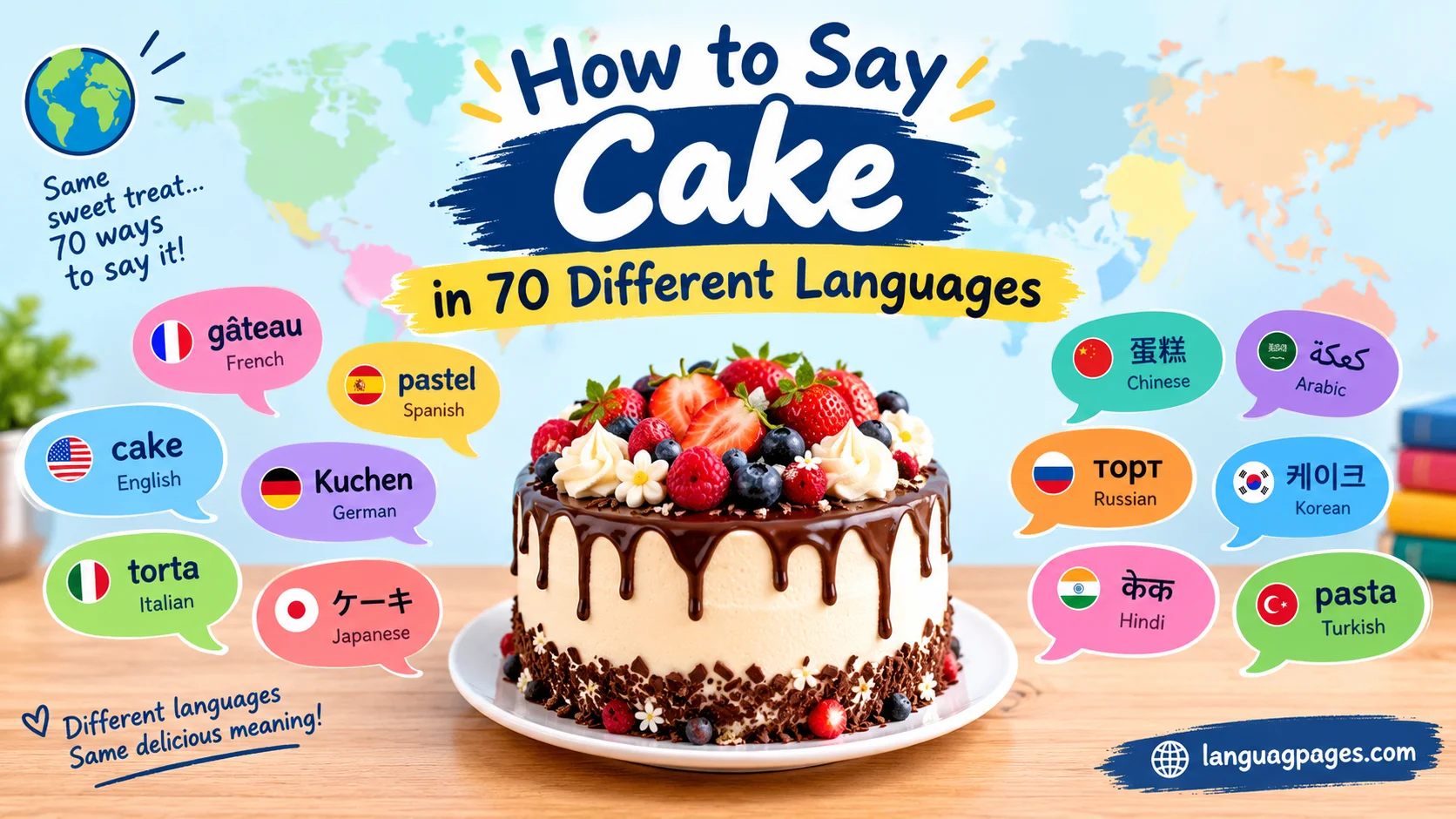
Cake connects language with celebration, comfort, and creativity, making How to Say Cake in 70 Different Languages an enjoyable way to explore global vocabulary. From birthday treats to traditional desserts, learning these words helps you discover how people describe familiar foods across cultures.
Understanding cake translations is useful for language learning, travel, and everyday conversations about food. Different languages use unique vocabulary, pronunciation, and regional expressions to describe cakes and pastries. Exploring these differences builds cultural awareness, improves word recognition, and helps you understand how meaning and usage can change between countries, even when people discuss similar desserts.
In this article, you’ll discover cake translations in 70 different languages, including European, Asian, African, and Middle Eastern languages. Each entry provides the translated word, an easy pronunciation guide, and a practical example sentence with its English meaning. You’ll also explore regional variations, traditional dessert names, and helpful language tips to make these expressions easier to understand and use naturally in everyday conversations.
Interesting Facts About Cake
- Cake names differ: Some languages have a general word for cake, while others distinguish cakes from pastries, pies, or sweet breads.
- Borrowed vocabulary is common: Several languages use words related to English cake, reflecting international food vocabulary.
- Celebrations influence usage: Birthday and wedding cakes have familiar names in many languages, although traditions and designs differ.
- Writing systems vary: Cake vocabulary can be written in Latin, Cyrillic, Arabic, Devanagari, Chinese, Japanese, and other scripts.
- One word may cover several desserts: A single translation may refer to multiple baked sweets rather than one specific recipe.
- Regional differences matter: Everyday food vocabulary can change between countries and dialects, even when speakers share a language.
- Pronunciation is part of learning: Knowing the written translation is useful, but practicing its sounds helps you order food and communicate more naturally.
What Does Cake Mean?
A cake is generally a sweet baked food made from a mixture of ingredients such as flour, sugar, eggs, and fat. It may contain fruit, chocolate, cream, spices, or other flavorings.
Cakes are often served at birthdays, weddings, holidays, and family celebrations, but they can also be everyday desserts. The English word covers many varieties, including sponge cake, chocolate cake, fruitcake, and cheesecake.
Not every culture categorizes sweet baked foods in the same way. Depending on the language, a word translated as cake may refer to a pastry, a small sweet bun, or a particular traditional dessert.
Why Can Cake Have Different Translations?
Translations differ because languages divide food categories in different ways. A general word for cake may be suitable in one country, while another language distinguishes between layered cakes, pastries, and sweet breads.
Regional usage also matters. Speakers may use a borrowed word in casual conversation but a traditional name for a local dessert. Some languages adapt foreign food words to their own spelling and pronunciation.
The context can change the best choice, too. If you want a birthday cake, a bakery item, or a traditional dessert, naming the specific type can prevent confusion. The tables below provide useful general equivalents rather than claiming that every translation describes every kind of cake.
Asian Languages
Asia includes languages with many different writing systems, pronunciation patterns, and culinary traditions. Some use adapted versions of the English word, while others have broader traditional terms for sweet baked foods.
| Language | Country/Region | Translation | Pronunciation | Example Sentence |
| Mandarin Chinese | China, Taiwan, Singapore | 蛋糕 (dàngāo) | dan-gao | 这个蛋糕很好吃。— This cake is delicious. |
| Cantonese | Hong Kong, Guangdong | 蛋糕 (daan6 gou1) | daan-gou | 呢個蛋糕好好食。— This cake is delicious. |
| Japanese | Japan | ケーキ (kēki) | keh-kee | このケーキはおいしいです。— This cake is delicious. |
| Korean | South Korea, North Korea | 케이크 (keikeu) | keh-i-keu | 케이크가 맛있어요. — The cake is delicious. |
| Hindi | India | केक (kek) | kayk | यह केक स्वादिष्ट है। — This cake is delicious. |
| Urdu | Pakistan, India | کیک (cake) | kayk | یہ کیک مزیدار ہے۔ — This cake is delicious. |
| Bengali | Bangladesh, India | কেক (kek) | kek | কেকটি খুব মজার। — The cake is very tasty. |
| Punjabi | Pakistan, India | ਕੇਕ / ਕੇਕ (kek) | kayk | ਇਹ ਕੇਕ ਸੁਆਦੀ ਹੈ। — This cake is tasty. |
| Gujarati | India | કેક (kek) | kayk | આ કેક સ્વાદિષ્ટ છે. — This cake is delicious. |
| Marathi | India | केक (kek) | kayk | हा केक स्वादिष्ट आहे. — This cake is delicious. |
| Tamil | India, Sri Lanka | கேக் (kēk) | kayk | இந்த கேக் சுவையாக இருக்கிறது. — This cake is tasty. |
| Telugu | India | కేక్ (kēk) | kayk | ఈ కేక్ రుచిగా ఉంది. — This cake is tasty. |
| Kannada | India | ಕೇಕ್ (kēk) | kayk | ಈ ಕೇಕ್ ರುಚಿಯಾಗಿದೆ. — This cake is tasty. |
| Malayalam | India | കേക്ക് (kēk) | kayk | ഈ കേക്ക് രുചികരമാണ്. — This cake is delicious. |
| Nepali | Nepal | केक (kek) | kayk | यो केक मिठो छ। — This cake is tasty. |
| Sinhala | Sri Lanka | කේක් (kēk) | kayk | මේ කේක් රසයි. — This cake is tasty. |
| Thai | Thailand | เค้ก (khék) | khek, falling tone | เค้กนี้อร่อยมาก — This cake is very tasty. |
| Vietnamese | Vietnam | Bánh ngọt | ban nyot | Bánh ngọt này rất ngon. — This cake is very tasty. |
| Indonesian | Indonesia | Kue | koo-eh | Kue ini enak. — This cake is delicious. |
| Malay | Malaysia, Brunei, Singapore | Kek | kek | Kek ini sedap. — This cake is delicious. |
| Filipino/Tagalog | Philippines | Keyk / cake | kayk | Masarap ang keyk na ito. — This cake is delicious. |
| Burmese | Myanmar | ကိတ်မုန့် (keit mont) | kate-mohnt | ဒီကိတ်မုန့်က အရသာရှိတယ်။ — This cake is tasty. |
| Khmer | Cambodia | នំខេក (nom khek) | nom-khek | នំខេកនេះឆ្ងាញ់។ — This cake is delicious. |
| Lao | Laos | ເຄັກ (khek) | khek | ເຄັກນີ້ແຊບ. — This cake is tasty. |
| Mongolian | Mongolia | Бялуу (byaluu) | byah-loo | Бялуу амттай байна. — The cake is tasty. |
| Kazakh | Kazakhstan | Торт (tort) | tort | Торт дәмді. — The cake is delicious. |
| Uzbek | Uzbekistan | Tort | tort | Tort mazali. — The cake is delicious. |
Cultural Notes
In Mandarin, 蛋糕 (dàngāo) is the usual word for cake, while Japanese ケーキ and Korean 케이크 are adapted loanwords. Vietnamese bánh ngọt is a broader expression for sweet cakes or pastries, so the exact dessert may need clarification. Traditional rice-based sweets across Asia may have their own names rather than using the everyday word for Western-style cake.
African Languages
Africa is home to thousands of languages and many distinct food traditions. Cake vocabulary can include borrowed words, established local terms, and names for traditional sweet foods.
| Language | Country/Region | Translation | Pronunciation | Example Sentence |
| Swahili | Tanzania, Kenya, East Africa | Keki | KEH-kee | Keki hii ni tamu. — This cake is sweet. |
| Afrikaans | South Africa, Namibia | Koek | kook | Die koek is lekker. — The cake is tasty. |
| Zulu | South Africa | Ikhekhe | ee-KHEH-kheh | Ikhekhe limnandi. — The cake is delicious. |
| Xhosa | South Africa | Ikeyiki | ee-kay-YEE-kee | Ikeyiki imnandi. — The cake is delicious. |
| Amharic | Ethiopia | ኬክ (kēk) | kayk | ይህ ኬክ ጣፋጭ ነው። — This cake is sweet. |
| Yoruba | Nigeria, West Africa | Akara oyinbo | ah-kah-rah oh-YEEN-boh | Akara oyinbo yii dun. — This cake is tasty. |
| Igbo | Nigeria | Achicha | ah-CHEE-chah | Achicha a dị ụtọ. — This cake is sweet. |
| Hausa | Nigeria, Niger, West Africa | Kek | kek | Kek ɗin yana da daɗi. — The cake is tasty. |
| Somali | Somalia, Horn of Africa | Keeg | kayg | Keegani waa macaan. — This cake is delicious. |
| Shona | Zimbabwe | Keke | KEH-keh | Keke iyi inonaka. — This cake is tasty. |
| Sesotho | Lesotho, South Africa | Kuku | KOO-koo | Kuku ena e monate. — This cake is delicious. |
| Malagasy | Madagascar | Mofomamy | moh-foh-MAH-mee | Mofomamy ity dia mamy. — This cake is sweet. |
Cultural Notes
In African languages, the word for a Western-style baked cake may differ from terms for local steamed, fried, or grain-based sweets. For example, mofomamy in Malagasy is a broader term for sweet cakes or pastries. If you are discussing a particular dessert, describing its ingredients or appearance can make your meaning clearer.
Middle Eastern Languages
The Middle East contains several language families, including Semitic, Indo-European, and Turkic languages. Food vocabulary differs across countries, and the same word may describe different baked desserts.
| Language | Country/Region | Translation | Pronunciation | Example Sentence |
| Modern Standard Arabic | Middle East, North Africa | كعكة (kaʿka) | KAH-kah | هذه الكعكة لذيذة. — This cake is delicious. |
| Persian (Farsi) | Iran, Persian-speaking communities | کیک (kik) | keek | این کیک خوشمزه است. — This cake is delicious. |
| Hebrew | Israel | עוגה (וגה; ugah) | oo-GAH | העוגה טעימה. — The cake is tasty. |
| Kurdish (Kurmanji) | Türkiye, Iraq, Syria, Iran | Paste | pas-TEH | Ev paste xweş e. — This cake is good. |
| Turkish | Türkiye, Cyprus | Kek | kek | Bu kek çok lezzetli. — This cake is very tasty. |
| Armenian | Armenia, Armenian communities worldwide | Տորթ (t’ort’) | tort | Այս տորթը համեղ է։ — This cake is delicious. |
Cultural Notes
Arabic has regional variation. The table uses Modern Standard Arabic, but everyday speakers may use different words for cake depending on their country and the dessert in question. In Persian, kik is a common term for cake, while Turkish kek commonly refers to cake, including sponge-style varieties. Always consider the local context when ordering a specific dessert.
Other World Languages
Languages from the Pacific, the Americas, and international language communities offer additional ways to describe cake. Traditional foods sometimes require a more specific term than a general translation.
| Language | Country/Region | Translation | Pronunciation | Example Sentence |
| Māori | New Zealand | Keke | KEH-keh | He reka tēnei keke. — This cake is delicious. |
| Samoan | Samoa, Pacific communities | Keke | KEH-keh | E suamalie le keke. — The cake is sweet. |
| Hawaiian | Hawaiʻi | Keke | KEH-keh | He ono kēia keke. — This cake is delicious. |
| Quechua | Andes, including Peru and Bolivia | Torta | TOR-tah | Regional vocabulary varies; torta may be used for cake. |
| Guarani | Paraguay, South America | Torta | TOR-tah | Usage may vary; torta is used for some cakes. |
| Haitian Creole | Haiti | Gato | gah-TOH | Gato sa a bon. — This cake is good. |
| Esperanto | International constructed language | Kuko | KOO-koh | La kuko estas bongusta. — The cake is delicious. |
Note: In Quechua and Guarani, food vocabulary can vary between regional varieties, and torta may be used as a borrowed term rather than a universal traditional word. These entries are best treated as practical starting points, not substitutes for checking local terminology.
How to Choose the Right Translation
The best translation depends on what kind of cake you mean and where you plan to use the word.
- Consider the region: Spanish pastel is useful in many places, but local alternatives may be more familiar.
- Name the dessert: If you want chocolate cake or cheesecake, learn the specific term rather than relying on a general word.
- Check pronunciation: Listen to a speaker when possible, especially for unfamiliar sounds or tones.
- Use natural sentences: A complete phrase such as “This cake is delicious” can be more useful than a vocabulary word alone.
- Ask when uncertain: At a bakery, pointing to the item or describing its ingredients can help avoid misunderstandings.
Common Mistakes When Translating Cake
A common mistake is assuming that every language divides desserts into the same categories as English. A word for cake may also refer to pastries, sweet breads, or other baked foods.
Other mistakes include ignoring regional vocabulary, mispronouncing borrowed words, and assuming that a translation used in one country works everywhere. Some languages also change word endings according to grammatical rules.
Remember that transliterations are learning aids, not exact substitutes for listening to native pronunciation. When a particular recipe matters, use its specific name and confirm that the translation describes the intended dessert.
Why Learn Cake in Different Languages?
Learning food vocabulary makes everyday communication more practical. Knowing how to say cake can help you read menus, shop at bakeries, discuss recipes, and share food with people from different backgrounds.
It also introduces you to cultural differences. Traditional sweets often reflect local ingredients, cooking methods, and family customs. Exploring these differences can expand your vocabulary and make travel more enjoyable.
Even a single word can be a useful starting point for learning a language. Pair cake with words such as sweet, chocolate, birthday, and delicious to build simple sentences and develop confidence in everyday conversations.
FAQs:
1. How do you say cake in 70 different languages?
Cake has different names around the world. Examples include gâteau in French, Kuchen in German, torta in Italian, kakku in Finnish, 蛋糕 in Mandarin Chinese, and keki in Swahili.
2. What is the most natural translation of cake?
There is no single translation that works in every language. For example, French uses gâteau, German commonly uses Kuchen, and Portuguese uses bolo for many cakes.
3. Does cake have the same meaning in every country?
Not exactly. The word may refer to different types of desserts depending on local food traditions. Some languages distinguish between layered cakes, pastries, and sweet breads more clearly than English does.
4. How do you say birthday cake in another language?
The translation depends on the language. In French, gâteau d’anniversaire means birthday cake. In Spanish, pastel de cumpleaños is a common option, although regional wording varies.
5. Are cake translations different in American and British English?
The basic word is cake in both varieties. Differences are more likely to involve particular dessert names, ingredients, and regional pronunciation than the word itself.
6. Which Asian languages use a word similar to cake?
Japanese ケーキ, Korean 케이크, Hindi केक, and Urdu کیک use forms resembling the English word. Mandarin Chinese generally uses 蛋糕.
7. Why do some languages use borrowed words for cake?
Languages borrow food vocabulary through cultural contact, travel, trade, and changing eating habits. Borrowed words may be adapted to local spelling, pronunciation, and grammar.
8. Is pronunciation the same as spelling?
No. A word may be pronounced differently from what an English reader expects. Romanization guides provide an approximate starting point, but listening to audio is helpful for accurate pronunciation.
9. Can one translation describe several desserts?
Yes. A general word may cover different cakes and pastries. When ordering, specify the flavor, ingredients, or style to make your request clearer.
10. What is the easiest way to remember cake in different languages?
Group words by language family or region, use flashcards, and practice them in short sentences. Reviewing a few words regularly is usually more manageable than memorizing the entire list at once.
Conclusion:
How to Say Cake in 70 Different Languages helps you explore global vocabulary, discover cultural traditions, and learn useful food-related words. These translations make language learning more enjoyable and meaningful.
Learning how to say cake in different languages expands your vocabulary and deepens your understanding of cultures worldwide. Use these translations, pronunciation guides, and example sentences to practice confidently. Whether traveling, studying, or sharing desserts with friends, these words help you connect with people through food, language, and cultural discovery.












