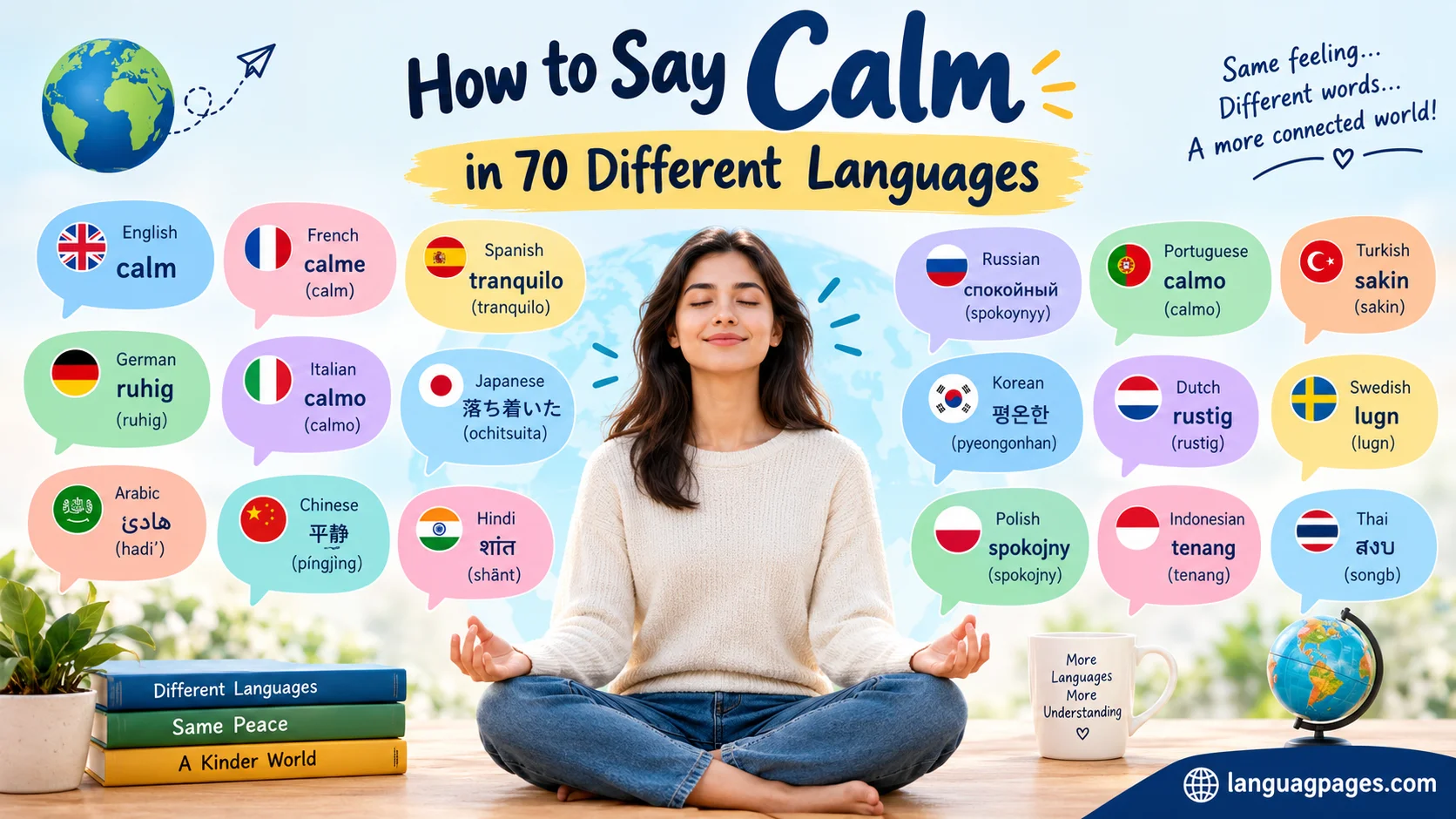
The word calm describes a peaceful mind, a relaxed person, or a quiet environment. Learning How to Say Calm in 70 Different Languages helps you express tranquility, understand emotions, and communicate thoughtfully across cultures and languages.
This vocabulary topic is useful for language learners, travelers, students, and anyone interested in multilingual communication. Different languages express calmness through words meaning peaceful, relaxed, quiet, or composed. Understanding these translations, meanings, pronunciation guides, and cultural expressions helps you choose appropriate words for conversations, messages, and everyday situations. Context also matters because formal and informal expressions may differ.
In this article, you will explore calm in different languages, including European, Asian, African, and Middle Eastern expressions. Discover native words, pronunciation tips, regional variations, and practical sentence examples that demonstrate natural usage. You will also learn how grammar, context, and cultural differences influence translation choices, helping you understand each expression more clearly and use the right words when communicating with people from different linguistic backgrounds.
Interesting Facts About Calm
- Calm has several meanings: It can describe a relaxed person, a quiet place, gentle weather, or a situation without conflict.
- Peaceful and calm are related: Many languages distinguish inner emotional balance from the absence of noise or disturbance.
- Grammar matters: Some languages change adjectives according to gender, number, or grammatical agreement.
- Context changes word choice: Describing a calm sea may require a different expression from comforting an anxious friend.
- Pronunciation can be unfamiliar: Languages such as Mandarin use tones, which can change the meaning of a spoken syllable.
- Politeness influences expression: A reassuring phrase used with a close friend may differ from one used in a formal conversation.
- Translation is not always one-to-one: Words expressing calmness can overlap with relaxation, silence, serenity, or composure.
What Does Calm Mean?
Calm describes a state of peace, relaxation, or freedom from agitation. A calm person may remain composed during a difficult conversation, while a calm environment feels quiet and undisturbed.
Emotionally, calmness suggests self-control and inner peace. For example, someone might take a few deep breaths to remain calm before an examination. The word can also describe nature, such as a calm lake with little movement.
Depending on the situation, related words include peaceful, relaxed, quiet, serene, composed, and tranquil. These words are connected, but they are not always interchangeable.
Why Can Calm Have Different Translations?
The best translation depends on what you want to describe. An adjective for a relaxed person may differ from the word used for still water or a peaceful room.
Other factors include:
- Gender and grammar: Some languages change adjective endings to agree with the person or noun being described.
- Formality: A reassuring expression may sound different in a professional setting.
- Regional variation: Speakers of the same language may prefer different everyday expressions.
- Emotional context: “Stay calm” is an instruction, whereas “I feel calm” describes an internal state.
- Natural phrasing: A literal translation can sound awkward even when individual words are correct.
The tables below focus on the meaning of calm as peaceful, composed, or relaxed, with examples showing practical usage. The English translation is a guide rather than a guarantee that every word has exactly the same range of meanings.
English Varieties
American, British, and Australian English use the same spelling and basic meaning of calm. Differences mainly involve accent, rhythm, and occasional conversational phrasing rather than a separate translation.
Cultural Notes
Romance languages such as Spanish, French, Italian, and Portuguese may use different adjective forms according to grammatical gender. In Germanic and Slavic languages, the natural expression can also change according to whether you are describing someone or telling them to remain calm.
Asian Languages
Asia contains many language families and writing systems. The examples below include languages that use Chinese characters, Japanese scripts, South Asian writing systems, and Southeast Asian alphabets. Pronunciation guides are simplified for English readers.
| 🌍 Language | Country/Region | Translation | Pronunciation | Example Sentence |
| Mandarin Chinese | China, Taiwan, Singapore | 冷静 (lěngjìng) | lung-jing, third and fourth tones | 保持冷静。— Stay calm. |
| Cantonese | Hong Kong, Guangdong | 冷靜 (laang5 zing6) | laang-jing, tones 5–6 | 保持冷靜。— Stay calm. |
| Japanese | Japan | 落ち着いて (ochitsuite) | oh-chee-ts oo-ee-teh | 落ち着いてください。— Please stay calm. |
| Korean | Korea | 차분한 (chabunhan) | cha-boon-han | 차분하게 생각하세요. — Think calmly. |
| Hindi | India | शांत (shaant) | shaant | शांत रहिए। — Please stay calm. |
| Urdu | Pakistan, India | پُرسکون (pursukoon) | pur-suh-koon | پُرسکون رہیں۔ — Stay calm. |
| Bengali | Bangladesh, India | শান্ত (shanto) | shahn-toh | শান্ত থাকুন। — Stay calm. |
| Punjabi | Pakistan, India | ਸ਼ਾਂਤ / ਸ਼ਾਂਤ | shaant | ਸ਼ਾਂਤ ਰਹੋ। — Stay calm. |
| Gujarati | India | શાંત (shaant) | shaant | શાંત રહો. — Stay calm. |
| Marathi | India | शांत (shaant) | shaant | शांत राहा. — Stay calm. |
| Tamil | India, Sri Lanka | அமைதியான (amaithiyaana) | uh-my-thee-yaa-nah | அமைதியாக இருங்கள். — Please stay calm. |
| Telugu | India | ప్రశాంతమైన (prashantamaina) | pruh-shaan-tuh-my-nah | ప్రశాంతంగా ఉండండి. — Please stay calm. |
| Kannada | India | ಶಾಂತ (shaanta) | shaan-tuh | ಶಾಂತವಾಗಿರಿ. — Please stay calm. |
| Malayalam | India | ശാന്തമായ (shaanthamaaya) | shaan-thuh-maa-yah | ശാന്തമായി ഇരിക്കുക. — Please remain calm. |
| Nepali | Nepal | शान्त (shaanta) | shaan-tuh | शान्त रहनुहोस्। — Please stay calm. |
| Sinhala | Sri Lanka | සන්සුන් (sansun) | sun-soon | සන්සුන්ව සිටින්න. — Please stay calm. |
| Thai | Thailand | สงบ (sa-ngop) | sa-ngop | ใจเย็น ๆ นะ — Take it easy; stay calm. |
| Vietnamese | Vietnam | Bình tĩnh | bing ting | Hãy bình tĩnh. — Stay calm. |
| Indonesian | Indonesia | Tenang | tuh-nang | Tetap tenang. — Stay calm. |
| Malay | Malaysia, Brunei, Singapore | Tenang | tuh-nang | Bertenanglah. — Please calm down. |
| Filipino/Tagalog | Philippines | Kalmado | kal-MAH-doh | Manatiling kalmado. — Stay calm. |
| Burmese | Myanmar | တည်ငြိမ်သော | ti-nyiain-thaw | စိတ်အေးအေးထားပါ။ — Keep calm. |
| Khmer | Cambodia | ស្ងប់ស្ងាត់ | sngop-sngat | សូមស្ងប់ស្ងាត់។ — Please stay calm. |
| Lao | Laos | ສະຫງົບ | sa-ngop | ຈົ່ງໃຈເຢັນ។ — Keep calm. |
| Mongolian | Mongolia | Тайван | tai-wan | Тайван байгаарай. — Please stay calm. |
| Kazakh | Kazakhstan | Сабырлы | sah-bir-lih | Сабыр сақтаңыз. — Keep calm. |
| Uzbek | Uzbekistan | Xotirjam | kho-teer-jam | Xotirjam bo’ling. — Please stay calm. |
| Turkish | Türkiye, Cyprus | Sakin | sah-keen | Sakin ol. — Calm down. |
Cultural Notes
In Mandarin, 冷静 (lěngjìng) is useful for composure, particularly in challenging situations. Japanese 落ち着いて (ochitsuite) is a conversational way to tell someone to settle down or remain calm. In Thai, ใจเย็น ๆ is a common reassuring expression that literally relates to having a cool heart.
African Languages
Africa is home to extensive linguistic diversity, with languages used across national borders and communities. These examples focus on common words or expressions for calmness, composure, or remaining peaceful; some forms are more natural in particular sentence structures.
| 🌍 Language | Country/Region | Translation | Pronunciation | Example Sentence |
| Swahili | Tanzania, Kenya, East Africa | Tulivu | too-LEE-voo | Tulia na uwe mtulivu. — Calm down and be composed. |
| Afrikaans | South Africa, Namibia | Kalm | kahlm | Bly kalm. — Stay calm. |
| Zulu | South Africa | Zolile | zoh-LEE-leh | Hlala uzolile. — Remain calm. |
| Xhosa | South Africa | Zolile | zoh-LEE-leh | Hlala uzolile. — Stay calm. |
| Amharic | Ethiopia | शांत / ረጋ ያለ | reh-ga yah-leh | ረጋ ብለህ ተናገር። — Speak calmly. |
| Yoruba | Nigeria, Benin | Tútù | TOO-too | Máa balẹ̀. — Calm down. |
| Igbo | Nigeria | Jụụ | joo | Dị jụụ. — Be calm. |
| Hausa | Nigeria, Niger, West Africa | Natsuwa | nah-tsoo-wah | Ka kwantar da hankalinka. — Calm yourself. |
| Somali | Somalia, Horn of Africa | Deggan | deh-gan | Is deji. — Calm down. |
| Shona | Zimbabwe | Dzikama | dzee-KAH-mah | Dzikama zvako. — Calm down. |
| Sesotho | Lesotho, South Africa | Khutsitse | khoo-tsee-tseh | Lula u khutsitse. — Stay calm. |
| Setswana | Botswana, South Africa | Didimala | dee-dee-MAH-lah | Nna o didimale. — Stay calm. |
| Kinyarwanda | Rwanda | Tuze | too-zeh | Tuza. — Calm down. |
| Malagasy | Madagascar | Tony | TOO-nee | Tony ianao. — You are calm. |
Cultural Notes
In Swahili, tulia is often used as an instruction to settle down, while mtulivu describes someone who is calm. In Yoruba, Máa balẹ̀ is an everyday way to encourage someone to calm down. Exact phrasing can vary with sentence structure and local speech.
Middle Eastern Languages
The Middle East includes Arabic, Persian, Hebrew, Kurdish, Turkish, and other distinct language traditions. Arabic itself has Modern Standard Arabic and numerous regional dialects, so a phrase used in formal writing may differ from everyday speech.
| 🌍 Language | Country/Region | Translation | Pronunciation | Example Sentence |
| Modern Standard Arabic | Middle East, North Africa | هادئ (hādiʾ) | HAA-dee | ابقَ هادئًا. — Stay calm. |
| Persian (Farsi) | Iran, communities abroad | آرام (ārām) | aa-RAAM | آرام باش. — Be calm. |
| Hebrew | Israel | רגוע/רגועה (ragua/ragua’a) | rah-GOO-ah | תישאר רגוע. — Stay calm. |
| Kurdish (Kurmanji) | Türkiye, Iraq, Syria, Iran | Aram | ah-RAHM | Aram be. — Be calm. |
| Armenian | Armenia, diaspora | Հանգիստ (hangist) | hahn-GEEST | Հանգիստ մնա։ — Stay calm. |
| Turkish | Türkiye, Cyprus | Sakin | sah-keen | Sakin kal. — Remain calm. |
Cultural Notes
In Arabic, هادئ describes a calm or quiet person, while ابقَ هادئًا tells a man to stay calm; forms may change with gender. Persian آرام can describe peacefulness or a relaxed state. In Hebrew, adjective forms also depend on gender.
Other World Languages
These additional languages broaden the guide beyond the main regions. Their expressions are useful examples of how calmness can be described through words connected with peace, stillness, or composure.
| 🌍 Language | Country/Region | Translation | Pronunciation | Example Sentence |
| Māori | New Zealand | Mārie | maa-ree-eh | Kia mārie. — Be calm/peaceful. |
| Samoan | Samoa, Pacific Islands | Filemu | fee-leh-moo | Ia filemu. — Be peaceful. |
| Hawaiian | Hawaiʻi, United States | Mālie | maa-lee-eh | E mālie. — It is calm/peaceful. |
| Quechua | Andes, South America | Thak | thak | Regional usage varies; verify the local variety before use. |
| Guarani | Paraguay, South America | Py’aguapy | puh-ah-gwah-puh | Py’aguapy eiko. — Live peacefully. |
| Haitian Creole | Haiti, diaspora | Kal / trankil | kahl / trahn-KEEL | Rete kal. — Stay calm. |
| Esperanto | International constructed language | Trankvila | trahn-KVEE-lah | Restu trankvila. — Stay calm. |
Note: Quechua covers multiple varieties, and the best word for calmness depends on the local language variety and intended meaning. It is better to verify a local form than to rely on a potentially misleading one-word equivalent.
How to Choose the Right Translation
Choose a translation based on what you mean and whom you are addressing.
- For emotional support: Choose a natural expression meaning “stay calm” or “take it easy.”
- For describing a person: Use the appropriate adjective and grammatical form.
- For a peaceful setting: Check whether the language uses a different word for quiet surroundings.
- For formal communication: Prefer a polite construction rather than a blunt command.
- For travel: Learn the local pronunciation and listen to how people use the phrase.
- For writing: Check gender agreement, accents, and the correct writing system.
When possible, confirm an unfamiliar expression with a reliable dictionary or a speaker familiar with the relevant region.
Common Mistakes When Translating Calm
One common mistake is assuming that every language has a single word matching every use of “calm.” A word for quiet surroundings may not work when describing emotional composure.
Other mistakes include:
- Translating word for word without checking natural phrasing.
- Ignoring gender and grammar, which can produce incorrect adjective forms.
- Mixing dialects without realizing that the wording differs by region.
- Using the wrong level of formality when reassuring someone.
- Overlooking pronunciation, especially tones and unfamiliar sounds.
- Assuming related words are identical: peaceful, quiet, relaxed, and composed overlap but have different meanings.
The best approach is to learn a complete, natural expression and its context rather than memorizing an isolated word.
Why Learn Calm in Different Languages?
Learning how to express calmness across languages adds useful vocabulary and helps you communicate with greater care. A simple reassuring phrase can be valuable when traveling, supporting a friend, studying another language, or talking with someone from a different background.
It also shows how languages organize ideas differently. Some expressions emphasize inner peace, others focus on self-control, and some suggest quietness or a slower pace. These distinctions make language learning more interesting and practical.
Practicing pronunciation can improve your confidence, while learning about formality and regional variation can help prevent misunderstandings. You do not need to memorize every translation at once. Start with a language that interests you, learn one expression, and practice it in a realistic sentence.
FAQs:
How do you say calm in different languages?
Examples include calme in French, ruhig in German, tranquilo/a in Spanish, 冷静 (lěngjìng) in Mandarin, and tenang in Indonesian. The best choice depends on context.
What is the most natural translation of calm?
There is no single translation that works in every situation. The natural word depends on whether you mean emotionally composed, relaxed, quiet, or peaceful.
Can the translation change by country?
Yes. Speakers may use different regional expressions, even when they share a language. Everyday speech can differ from formal or written language.
Why do some languages have multiple translations?
A word may express different shades of meaning. Languages can distinguish emotional composure, physical quietness, relaxation, and peace.
Does pronunciation change between regions?
Yes. Accents, stress, tones, and local speech patterns can vary. Mandarin tones, for example, are important to pronunciation and meaning.
How can I pronounce calm correctly in another language?
Read a reliable pronunciation guide, listen to recordings from the relevant region, and practice the full expression rather than just the isolated word.
Is a literal translation always accurate?
No. Word-for-word translations can sound unnatural or change the intended meaning. A complete phrase is often more useful.
Which languages use a different writing system?
Mandarin, Japanese, Korean, Hindi, Urdu, Arabic, Hebrew, Thai, and many others use writing systems different from the standard English alphabet.
Can I use these translations in a message?
Yes, but check the tone and context first. A phrase that sounds reassuring in one language may sound overly direct in another.
How can learning this word help with language learning?
It builds practical vocabulary, introduces grammatical patterns, and helps you understand how different languages describe emotions and states of mind.
Is calm the same as peaceful?
Not always. Calm often emphasizes a lack of agitation, while peaceful can suggest harmony or freedom from conflict. Their meanings overlap, but context matters.
Conclusion:
Learning How to Say Calm in 70 Different Languages helps you express peacefulness, understand different cultures, and improve your vocabulary while connecting with people through meaningful words and expressions worldwide.
Exploring these translations also teaches you how language reflects emotions, culture, and communication. Practice the words, learn their pronunciation, and use them in suitable contexts to express calmness naturally in everyday conversations across different languages and cultures.