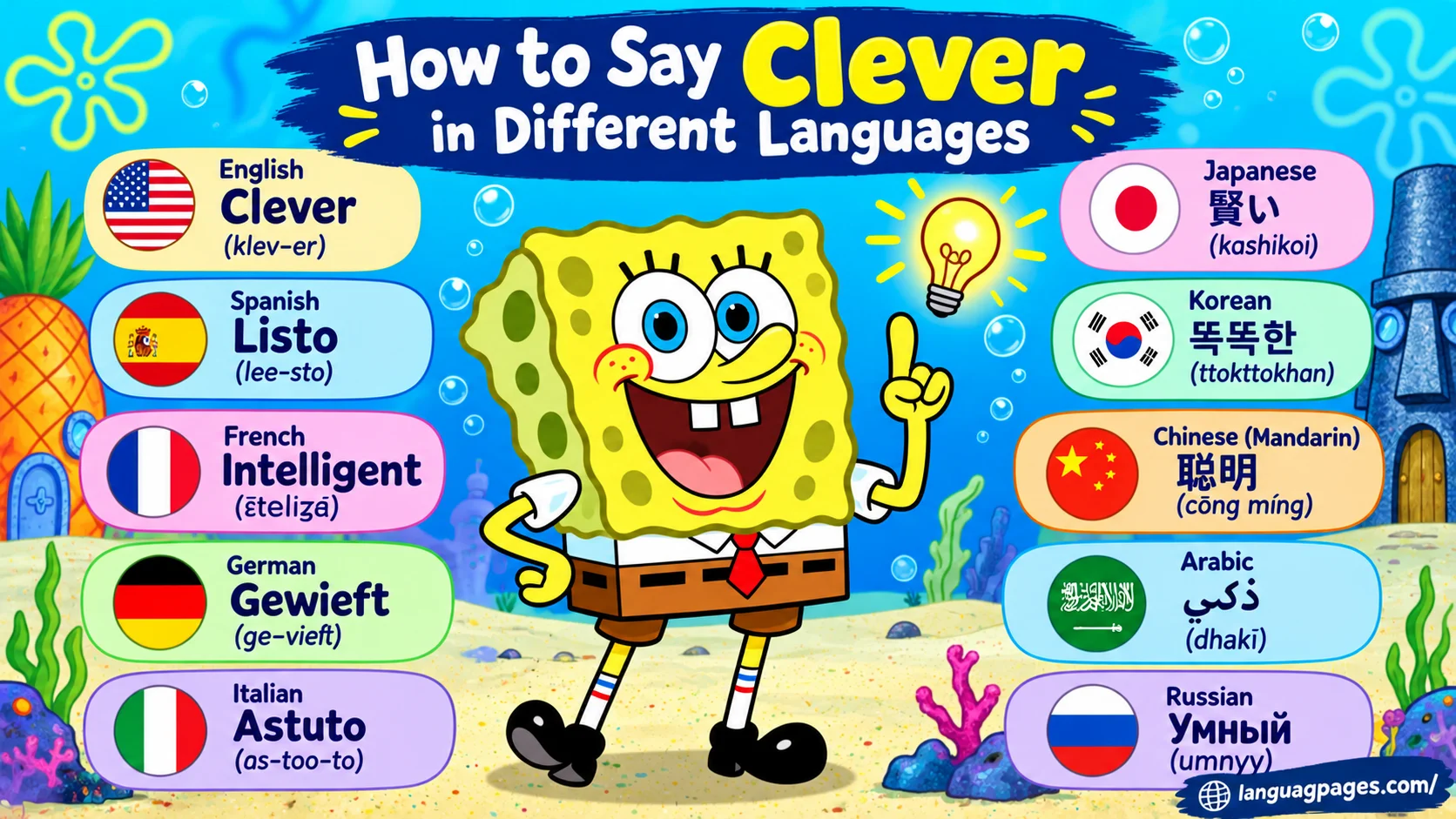
Being clever is often associated with intelligence, quick thinking, creativity, resourcefulness, and good judgment. While the idea exists in nearly every culture, different languages express it in unique ways. Some emphasize wisdom, others focus on ingenuity, learning ability, or practical problem-solving.
Learning how to say Clever in different languages can help language learners, travelers, students, and multilingual communicators understand how cultures describe intelligence and capability. A direct translation is not always identical because languages often separate concepts such as smart, wise, bright, sharp, and clever.
In this guide, you will discover translations, pronunciations, cultural notes, and examples from many world languages. Keep in mind that translations may vary according to region, dialect, context, formality, and cultural usage.
Interesting Facts About Clever
- The English word clever may describe intelligence, creativity, or practical skill.
- Some languages use different words for book intelligence and practical cleverness.
- A translation meaning “smart” may not always carry the same nuance as “clever.”
- In certain cultures, being clever can imply creativity and innovation rather than academic ability.
- Regional dialects may favor different words for intelligent people.
- Some languages distinguish between wise, intelligent, and clever more clearly than English.
What Does Clever Mean?
Clever generally means quick to understand, learn, think, or solve problems. It can describe someone who is intelligent, inventive, resourceful, or mentally sharp.
People use the word when praising someone’s ideas, solutions, learning ability, or creativity. Depending on context, it may also describe a smart design, a witty comment, or an effective solution.
Why Can Clever Have Different Translations?
There is rarely a perfect one-word match across all languages. Translations depend on:
- Context
- Formality
- Regional usage
- Age of speakers
- Cultural expectations
- Written vs spoken language
- Intelligence vs wisdom distinctions
- Natural expression rather than literal translation
A word meaning “intelligent” may be the most natural translation in one language, while another language may prefer a term meaning “quick-witted” or “resourceful.”
European Languages
Europe contains many language families, including Germanic, Romance, Slavic, Celtic, Baltic, and Finno-Ugric languages. Although the concept of being clever exists throughout Europe, the preferred wording can differ significantly.
| 🌍 Language | Country/Region | Translation | Pronunciation | Example |
| English | Global | Clever | KLEV-er | She is very clever. |
| American English 🇺🇸 | USA | Clever | KLEV-er | That’s a clever idea. |
| British English 🇬🇧 | UK | Clever | KLEV-uh | He’s quite clever. |
| Australian English 🇦🇺 | Australia | Clever | KLEV-uh | What a clever solution. |
| Spanish | Spain, Latin America | Inteligente | in-te-li-HEN-te | Ella es inteligente. |
| French | France | Intelligent | an-tel-ee-ZHAN | Il est intelligent. |
| German | Germany | Klug | kloog | Sie ist klug. |
| Italian | Italy | Intelligente | in-tel-li-JEN-te | È intelligente. |
| Portuguese | Portugal, Brazil | Inteligente | in-te-li-ZHEN-che | Ela é inteligente. |
| Dutch | Netherlands | Slim | slim | Hij is slim. |
| Swedish | Sweden | Smart | smart | Hon är smart. |
| Norwegian | Norway | Smart | smart | Han er smart. |
| Danish | Denmark | Klog | kloh | Hun er klog. |
| Finnish | Finland | Älykäs | AE-ly-kas | Hän on älykäs. |
| Icelandic | Iceland | Snjall | snyatl | Hann er snjall. |
| Irish | Ireland | Cliste | KLISH-te | Tá sí cliste. |
| Welsh | Wales | Clyfar | KLUH-var | Mae e’n glyfar. |
| Polish | Poland | Sprytny | SPRIT-nih | Jest sprytny. |
| Czech | Czechia | Chytrý | KHI-tree | Je chytrý. |
| Slovak | Slovakia | Múdry | MOO-dri | Je múdry. |
| Ukrainian | Ukraine | Розумний | ro-ZOOM-nyi | Він розумний. |
| Russian | Russia | Умный | OOM-nihy | Он умный. |
| Romanian | Romania | Deștept | deh-SHTEPT | El este deștept. |
| Hungarian | Hungary | Okos | O-kosh | Ő okos. |
| Greek | Greece | Έξυπνος | EK-see-pnos | Είναι έξυπνος. |
| Bulgarian | Bulgaria | Умен | OO-men | Той е умен. |
| Croatian | Croatia | Pametan | PA-me-tan | On je pametan. |
| Serbian | Serbia | Паметан | PA-me-tan | Он је паметан. |
| Slovenian | Slovenia | Pameten | PA-me-ten | Je pameten. |
| Lithuanian | Lithuania | Protingas | pro-TIN-gas | Jis protingas. |
| Latvian | Latvia | Gudrs | GOOD-rs | Viņš ir gudrs. |
| Estonian | Estonia | Tark | tark | Ta on tark. |
Cultural Note: Many European languages use a word closer to intelligent than the exact English nuance of clever.
Asian Languages
Asia includes hundreds of languages and writing systems. Some languages distinguish between academic intelligence, wisdom, and practical cleverness, while others use one broad term.
| 🌍 Language | Country/Region | Translation | Pronunciation | Example |
| Mandarin Chinese | China | 聪明 | cōngmíng | 她很聪明。 |
| Cantonese | Hong Kong | 聰明 | chung ming | 佢好聰明。 |
| Japanese | Japan | 賢い | kashikoi | 彼は賢い。 |
| Korean | Korea | 영리한 | yeong-ri-han | 그는 영리하다. |
| Hindi | India | चतुर | chatur | वह चतुर है। |
| Urdu | Pakistan | ہوشیار | hoshiyar | وہ ہوشیار ہے۔ |
| Bengali | Bangladesh | চতুর | chotur | সে চতুর। |
| Punjabi | Punjab | ਹੋਸ਼ਿਆਰ | hoshiar | ਉਹ ਹੋਸ਼ਿਆਰ ਹੈ। |
| Gujarati | India | હોશિયાર | hoshiyar | તે હોશિયાર છે. |
| Marathi | India | हुशार | hushar | तो हुशार आहे. |
| Tamil | India | புத்திசாலி | putthisaali | அவள் புத்திசாலி. |
| Telugu | India | తెలివైన | telivaina | అతను తెలివైనవాడు. |
| Kannada | India | ಬುದ್ಧಿವಂತ | buddhivanta | ಅವನು ಬುದ್ಧಿವಂತ. |
| Malayalam | India | ബുദ്ധിമാൻ | buddhimaan | അവൻ ബുദ്ധിമാൻ. |
| Nepali | Nepal | चलाख | chalakh | ऊ चलाख छ। |
| Sinhala | Sri Lanka | දක්ෂ | daksha | ඔහු දක්ෂයි. |
| Thai | Thailand | ฉลาด | cha-lat | เขาฉลาดมาก |
| Vietnamese | Vietnam | Thông minh | thong min | Cô ấy thông minh. |
| Indonesian | Indonesia | Pintar | pin-tar | Dia pintar. |
| Malay | Malaysia | Bijak | bee-jak | Dia bijak. |
| Tagalog | Philippines | Matalino | ma-ta-li-no | Siya ay matalino. |
| Burmese | Myanmar | လိမ္မာ | lain-ma | သူ လိမ္မာတယ်။ |
| Khmer | Cambodia | ឆ្លាត | chhlat | គាត់ឆ្លាត។ |
| Lao | Laos | ສະຫຼາດ | sa-lat | ລາວສະຫຼາດ. |
| Mongolian | Mongolia | Ухаалаг | ukhaa-lag | Тэр ухаалаг. |
| Kazakh | Kazakhstan | Ақылды | aqyldy | Ол ақылды. |
| Uzbek | Uzbekistan | Aqlli | ak-li | U aqlli. |
| Turkish | Türkiye | Zeki | zeh-kee | O zeki. |
| Persian | Iran | باهوش | ba-hoosh | او باهوش است. |
Cultural Note: In several Asian languages, words for clever may overlap with wise, skilled, or intelligent depending on context.
African Languages
Africa contains remarkable linguistic diversity. Meanings connected to intelligence and practical wisdom may vary between regions and language families.
| 🌍 Language | Country/Region | Translation | Pronunciation | Example |
| Swahili | East Africa | Mjanja | m-jan-ja | Yeye ni mjanja. |
| Afrikaans | South Africa | Slim | slim | Hy is slim. |
| Zulu | South Africa | Hlakaniphile | hla-ka-ni-pi-le | Uhlakaniphile. |
| Xhosa | South Africa | Krelekrele | kre-le-kre-le | Ukrelekrele. |
| Amharic | Ethiopia | ብልህ | bilih | እሱ ብልህ ነው. |
| Yoruba | Nigeria | Ọlọ́gbọ́n | o-lo-gbon | Ó jẹ ọlọ́gbọ́n. |
| Igbo | Nigeria | Amamihe | a-ma-mi-he | Ọ bụ amamihe. |
| Hausa | West Africa | Mai hankali | mai han-ka-li | Yana da hankali. |
| Somali | Somalia | Caqli badan | aqli badan | Waa caqli badan. |
| Shona | Zimbabwe | Akangwara | a-kang-wa-ra | Akangwara. |
| Sesotho | Lesotho | Bohlale | bo-hla-le | O na le bohlale. |
| Setswana | Botswana | Botlhale | bo-tlha-le | O botlhale. |
| Kinyarwanda | Rwanda | Umunyabwenge | u-mu-nya-bwen-ge | Ni umunyabwenge. |
| Malagasy | Madagascar | Hendry | hen-dree | Hendry izy. |
Cultural Note: Some African languages emphasize wisdom and good judgment rather than only intellectual ability.
Middle Eastern Languages
The Middle East includes Semitic, Turkic, Iranian, and other language traditions. Expressions related to intelligence often carry nuances of wisdom, understanding, or sound judgment.
| 🌍 Language | Country/Region | Translation | Pronunciation | Example |
| Arabic (MSA) | Middle East | ذكي | dhakiyy | هو ذكي. |
| Hebrew | Israel | חכם | kha-kham | הוא חכם. |
| Kurdish | Kurdistan Region | Zîrek | zee-rek | Ew zîrek e. |
| Armenian | Armenia | Խելացի | khe-la-tsi | Նա խելացի է։ |
| Persian | Iran | باهوش | ba-hoosh | او باهوش است. |
| Turkish | Türkiye | Zeki | zeh-kee | O zeki. |
Other World Languages
| 🌍 Language | Country/Region | Translation | Pronunciation | Example |
| Māori | New Zealand | Mātau | maa-tau | He tangata mātau ia. |
| Samoan | Samoa | Atamai | a-ta-mai | E atamai o ia. |
| Tongan | Tonga | Poto | po-to | ʻOku poto ia. |
| Hawaiian | Hawaii | Akamai | a-ka-mai | He akamai ʻo ia. |
| Quechua | Andes | Yachayniyuq | ya-chay-ni-yok | Pay yachayniyuqmi. |
| Guarani | Paraguay | Arandu | a-ran-du | Ha’e arandu. |
| Haitian Creole | Haiti | Entelijan | en-te-li-zhan | Li entelijan. |
| Esperanto | International | Saĝa | sa-ja | Li estas saĝa. |
Quick Reference: Clever in Different Languages
| Language | Translation |
| English | Clever |
| Spanish | Inteligente |
| French | Intelligent |
| German | Klug |
| Italian | Intelligente |
| Portuguese | Inteligente |
| Dutch | Slim |
| Swedish | Smart |
| Danish | Klog |
| Finnish | Älykäs |
| Polish | Sprytny |
| Russian | Умный |
| Greek | Έξυπνος |
| Mandarin | 聪明 |
| Japanese | 賢い |
| Korean | 영리한 |
| Hindi | चतुर |
| Urdu | ہوشیار |
| Bengali | চতুর |
| Punjabi | ਹੋਸ਼ਿਆਰ |
| Turkish | Zeki |
| Persian | باهوش |
| Arabic | ذكي |
| Swahili | Mjanja |
| Afrikaans | Slim |
| Yoruba | Ọlọ́gbọ́n |
| Hebrew | חכם |
| Māori | Mātau |
| Esperanto | Saĝa |
How to Choose the Right Translation
The best translation depends on context, audience, formality, and region. When describing a person, one language may prefer a word meaning intelligent, while another may favor wise, bright, or resourceful.
For everyday communication, use the most natural local expression rather than a literal dictionary translation. Pay attention to pronunciation and regional differences whenever possible.
Common Mistakes When Translating Clever
- Using a word-for-word translation without considering context.
- Confusing wise with clever.
- Mixing formal and informal expressions.
- Assuming one translation works across every country.
- Ignoring regional pronunciation differences.
- Using a term that means academic intelligence when practical cleverness is intended.
- Forgetting script and pronunciation differences.
Why Learn Clever in Different Languages?
Learning Clever in different languages expands your vocabulary and cultural awareness. It helps you communicate more naturally with native speakers, recognize important linguistic nuances, and understand how different societies describe intelligence and creativity.
It can also improve language-learning skills, support travel experiences, and encourage deeper appreciation of global communication. Small words often reveal fascinating cultural perspectives.
FAQs:
How do you say Clever in different languages?
Most languages use words meaning intelligent, smart, bright, or resourceful depending on context.
What is the closest meaning of Clever?
The closest meaning is usually smart, intelligent, quick-thinking, or resourceful.
Can the translation change by country?
Yes. Regional vocabulary often varies between countries using the same language.
Is a literal translation always correct?
No. Natural usage is usually more important than literal translation.
Why do some languages have several translations?
They may distinguish between wisdom, intelligence, creativity, and practical skill.
Does pronunciation vary by region?
Yes. Accents and dialects can affect pronunciation significantly.
Which languages use non-Latin scripts?
Chinese, Japanese, Korean, Arabic, Hebrew, Hindi, Bengali, Urdu, Russian, Greek, and many others.
Can I use these translations in conversation?
Generally yes, but context and formality should always be considered.
Is Clever the same as Wise?
Not always. Wise often refers to judgment and experience, while clever emphasizes quick thinking.
How does learning these translations help language learners?
It improves vocabulary, cultural understanding, pronunciation skills, and communication confidence.
Conclusion:
Clever communication goes beyond simple translation. Understanding its meaning across languages improves clarity, cultural awareness, and expression, helping readers choose appropriate words while building stronger multilingual communication skills worldwide.
Learning how different cultures express intelligence and resourcefulness encourages more thoughtful communication. By paying attention to pronunciation, regional preferences, and context, you can use language more naturally. This knowledge supports language learning, professional interactions, and meaningful cross-cultural connections.Being clever is often associated with intelligence, quick thinking, creativity, resourcefulness, and good judgment. While the idea exists in nearly every culture, different languages express it in unique ways. Some emphasize wisdom, others focus on ingenuity, learning ability, or practical problem-solving.