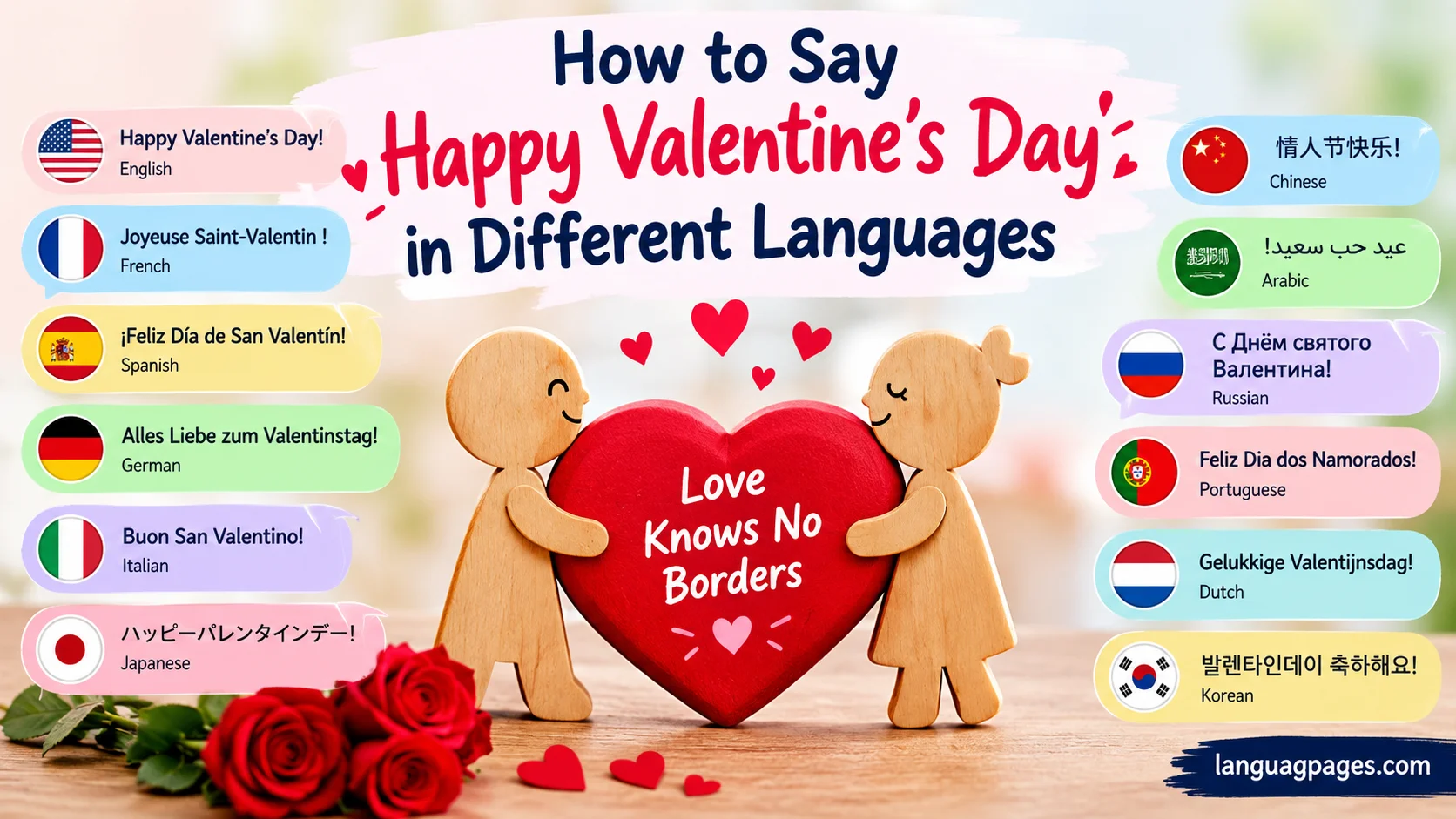
Happy Valentine’s Day is more than a seasonal greeting. It is a warm expression used to celebrate love, affection, friendship, and appreciation on February 14. Whether you are writing a card, sending a message, traveling abroad, learning a new language, or connecting with someone from another culture, knowing how to express this greeting in different languages can make your message feel more personal and thoughtful.
The way people express Valentine’s wishes varies across cultures. Some languages use a direct translation, while others prefer a phrase that naturally fits local customs and communication styles. In some places, Valentine’s Day focuses on romantic relationships, while in others it may also include friends, family members, or people who are important in everyday life.
This guide explores Happy Valentine’s Day in different languages, including pronunciation, regional context, and example usage. Keep in mind that translations can vary depending on dialect, formality, region, and cultural preference. The examples below are intended as natural, commonly understood ways to express the greeting.
Interesting Facts About Happy Valentine’s Day
- Many languages use a direct equivalent of “Happy Valentine’s Day,” while others translate it as “Good Saint Valentine’s Day.”
- Some cultures celebrate Valentine’s Day mainly as a romantic occasion, while others include friends and family.
- The greeting is often borrowed from English in international advertising and social media.
- Languages with grammatical gender may slightly change related messages depending on the speaker and recipient.
- Pronunciation can vary significantly even when languages share similar spelling.
- In multilingual countries, several versions of the greeting may be used side by side.
What Does Happy Valentine’s Day Mean?
Happy Valentine’s Day is a greeting used to wish someone joy, happiness, and affection on Valentine’s Day. It is commonly associated with romantic love, but it can also express appreciation, kindness, and friendship. People use it in cards, text messages, gifts, social media posts, and conversations.
Why Can Happy Valentine’s Day Have Different Translations?
A phrase does not always have a perfect word-for-word equivalent in every language. Differences may depend on:
- Formality
- Regional dialects
- Cultural traditions
- Spoken versus written language
- Relationship between speakers
- Literal versus natural translation
For this reason, the most natural translation is often preferred over a strict word-for-word version.
European Languages
Europe contains many language families and traditions. Even when the meaning stays the same, grammar, word order, and cultural style can differ from one language to another.
| 🌍 Language | Country/Region | Translation | Pronunciation | Example Sentence |
| American English 🇺🇸 | USA | Happy Valentine’s Day | Happy Val-en-tines Day | Happy Valentine’s Day, hope you have a wonderful day. |
| British English 🇬🇧 | UK | Happy Valentine’s Day | Same wording | Happy Valentine’s Day to you. |
| Australian English 🇦🇺 | Australia | Happy Valentine’s Day | Same wording | Happy Valentine’s Day, mate. |
| Spanish | Spain, Latin America | Feliz Día de San Valentín | fe-LEEZ DEE-ah de San Val-en-TEEN | ¡Feliz Día de San Valentín! |
| French | France, Canada | Joyeuse Saint-Valentin | zhwa-YEUZ san val-an-TAN | Joyeuse Saint-Valentin. |
| German | Germany, Austria | Frohen Valentinstag | FROH-en va-len-TEENS-tag | Frohen Valentinstag! |
| Italian | Italy | Buon San Valentino | bwon san va-len-TEE-no | Buon San Valentino! |
| Portuguese | Portugal, Brazil | Feliz Dia dos Namorados* | fe-LEEZ DEE-ah dos na-mo-RA-dos | Feliz Dia dos Namorados. |
| Dutch | Netherlands | Fijne Valentijnsdag | FINE-uh va-len-TINES-dakh | Fijne Valentijnsdag! |
| Swedish | Sweden | Glad Alla hjärtans dag | glad AL-la YER-tans dag | Glad Alla hjärtans dag! |
| Norwegian | Norway | God valentinsdag | goo val-en-TEEN-dag | God valentinsdag! |
| Danish | Denmark | Glædelig Valentinsdag | GLEH-de-lig | Glædelig Valentinsdag! |
| Finnish | Finland | Hyvää ystävänpäivää | HUU-vaa uus-ta-van-pie-vaa | Hyvää ystävänpäivää! |
| Icelandic | Iceland | Gleðilegan Valentínusardag | GLETH-i-leg-an | Gleðilegan Valentínusardag! |
| Irish | Ireland | Lá Fhéile Vailintín sona duit | law ay-la val-in-TEEN | Lá Fhéile Vailintín sona duit. |
| Welsh | Wales | Dydd Santes Ffolant Hapus | theeth SAN-tes FO-lant HAP-is | Dydd Santes Ffolant Hapus. |
| Polish | Poland | Szczęśliwych Walentynek | shchen-SHLI-vikh | Szczęśliwych Walentynek! |
| Czech | Czech Republic | Šťastného Valentýna | shtyas-tne-ho | Šťastného Valentýna! |
| Slovak | Slovakia | Šťastného Valentína | shtyas-tne-ho | Šťastného Valentína! |
| Ukrainian | Ukraine | З Днем святого Валентина | Z Dnem Svyatoho Valentyna | З Днем святого Валентина! |
| Russian | Russia | С Днём святого Валентина | S Dnyom Svyatovo Valentina | С Днём святого Валентина! |
| Romanian | Romania | La mulți ani de Ziua Îndrăgostiților | la mults an | La mulți ani! |
| Hungarian | Hungary | Boldog Valentin-napot | BOL-dog | Boldog Valentin-napot! |
| Greek | Greece | Χρόνια πολλά για του Αγίου Βαλεντίνου | HRO-nia po-LA | Χρόνια πολλά! |
| Bulgarian | Bulgaria | Честит Свети Валентин | Ches-TIT Sveti Valentin | Честит Свети Валентин! |
| Croatian | Croatia | Sretan Dan zaljubljenih | SRE-tan | Sretan Dan zaljubljenih! |
| Serbian | Serbia | Срећан Дан заљубљених | Srechan Dan zaljubljenih | Срећан Дан заљубљених! |
| Slovenian | Slovenia | Veselo valentinovo | ve-SE-lo | Veselo valentinovo! |
| Lithuanian | Lithuania | Su Valentino diena | soo val-en-TEE-no | Su Valentino diena! |
| Latvian | Latvia | Priecīgu Valentīndienu | prie-TSEE-gu | Priecīgu Valentīndienu! |
| Estonian | Estonia | Head sõbrapäeva | head subra-paeva | Head sõbrapäeva! |
Cultural Note: Portuguese speakers in Brazil often associate Dia dos Namorados with a different date, while Valentine’s greetings are still widely understood.
Asian Languages
Asia contains hundreds of languages and writing systems. The same greeting may appear in alphabetic scripts, syllabaries, or character-based writing systems.
| 🌍 Language | Country/Region | Translation | Pronunciation | Example Sentence |
| Mandarin Chinese | China, Taiwan | 情人节快乐 | Qíngrénjié kuàilè | 情人节快乐! |
| Cantonese | Hong Kong | 情人節快樂 | Ching yan jit faai lok | 情人節快樂! |
| Japanese | Japan | ハッピーバレンタインデー | Happī Barentain Dē | ハッピーバレンタインデー! |
| Korean | South Korea | 행복한 발렌타인데이 | Haengbokhan Ballentain Dei | 행복한 발렌타인데이! |
| Hindi | India | हैप्पी वैलेंटाइन डे | Happy Valentine De | हैप्पi वैलेंटाइन डे! |
| Urdu | Pakistan | ہیپی ویلنٹائن ڈے | Happy Valentine Day | ہیپی ویلنٹائن ڈے! |
| Bengali | Bangladesh, India | শুভ ভ্যালেন্টাইনস ডে | Shubho Valentine’s Day | শুভ ভ্যালেন্টাইনস ডে |
| Punjabi | Pakistan, India | ਹੈਪੀ ਵੈਲੇਨਟਾਈਨ ਡੇ | Happy Valentine De | ਹੈਪੀ ਵੈਲੇਨਟਾਈਨ ਡੇ |
| Gujarati | India | હેપી વેલેન્ટાઇન ડે | Happy Valentine De | હેપી વેલેન્ટાઇન ડે |
| Marathi | India | हॅपी व्हॅलेंटाईन डे | Happy Valentine De | हॅपी व्हॅलेंटाईन डे |
| Tamil | India, Sri Lanka | இனிய காதலர் தின வாழ்த்துகள் | Iniya Kaadhalar Dina Vaazhthukkal | இனிய காதலர் தின வாழ்த்துகள் |
| Telugu | India | హ్యాపీ వాలెంటైన్స్ డే | Happy Valentines Day | హ్యాపీ వాలెంటైన్స్ డే |
| Kannada | India | ಪ್ರೇಮಿಗಳ ದಿನದ ಶುಭಾಶಯಗಳು | Premigala Dinada Shubhashayagalu | ಶುಭಾಶಯಗಳು |
| Malayalam | India | ഹാപ്പി വാലന്റൈൻസ് ഡേ | Happy Valentines Day | ഹാപ്പി വാലന്റൈൻസ് ഡേ |
| Nepali | Nepal | ह्याप्पी भ्यालेन्टाइन डे | Hyappi Bhyalentain De | ह्याप्पी भ्यालेन्टाइन डे |
| Sinhala | Sri Lanka | සුභ වැලන්ටයින් දිනයක් | Subha Valentine Dinayak | සුභ වැලන්ටයින් දිනයක් |
| Thai | Thailand | สุขสันต์วันวาเลนไทน์ | Suksan Wan Valentine | สุขสันต์วันวาเลนไทน์ |
| Vietnamese | Vietnam | Chúc mừng Ngày Valentine | Chook mung Ngai Valentine | Chúc mừng Ngày Valentine |
| Indonesian | Indonesia | Selamat Hari Valentine | Se-la-mat Hari Valentine | Selamat Hari Valentine |
| Malay | Malaysia | Selamat Hari Valentine | Same pronunciation | Selamat Hari Valentine |
| Filipino/Tagalog | Philippines | Maligayang Araw ng mga Puso | Ma-li-ga-yang | Maligayang Araw ng mga Puso |
| Burmese | Myanmar | ပျော်ရွှင်ဖွယ် ချစ်သူများနေ့ | Pyaw Shwin Phwel | Greeting example |
| Khmer | Cambodia | រីករាយថ្ងៃបុណ្យនៃក្តីស្រឡាញ់ | Rikreay Thngai | Greeting example |
| Lao | Laos | ສຸກສັນວັນວາເລນທາຍ | Suksan Wan Valentine | Greeting example |
| Mongolian | Mongolia | Гэгээн Валентины өдрийн мэнд | Gegeen Valentiny | Greeting example |
| Kazakh | Kazakhstan | Валентин күні құтты болсын | Valentin kuni qutty bolsyn | Greeting example |
| Uzbek | Uzbekistan | Valentin kuni muborak | Valentin kuni muborak | Greeting example |
| Turkish | Türkiye | Mutlu Sevgililer Günü | Moot-loo Sev-gi-li-ler Goo-noo | Mutlu Sevgililer Günü |
| Persian | Iran | روز ولنتاین مبارک | Rooz-e Valentine Mobarak | روز ولنتاین مبارک |
African Languages
Africa is home to tremendous linguistic diversity. Many speakers use local languages alongside regional or international languages.
| 🌍 Language | Country/Region | Translation | Pronunciation | Example Sentence |
| Swahili | East Africa | Heri ya Siku ya Wapendanao | He-ri ya Si-ku | Heri ya Siku ya Wapendanao |
| Afrikaans | South Africa, Namibia | Gelukkige Valentynsdag | khe-LUK-i-khe | Gelukkige Valentynsdag |
| Zulu | South Africa | Usuku Oluhle Lwezithandani | oo-soo-koo | Greeting example |
| Xhosa | South Africa | Usuku Olumnandi Lwabathandanayo | oo-soo-koo | Greeting example |
| Amharic | Ethiopia | መልካም የቫለንታይን ቀን | Melkam Yevalentain Qen | Greeting example |
| Yoruba | Nigeria | E ku ojo Valentine | eh koo ojo | Greeting example |
| Igbo | Nigeria | Obi ụtọ ụbọchị Valentine | Obi uto | Greeting example |
| Hausa | West Africa | Barka da ranar Valentine | Bar-ka da ra-na | Greeting example |
| Somali | Somalia | Maalin Jacayl Wacan | Maa-lin Ja-cayl | Greeting example |
| Shona | Zimbabwe | Zuva Rakanaka reValentine | Zoo-va | Greeting example |
| Sesotho | Lesotho | Letsatsi le monate la Valentine | Let-sat-si | Greeting example |
| Setswana | Botswana | Letsatsi la Valentine le monate | Let-sat-si | Greeting example |
| Kinyarwanda | Rwanda | Umunsi mwiza wa Valentine | Umunsi mwiza | Greeting example |
| Malagasy | Madagascar | Tratry ny Andron’ny Mpifankatia | Tratry ny | Greeting example |
Middle Eastern Languages
The Middle East includes several major language traditions. Usage may vary between countries and dialects, especially in everyday conversation.
| 🌍 Language | Country/Region | Translation | Pronunciation | Example Sentence |
| Modern Standard Arabic | Middle East | عيد حب سعيد | Eid Hubb Saeed | عيد حب سعيد |
| Hebrew | Israel | יום ולנטיין שמח | Yom Valentin Sameach | יום ולנטיין שמח |
| Kurdish | Iraq, Türkiye, Syria | Rojê Valentine pîroz be | Ro-zhe | Greeting example |
| Armenian | Armenia | Շնորհավոր Վալենտինի օրը | Shnorhavor Valentiny Ore | Greeting example |
| Azerbaijani | Azerbaijan | Sevgililər Gününüz Mübarək | Sev-gi-li-lar | Greeting example |
Other World Languages
| 🌍 Language | Country/Region | Translation | Pronunciation | Example Sentence |
| Māori | New Zealand | Kia hari te Rā o te Aroha | Kee-a ha-ri | Greeting example |
| Samoan | Samoa | Manuia le Aso Valentine | Ma-nu-ee-a | Greeting example |
| Tongan | Tonga | Fiefia he ʻAho Valentine | Fee-fee-a | Greeting example |
| Hawaiian | Hawaii | Hauʻoli Lā Valentine | How-oh-lee | Greeting example |
| Quechua | Andes Region | Kusisqa Valentine p’unchay | Koo-sis-ka | Greeting example |
| Guarani | Paraguay | Vy’a Valentine Árape | Vya | Greeting example |
| Haitian Creole | Haiti | Bòn Fèt Lanmou | Bon Fet Lan-mou | Greeting example |
| Esperanto | International | Feliĉan Sankt-Valentenan Tagon | Fe-li-chan | Greeting example |
Quick Reference: Happy Valentine’s Day in Different Languages
| Language | Translation |
| English | Happy Valentine’s Day |
| Spanish | Feliz Día de San Valentín |
| French | Joyeuse Saint-Valentin |
| German | Frohen Valentinstag |
| Italian | Buon San Valentino |
| Portuguese | Feliz Dia dos Namorados |
| Dutch | Fijne Valentijnsdag |
| Swedish | Glad Alla hjärtans dag |
| Mandarin Chinese | 情人节快乐 |
| Japanese | ハッピーバレンタインデー |
| Korean | 행복한 발렌타인데이 |
| Hindi | हैप्पी वैलेंटाइन डे |
| Urdu | ہیپی ویلنٹائن ڈے |
| Arabic | عيد حب سعيد |
| Hebrew | יום ולנטיין שמח |
| Swahili | Heri ya Siku ya Wapendanao |
| Turkish | Mutlu Sevgililer Günü |
| Persian | روز ولنتاین مبارک |
How to Choose the Right Translation
The best translation depends on who you are speaking to, where they live, and how formal the situation is. When possible, choose a version commonly used by native speakers in that region. Pay attention to pronunciation, script, and cultural expectations. If you are writing a greeting card, a natural local expression is usually better than a literal translation.
Common Mistakes When Translating Happy Valentine’s Day
- Using a strict word-for-word translation.
- Ignoring local cultural preferences.
- Mixing formal and informal wording.
- Using a dialect outside its normal region.
- Assuming one translation works everywhere.
- Mispronouncing names and borrowed words.
- Forgetting script differences in non-Latin languages.
Why Learn Happy Valentine’s Day in Different Languages?
Learning this expression can help you communicate more naturally with people from different backgrounds. It introduces new vocabulary, improves pronunciation skills, supports language learning, and encourages cultural awareness. Even a simple greeting can show respect and genuine interest in another person’s language and traditions.
FAQs:
How do you say Happy Valentine’s Day in different languages?
The wording varies by language, but the meaning remains a warm Valentine’s greeting.
Is a literal translation always correct?
No. Natural usage is often more important than a direct translation.
Can translations vary by country?
Yes. Regional preferences can affect wording and pronunciation.
Why do some languages borrow the English phrase?
Global media and international communication have increased the use of English expressions.
Which languages use different writing systems?
Chinese, Japanese, Korean, Arabic, Hebrew, Hindi, Urdu, Thai, and many others.
Is pronunciation important?
Yes. Good pronunciation helps listeners understand your message.
Can I use these greetings in cards?
Yes. They are commonly used in cards, messages, and social media posts.
Do dialects matter?
Sometimes. Local varieties may prefer slightly different wording.
Are these greetings only for romantic partners?
Not always. In some cultures they may also be used among friends or loved ones.
How does learning greetings help language learning?
Greetings build vocabulary, confidence, and cultural understanding.
Conclusion:
Happy Valentine’s Day is a heartfelt way to celebrate love, affection, and meaningful connections. Whether shared with a partner, friend, or family member, these words create warmth, appreciation, and lasting memories.
Valentine’s Day is more than a romantic occasion; it’s an opportunity to express gratitude, kindness, and genuine feelings. Choose thoughtful words that reflect your relationship, making your message feel personal, sincere, memorable, and emotionally meaningful.